
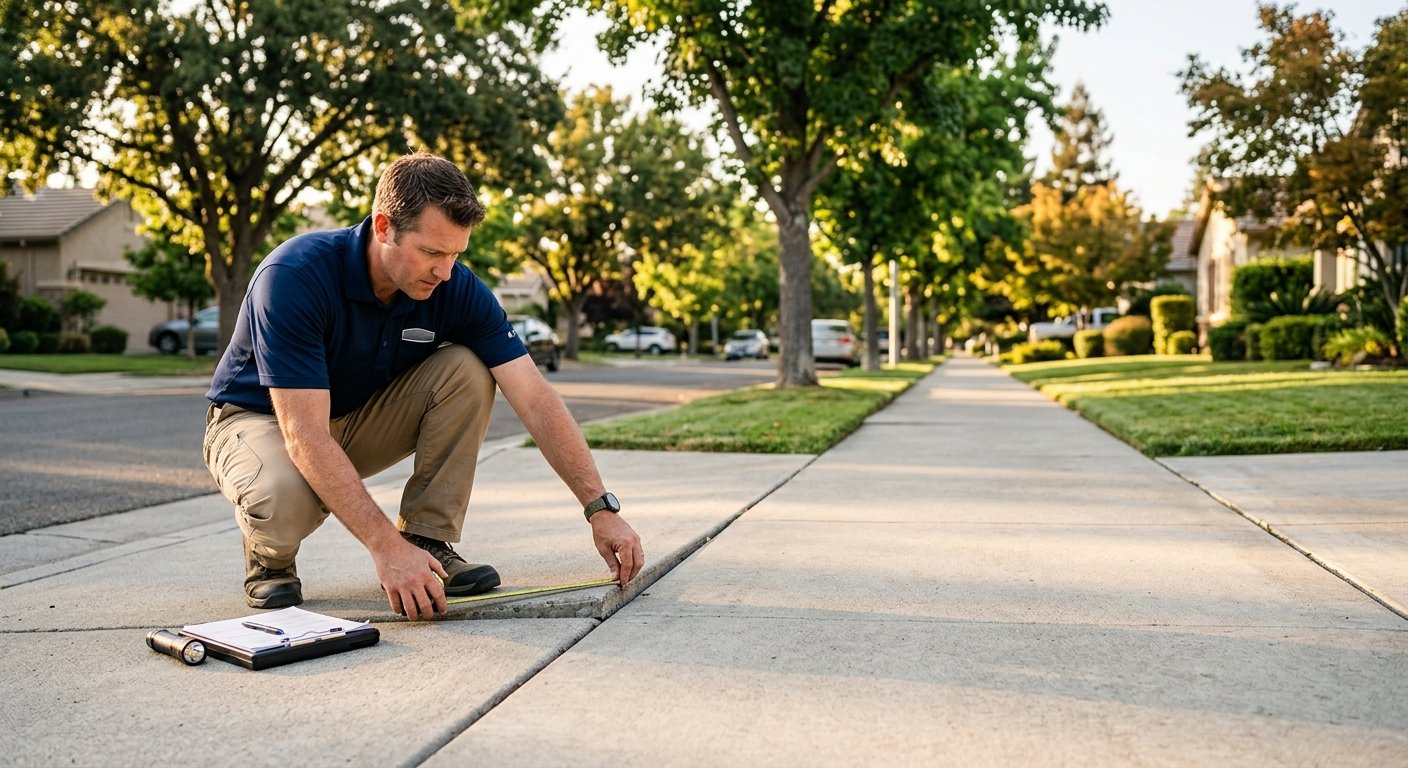
HOA boards in California are legally required to keep common-area sidewalks safe. A single trip-and-fall lawsuit can cost $30,000 to several hundred thousand dollars — far more than the repair that would have prevented it. The patented concrete cutting method costs 70–90% less than full panel replacement and achieves a true ADA-compliant 1:12 slope, letting boards address hazards within operating budgets rather than draining reserves.
- Any vertical surface change of ¼ inch or more is an ADA trip hazard — a small measurement with large legal consequences.
- Precision cutting costs 70–90% less than full concrete panel replacement and meets both ADA and OSHA standards.
- Correctly classifying repairs between the operating budget and reserve fund can keep reserves intact for genuine capital needs.
- A documented five-step process — assess, classify, prioritize, schedule, estimate — protects communities financially and legally.
- Maintaining inspection reports, invoices, and ADA compliance documentation is essential if a claim is ever filed.
This guide walks HOA decision-makers through a practical framework for identifying, prioritizing, and budgeting for uneven concrete sidewalk repair, with a focus on ADA-compliant solutions that protect communities without exhausting reserves.
Why Sidewalk Hazards Are a Liability HOAs Can’t Ignore
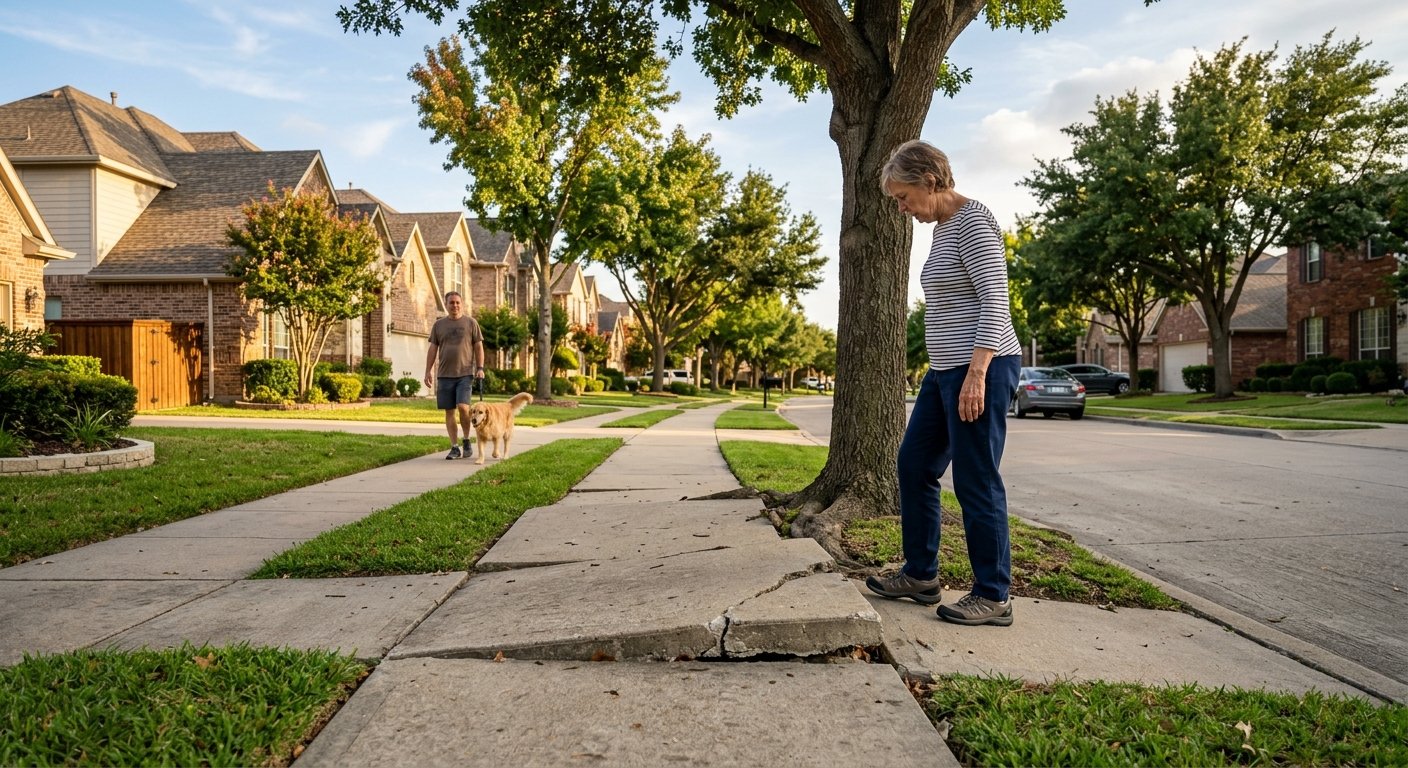
Under California law, HOAs have a duty to maintain common area property in a reasonably safe condition. Sidewalks within HOA-managed communities fall squarely within this obligation. When a resident, guest, or service worker trips on a raised concrete panel, the association — not just the individual property owner — can be named in a personal injury claim.
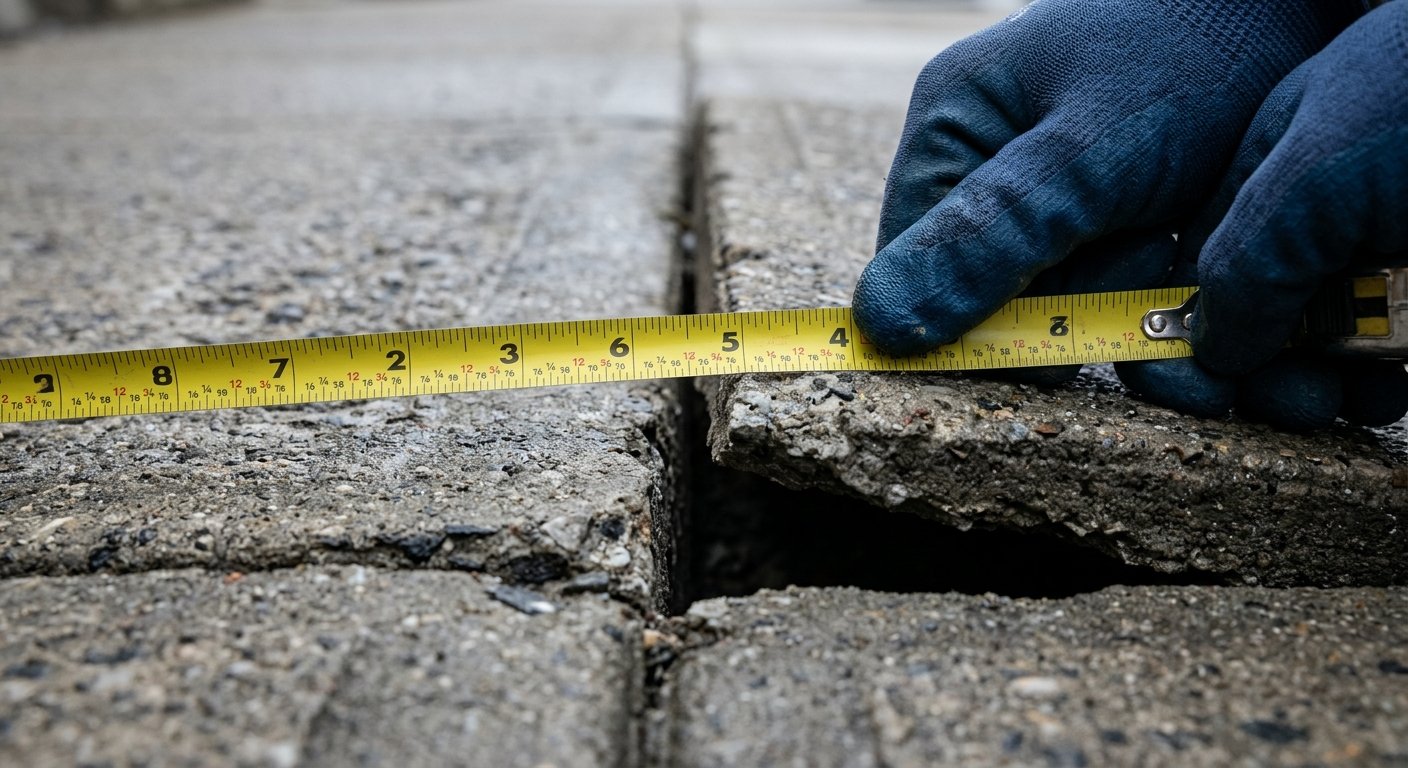
The ADA defines a trip hazard as any vertical change in a walking surface of ¼ inch or more. That’s a small measurement with significant consequences. According to the ADA National Network, accessible routes must maintain slope ratios no steeper than 1:12 for ramps and consistent, stable surfaces throughout. Non-compliant walkways expose HOAs to both tort liability from injuries and potential regulatory penalties from ADA enforcement actions.
For communities that serve older adults or residents with mobility challenges — a growing segment in California — the stakes are even higher. Proactive sidewalk trip hazard repair isn’t just about avoiding lawsuits; it’s about creating a safe environment for the people who live there.
Understanding the True Cost of Doing Nothing
Many HOA boards delay sidewalk repairs because they seem like a significant upfront expense. But this calculation rarely accounts for what inaction actually costs:
- Personal injury settlements and litigation fees — often six figures for serious falls
- Increased insurance premiums following a claim
- Deferred maintenance compounding — small lifted panels become larger structural problems over time
- Loss of property values in communities perceived as poorly maintained
- ADA enforcement costs — fines and mandated remediation timelines
The math consistently favors early intervention. An uneven sidewalk section that costs a few hundred dollars to correct today may require a full panel replacement costing several thousand dollars if left unaddressed for another two to three years.
A single trip-and-fall lawsuit can cost an HOA anywhere from $30,000 to several hundred thousand dollars — far more than the cost of the repair that could have prevented it.
How the Patented Cutting Method Changes the Budget Equation
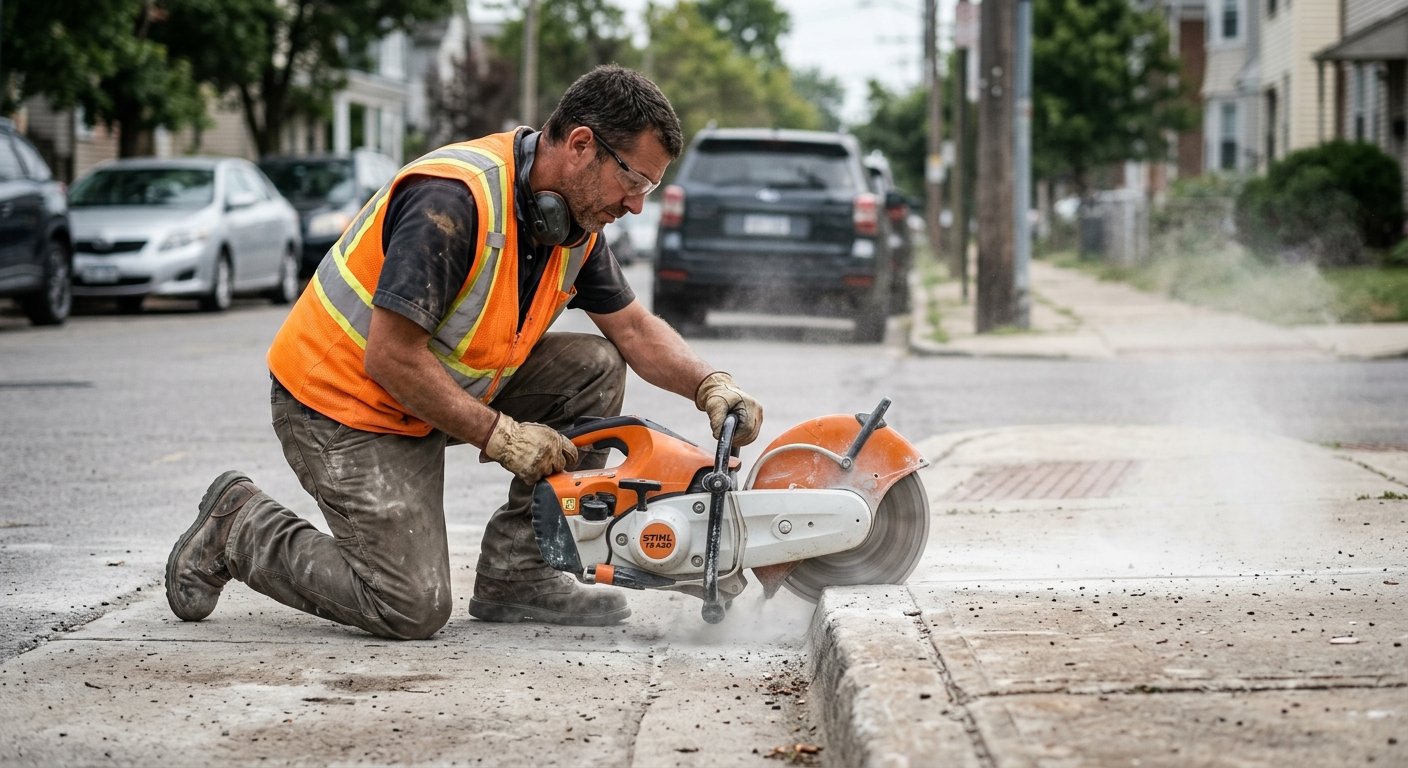
Traditional approaches to fixing uneven sidewalks have two common options: grinding the raised edge (which often leaves a beveled slope that doesn’t fully meet ADA standards) or full panel replacement (which is expensive, disruptive, and generates significant concrete waste).
| Factor | Standard Grinding | Patented Cutting Method |
|---|---|---|
| ADA slope compliance | Often leaves non-compliant slope | Achieves true 1:12 compliant slope |
| Relative cost | Moderate | 70–90% less than replacement |
| Surface result | Beveled, may look patched | Clean, intentional appearance |
| Environmental impact | Some waste | Concrete debris recycled |
| Disruption | Low–moderate | Minimal; completed quickly |
| OSHA slip resistance | Variable | Compliant |
Precision Concrete Cutting uses a patented concrete cutting method that takes a different approach entirely. Rather than grinding down the raised slab edge — which removes material and can leave non-compliant slopes — the cutting process creates a precisely tapered transition that achieves a true zero differential between panels. The result is an ADA-compliant slope of 1:12, OSHA-compliant slip resistance, and a surface that looks clean and intentional, not patched.
This method is typically 70–90% less expensive than full concrete replacement, which fundamentally changes how HOAs need to think about budgeting. Rather than reserving for expensive replacement projects every decade, communities can address trip hazards as they emerge at a fraction of the cost — preserving reserves while maintaining compliance.
Concrete debris from the cutting process is recycled, making this a more environmentally responsible choice than full panel replacement, which sends entire concrete slabs to landfill.
Building a Sidewalk Maintenance Budget for Your HOA
Commission a Baseline Sidewalk Assessment
A professional sidewalk inspection identifies every location where vertical displacement meets or exceeds the ¼-inch ADA threshold, documents slope issues, and flags areas of surface deterioration. This assessment becomes the foundation for immediate repair prioritization and long-range capital planning — and creates a paper trail demonstrating due diligence if a claim is ever filed.
Separate Operating Budget from Reserve Fund Items
Sidewalk repairs often span both budget categories. Routine trip hazard corrections on stable concrete — ideal candidates for the cutting method — belong in the operating budget. Larger-scale projects involving multiple panels or systemic settlement issues belong in the reserve fund. Because the cutting method reduces per-repair costs significantly, many corrections boards assumed would require reserve funding can be handled within the operating budget.
Prioritize by Risk Severity
Not all trip hazards carry equal risk. Address high-traffic areas near entrances, mailboxes, clubhouses, and parking lots first. Then hazards exceeding ½ inch of vertical displacement, locations near pools or playgrounds, and paths used by residents with mobility aids. Lower-traffic areas with smaller differentials can be scheduled on a rolling basis.
Build a Multi-Year Repair Schedule
Develop a three-to-five-year maintenance schedule that spreads costs while systematically eliminating hazards. For communities in Sacramento, Oakland, Burlingame, and throughout Northern California — where tree root intrusion and soil movement are common — an annual review cycle is particularly important given ongoing surface changes.
Get Itemized Estimates Before Finalizing Numbers
Request estimates that break down cost per repair location, not just a lump sum. This allows real-time prioritization decisions if the budget needs adjustment, and makes it easier to track spending against the approved plan throughout the fiscal year. A licensed and insured contractor can also provide ADA compliance documentation for completed repairs — useful for insurance renewals.
What HOAs Should Know About ADA Compliance and Commercial Sidewalk Repair
The U.S. Access Board’s ADA Standards for Accessible Design apply not just to new construction but to alterations of existing facilities. When HOAs undertake sidewalk repairs, those repaired sections must meet current ADA standards — which is why the method of repair matters, not just the fact that something was done.
Standard grinding can reduce the trip hazard but leave a slope that exceeds the 1:12 ADA requirement, creating a different type of compliance problem. The patented cutting method is specifically designed to achieve compliant slopes, making it the stronger choice for HOAs that need documented ADA compliant sidewalk repair rather than just a cosmetic fix.
For HOAs managing commercial sidewalk repair across retail areas or mixed-use community spaces, compliance documentation is especially important. It protects the association if a complaint or inspection occurs after a repair is completed.
Frequently Asked Questions
What qualifies as a trip hazard under ADA standards?
Any vertical change in a walking surface of ¼ inch or more is considered a trip hazard under ADA guidelines. Changes between ¼ inch and ½ inch must be beveled with a slope no steeper than 1:2. Changes of ½ inch or greater require a compliant ramp transition. Proactive correction before hazards reach these thresholds is the most cost-effective approach.
How often should HOAs inspect sidewalks for trip hazards?
A comprehensive inspection at least once per year is recommended, with additional walk-throughs after significant weather events or seasons when tree root activity is high. Communities in Northern California should be especially attentive in spring after root growth cycles and in fall when leaf cover can obscure surface changes.
Is concrete cutting less disruptive than full replacement?
Yes, significantly. The patented cutting method typically completes individual repairs in a fraction of the time required for panel replacement, which involves demolition, forming, pouring, and curing periods that can close walkways for days. Cutting allows most repairs to be completed quickly with minimal disruption to residents — an important consideration for communities with high foot traffic.
Can HOA insurance cover sidewalk repair costs?
Some HOA master policies include coverage for property damage repairs, but sidewalk trip hazard correction is generally considered a maintenance expense rather than an insurable event. Boards should review their policy with their broker. What insurance does cover — and what proactive maintenance directly reduces — is liability exposure from injury claims.
What documentation should HOAs keep after sidewalk repairs?
Maintain records of inspection reports, repair invoices, before-and-after measurements, and any ADA compliance documentation provided by your contractor. This file demonstrates due diligence and can support the HOA’s defense if a claim is filed related to a previously repaired area.
Take the Next Step Toward a Safer, Compliant Community
Budgeting for sidewalk trip hazard repairs doesn’t have to mean choosing between financial responsibility and resident safety. With the right approach — systematic assessment, intelligent prioritization, and a cost-effective repair method that achieves true ADA compliance — HOA boards can protect their communities without overextending reserves.
Schedule a Sidewalk Assessment for Your Community
Get a clear picture of your hazards, priorities, and costs — so your board can plan with confidence and protect residents before a claim occurs.

About Precision Concrete Cutting
Precision Concrete Cutting provides ADA-compliant sidewalk repair and trip hazard correction services for property managers, municipal facilities, and commercial property owners throughout Northern California. Using a patented concrete cutting method, the company delivers cost-effective solutions that are 70-90% less expensive than replacement while achieving zero differential and ADA-compliant slopes. The approach emphasizes safety, regulatory compliance, environmental responsibility through debris recycling, and rapid completion that minimizes disruption. Visit pccnorcal.com →