
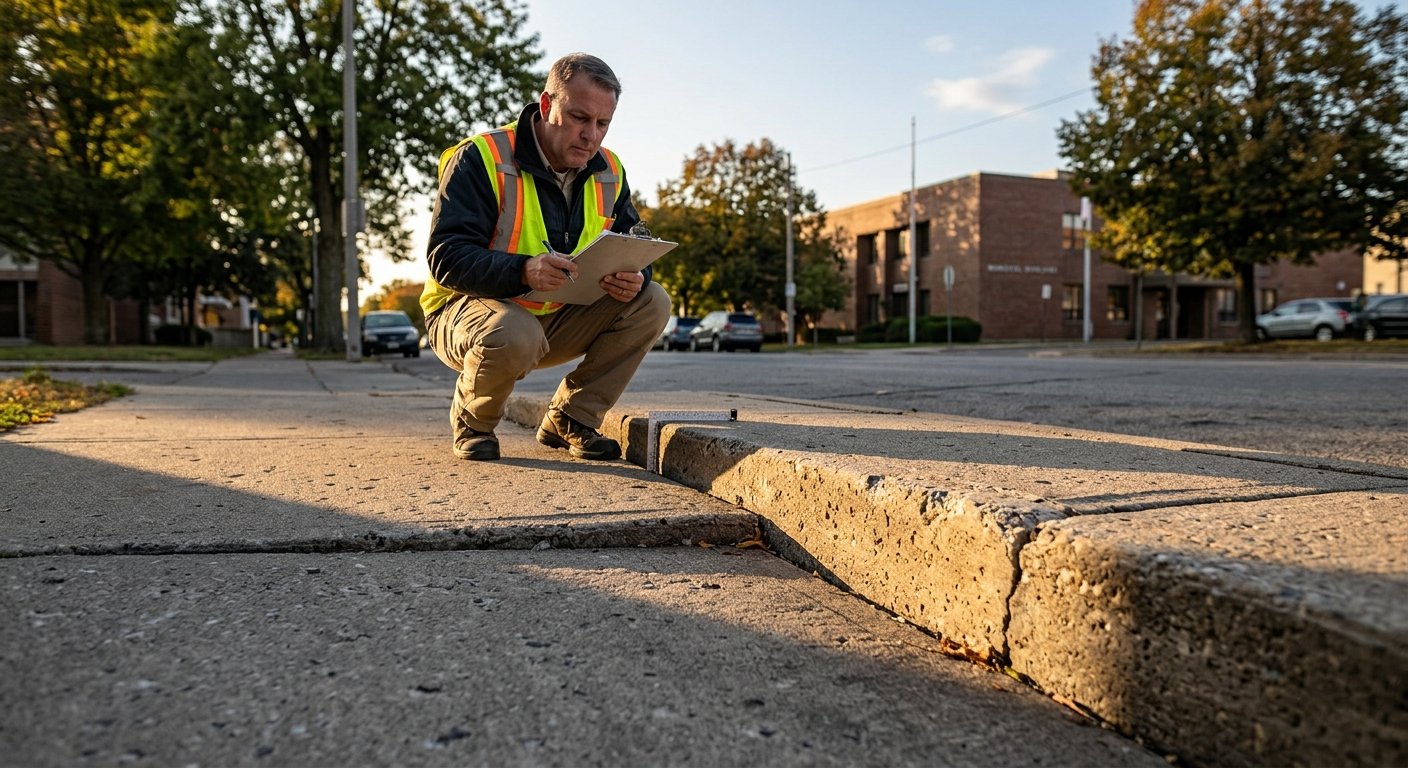
A single uneven sidewalk slab can trigger a slip-and-fall lawsuit that costs a property owner tens of thousands of dollars. Yet many facility managers delay repairs simply because they’re unsure which problem they’re dealing with — and whether the fix will be affordable. Understanding the difference between sunken and raised concrete slabs, what causes each condition, and which repair strategies actually work is the foundation of smart sidewalk maintenance.
Understanding the Two Types of Uneven Concrete
Sidewalk slabs fail in two distinct directions, and the root causes — as well as the repair approach — differ significantly between them.
Sunken Sidewalk Slabs
A sunken slab has dropped below its original elevation relative to adjacent panels. This typically happens when the soil or base material beneath the slab erodes, compresses, or washes away over time. Tree roots drawing moisture from surrounding soil, underground utility trenches that weren’t properly compacted, poor drainage design, or natural soil settlement over years can all create voids that allow slabs to sink.
Sunken slabs create a step-down condition at slab joints. When that vertical drop reaches or exceeds ¼ inch, it meets the legal definition of a trip hazard under the 2010 ADA Standards for Accessible Design. Even a ½-inch drop that most people would step over without a second thought can catch a toe, send someone forward, and result in a serious injury and legal action.
Raised Sidewalk Slabs
A raised slab has pushed upward — typically due to expansive soil, freeze-thaw cycles, or, most commonly in Northern California, tree root intrusion beneath the slab. As roots grow laterally seeking moisture and nutrients, they exert enormous upward pressure. Over time, one or more panels lift above the elevation of neighboring slabs, creating an abrupt upward step.
Raised slabs are arguably more dangerous than sunken ones. The upward edge protrudes into the walking path at exactly the height where a foot catches it. These are among the most common causes of pedestrian trip-and-fall incidents on commercial and municipal properties throughout Sacramento, Oakland, Burlingame, and surrounding Northern California communities.
Why the ¼-Inch Rule Matters So Much
The ADA’s ¼-inch vertical change standard isn’t arbitrary — it reflects decades of accessibility research on what constitutes a hazard for individuals using wheelchairs, walkers, canes, or prosthetic limbs, as well as for the general pedestrian population. According to the CDC’s fall injury data, falls remain one of the leading causes of injury-related emergency department visits in the United States, with outdoor trips being a significant contributor.
For property managers and municipal public works departments, this standard translates directly into legal exposure. If a slab differential exceeds ¼ inch and someone is injured, the property owner or responsible municipality faces a difficult defense. Documentation showing that a hazard was identified but not addressed often makes liability determinations straightforward — and expensive.
Proactive sidewalk trip hazard repair is not just a compliance checkbox. It’s a risk management strategy that protects budgets and protects people.
Traditional Repair Methods: Limitations You Should Know
Full Slab Replacement
The most disruptive and expensive option is removing the damaged slab entirely and pouring a new one. Replacement requires breaking up and hauling away old concrete, forming and pouring fresh concrete, and waiting for adequate cure time before reopening the area to foot traffic. Costs are high, timelines stretch over multiple days, and the process generates significant concrete waste. For a property manager overseeing a commercial campus or a school district administrator responsible for miles of walkways, replacement budgets can be prohibitive.
Standard Concrete Grinding
Surface grinding uses rotating abrasive heads to reduce the height of a raised edge. It’s faster than replacement but comes with meaningful limitations. Grinding creates a tapered bevel at the slab edge rather than a true ADA-compliant slope, and it removes the hardened surface layer of the concrete — which is often the densest, most durable part of the slab. The resulting surface may be rougher and more porous, and the repair is visible. Grinding also fails to address sunken slabs at all, since there’s nothing to remove from a panel that’s already too low.
Mudjacking and Foam Injection
Mudjacking (pumping a slurry beneath a sunken slab to lift it) and polyurethane foam injection are options for raising sunken panels. Both inject material through drilled holes to fill voids and restore elevation. Results vary significantly depending on the consistency of underlying soils, and both methods leave visible patch holes. Neither addresses raised slabs caused by root intrusion without also removing or cutting the root.
The Cutting Method: A Better Answer for Both Problems
Precision Concrete Cutting’s patented cutting technology takes a fundamentally different approach that resolves both sunken and raised slab conditions with superior accuracy, speed, and cost-effectiveness.
Rather than grinding a rough bevel or replacing the slab, the cutting method uses a precisely controlled blade to create a smooth, tapered repair that achieves:
- Zero differential — the transition between slabs is flush, eliminating the trip hazard entirely rather than simply reducing it
- ADA-compliant slope — the cut creates a 1:12 slope (or better), meeting the standard required for accessible design
- OSHA-compliant slip resistance — the cut surface maintains appropriate texture without the roughness that standard grinding leaves behind
- Clean, professional appearance — the finished repair looks intentional, not patched
For raised slabs caused by tree root intrusion, the cutting method removes the upward protrusion at the slab edge while preserving the integrity of the panel. For conditions where a sunken slab has created a drop at the adjacent raised panel’s edge, the same cutting technique brings the transition to a flush, compliant level.
The environmental advantage is also notable: concrete debris from cuts is recycled, keeping waste out of landfills — an increasingly important consideration for municipalities and commercial properties pursuing sustainability goals.
Learn more about how this applies to commercial properties at Precision Concrete Cutting’s commercial sidewalk repair resource, or explore the full scope of ADA compliance requirements for sidewalks.
Cost Comparison: Cutting vs. Replacement
The financial case for the cutting method is compelling. Compared to full slab replacement, precision cutting typically costs 70–90% less per repair. For a property manager overseeing a commercial campus with dozens of hazard locations, or a public works department managing city sidewalks across multiple neighborhoods, that cost differential makes systematic compliance programs financially realistic rather than aspirational.
Beyond direct material and labor costs, consider the secondary savings:
- Minimal traffic disruption — repairs are completed quickly, allowing normal use to resume rapidly without extended closures
- Reduced liability exposure — documented hazard correction supports a defensible position if a future incident occurs
- No cure wait time — unlike poured concrete replacement, cut repairs don’t require extended drying periods before reopening areas
- Scalable across large properties — high efficiency allows more locations to be addressed per mobilization visit
According to the Federal Highway Administration’s pedestrian safety guidelines, proactive sidewalk maintenance programs consistently demonstrate better long-term cost performance than deferred maintenance approaches that allow minor hazards to compound into major structural failures.
Which Problem Does Your Property Have?
Identifying whether a sidewalk problem involves a sunken or raised slab — or both — requires a site assessment. A few practical indicators:
- If you see a downward step when walking in the direction of travel, the far slab is sunken
- If you see an upward protrusion or a toe-catcher at a joint, the far slab is raised
- Tree proximity almost always suggests root-driven raising
- Areas near irrigation, drainage, or utility lines often indicate settlement or erosion-driven sinking
- Multiple adjacent panels with misalignment may signal broader soil or drainage issues
A licensed and insured professional assessment will confirm which conditions exist and whether the cutting method is appropriate for each location — which it is for the vast majority of trip hazard scenarios encountered on commercial and municipal properties.
Frequently Asked Questions
What qualifies as a sidewalk trip hazard under ADA standards?
Any vertical change in elevation of ¼ inch or more between adjacent sidewalk panels qualifies as a trip hazard under the 2010 ADA Standards for Accessible Design. Changes between ¼ and ½ inch must be beveled at a 1:2 slope; changes greater than ½ inch require a compliant ramp with a maximum 1:12 slope.
Can the cutting method fix both sunken and raised slabs?
Yes. Precision cutting addresses the edge condition at the slab joint — whether the hazard results from one slab dropping below or pushing above adjacent panels. The technique creates a flush transition with an ADA-compliant slope, resolving the trip hazard regardless of which direction the offset runs.
How does precision cutting compare to standard grinding?
Standard grinding creates a rough bevel and removes the hardened surface layer of the concrete. Precision cutting produces a smoother, more controlled slope that meets ADA specifications for both geometry and slip resistance. The finished result looks cleaner and preserves more of the slab’s structural integrity.
How long does sidewalk trip hazard repair take?
Most individual repair locations are completed in minutes, and a typical site visit addressing multiple hazards is finished within a single workday. Unlike concrete replacement, there’s no cure time required, so areas can be reopened to foot traffic promptly after work is completed.
Is sidewalk repair tax-deductible or eligible for ADA compliance funding?
Many ADA accessibility improvement expenses qualify for federal tax incentives, including the Disabled Access Credit for small businesses and Section 44 deductions. Municipal and institutional entities may access dedicated ADA compliance grant funding. Consulting with a tax professional or your public works finance office will clarify eligibility for your specific situation.
Take the Next Step Toward a Safer, Compliant Property
Whether your sidewalks have sunken from soil erosion or heaved upward from tree root pressure, uneven concrete is a liability that compounds over time. The good news is that effective, ADA-compliant repair doesn’t require demolition, extended closures, or replacement-level budgets.
Precision Concrete Cutting serves property managers, municipal facilities, and commercial property owners throughout Sacramento, Oakland, Burlingame, and Northern California with licensed, insured sidewalk hazard correction using patented cutting technology. Contact us today to schedule a site assessment and start protecting your property, your budget, and the people who walk your sidewalks every day.