
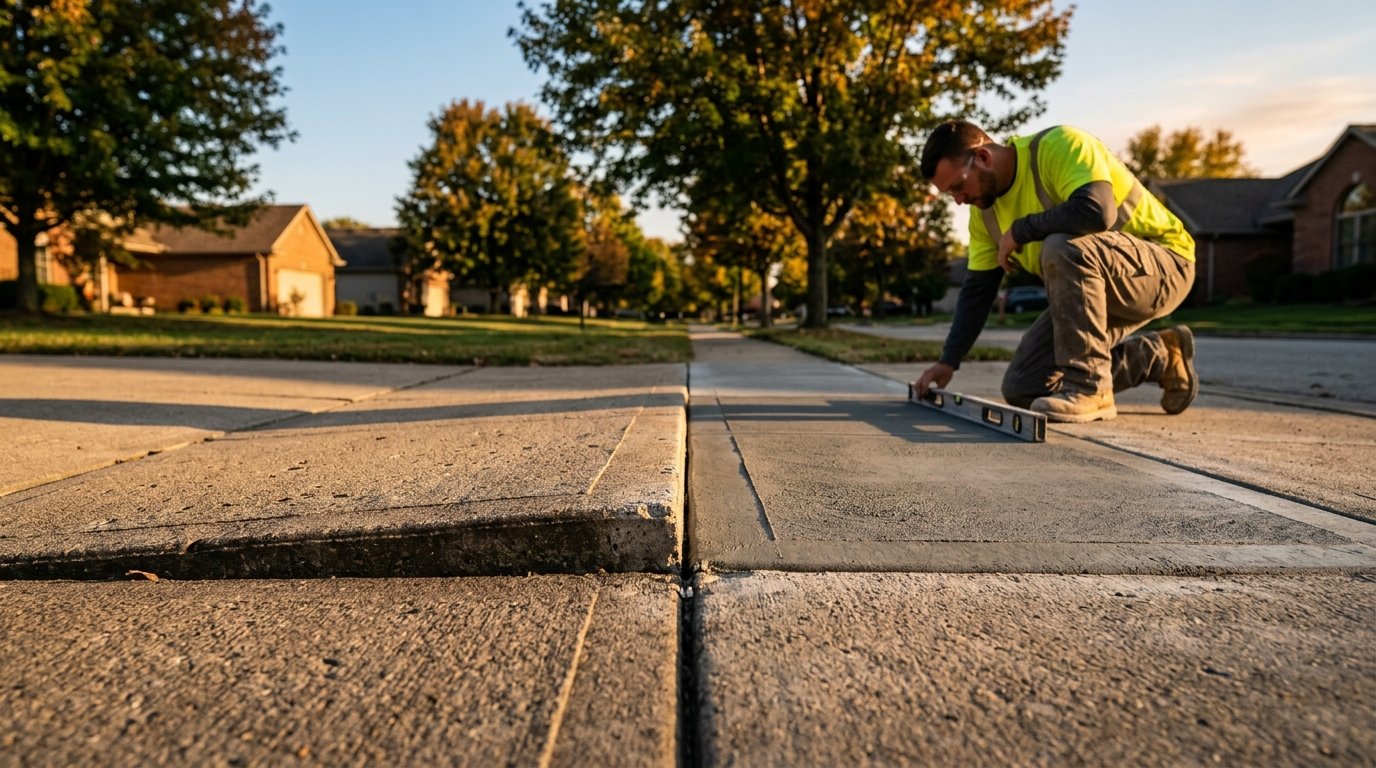
When correcting an uneven concrete sidewalk, grinding and mudjacking address the problem in fundamentally different ways. Concrete grinding removes raised material at the surface to eliminate trip hazards and restore ADA-compliant slopes, while mudjacking lifts sunken slabs by injecting material underneath them. For most surface-level trip hazards on otherwise structurally sound concrete, precision cutting produces a faster, more cost-effective, and code-compliant result.
- Grinding (precision cutting) corrects raised edges and trip hazards directly at the surface without disturbing the slab below.
- Mudjacking raises sunken slabs from beneath and works best when settlement—not surface displacement—is the primary issue.
- The ADA Standards for Accessible Design define a trip hazard as any vertical change exceeding ¼ inch, making precise surface correction critical.
- Precision concrete cutting can cost significantly less than full slab replacement while achieving zero differential and ADA-compliant ramp slopes.
- Choosing the wrong method can leave you with a non-compliant surface, recurring hazards, or unnecessary expense.
Why the Choice of Repair Method Matters
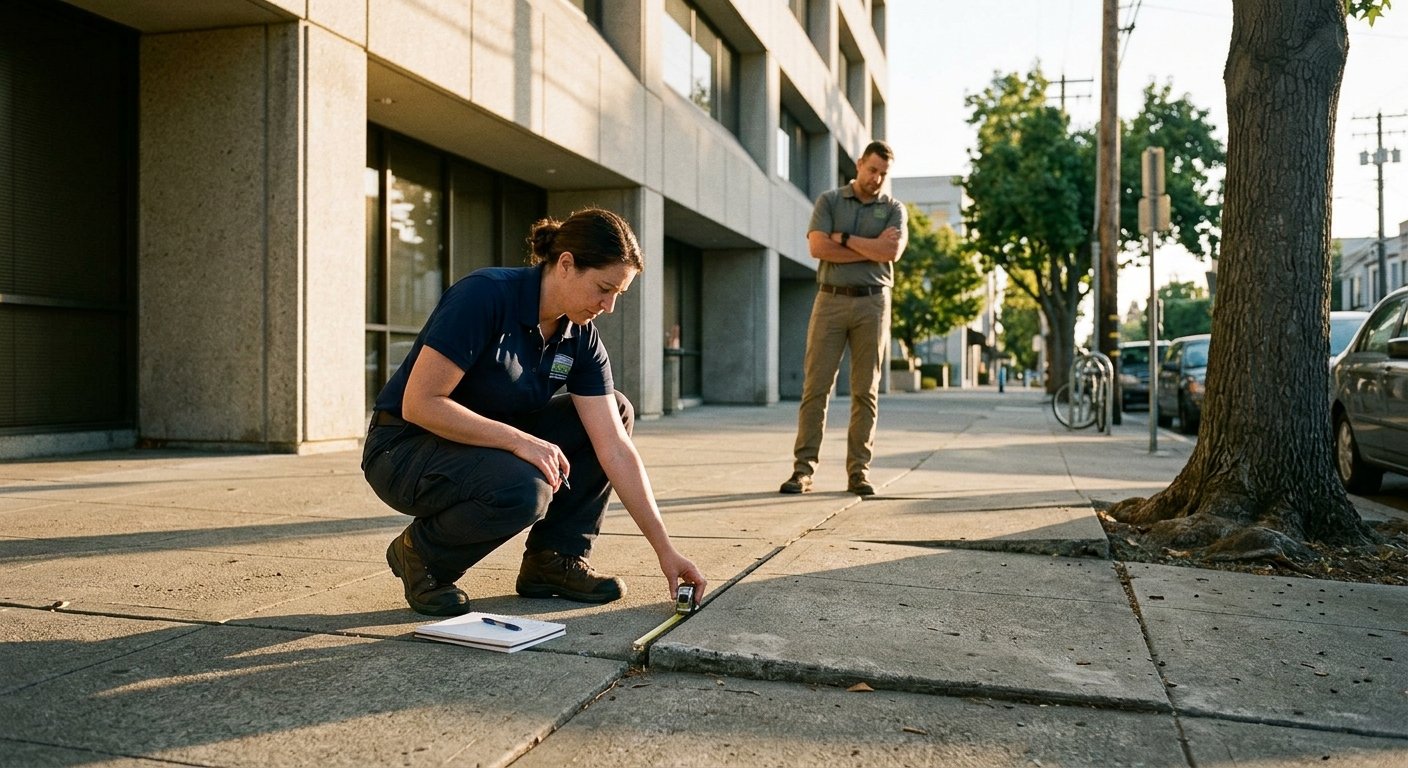
Property managers and facilities directors in Sacramento, Oakland, and Burlingame face a consistent challenge: sidewalk panels shift over time due to tree roots, soil movement, moisture cycles, and simple age. The result is a raised or sunken edge that creates a trip hazard — and under the ADA, any vertical change of more than ¼ inch at a walkway joint must be corrected. Getting the repair method right the first time determines whether your facility stays compliant, your budget stays intact, and your liability exposure is minimized.
The two most commonly discussed approaches — surface grinding and mudjacking — are frequently confused or conflated, yet they solve different problems. Understanding how each works is the starting point for making an informed decision.
Under the Americans with Disabilities Act, sidewalk trip hazards exceeding ¼ inch vertical change are a compliance violation. Municipal entities, commercial property owners, and HOAs can face legal action when accessible routes contain uncorrected hazards. The U.S. Access Board provides detailed guidance on accessible route requirements.
How Concrete Grinding Works
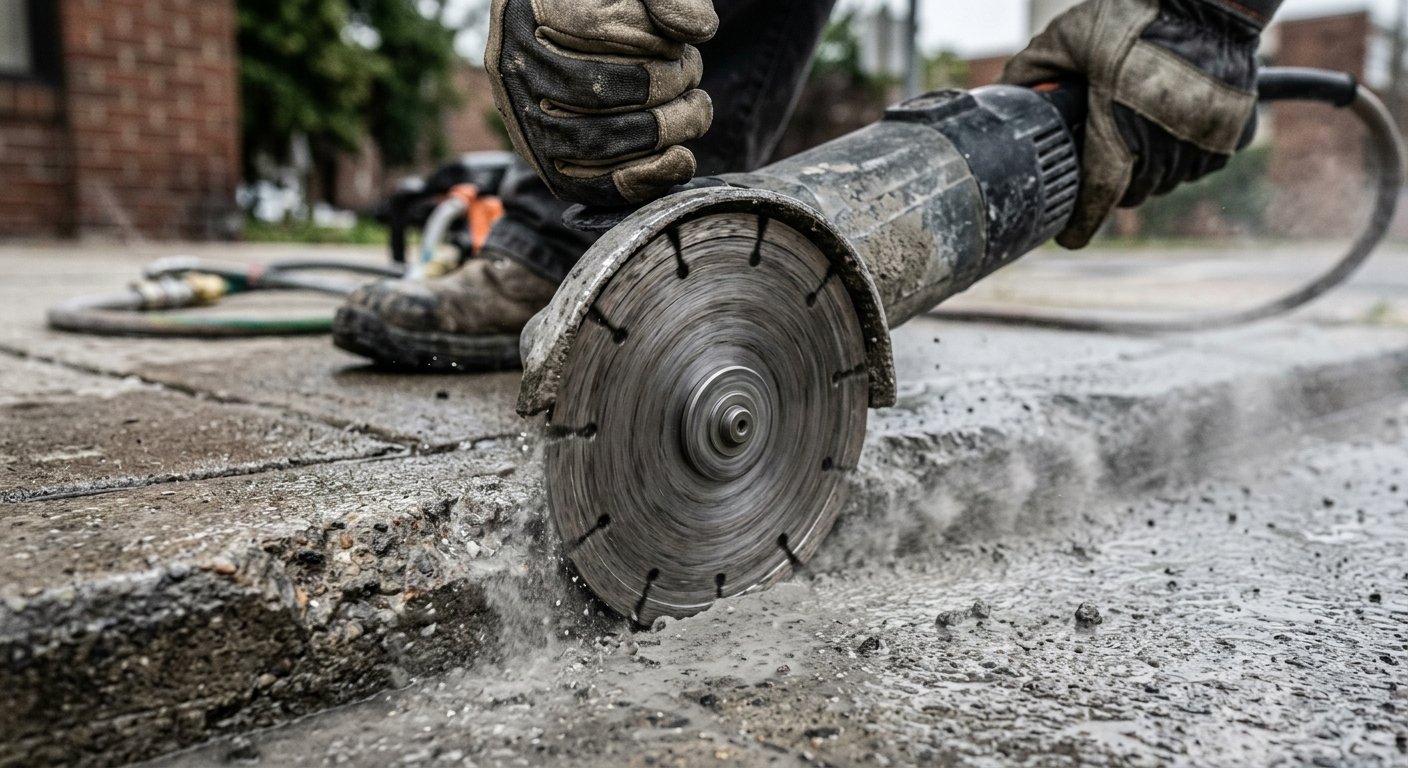
Concrete grinding — and more specifically, precision concrete cutting — removes the raised portion of a slab at the surface level. When one panel has heaved above its neighbor, the elevated lip is cut and beveled down to create a flush, level transition. The result is a surface that meets ADA slope requirements without removing or relocating the slab itself.
Modern precision cutting technology goes well beyond a basic grinder. Patented cutting equipment produces a controlled, tapered cut that achieves zero differential at the joint and a slope no steeper than 1:12 — the ADA-required maximum for accessible ramps. The finished surface also meets OSHA slip-resistance standards, which a roughly ground surface may not. Debris generated during the process is collected and recycled, keeping the worksite clean and reducing environmental impact.
This approach is particularly effective for sidewalk trip hazard repair where the slab itself is structurally sound. If the concrete is intact but one panel has simply pushed upward — typically due to tree root intrusion or soil expansion — surface cutting addresses the hazard directly without the complexity of lifting or replacing slabs.
Hazard assessment
The technician measures vertical displacement at each joint. Any edge exceeding ¼ inch is flagged for correction, and the underlying cause is noted to inform the repair plan.
Precision cutting
Patented equipment cuts a controlled bevel across the raised edge, tapering the surface to achieve zero differential at the joint and a compliant slope on either side.
Surface finishing
The repaired area is finished to meet OSHA slip-resistance requirements — critical in high-traffic commercial and municipal settings.
Debris recycling
All concrete material removed during cutting is collected and recycled, leaving the site clean and reducing landfill impact.
How Mudjacking Works
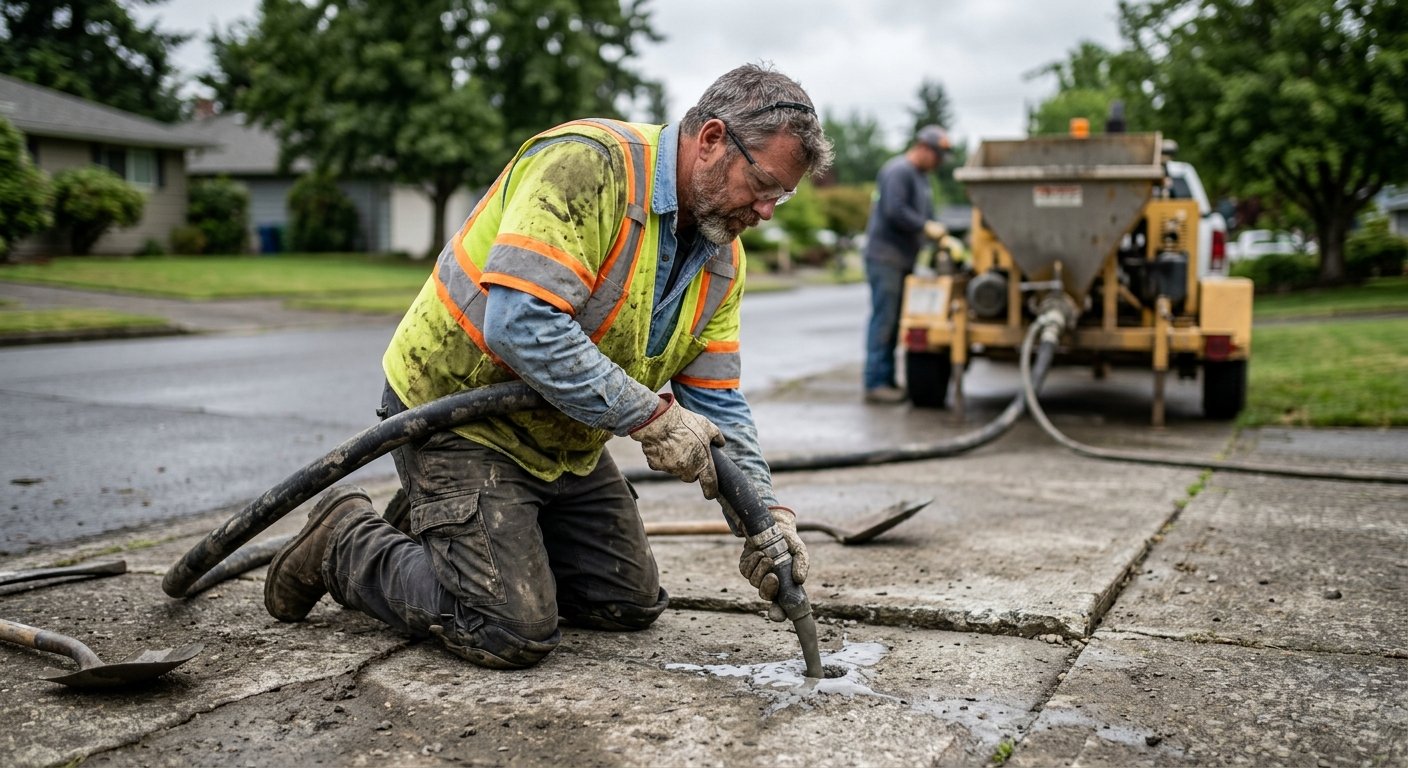
Mudjacking — also called slabjacking or pressure grouting — lifts a sunken concrete panel by pumping a slurry mixture (typically cement, soil, and water) through holes drilled into the slab. The injected material fills voids beneath the concrete and exerts upward pressure, raising the panel toward its original position.
Mudjacking is appropriate when a slab has settled downward rather than been pushed upward. If one panel sits lower than its neighbors due to soil washout, compaction failure, or subsurface voids, mudjacking can restore the slab to a level position. However, it does not address surface-level raised edges caused by heaving, and it requires drilling holes in the slab that must themselves be patched afterward.
The process is also less predictable than precision cutting. Achieving the exact elevation needed for ADA compliance depends on controlling injection pressure carefully, and some settling can recur if the underlying soil condition is not fully resolved. For uneven concrete repair caused by surface displacement rather than slab settlement, mudjacking is typically the wrong tool.
Comparing the Two Methods
| Criterion | Precision Concrete Cutting | Mudjacking |
|---|---|---|
| Best for | Raised edges, trip hazards, heaved panels | Sunken/settled slabs with subsurface voids |
| ADA compliance outcome | Zero differential, 1:12 slope achievable | Depends on injection precision; variable |
| Slab condition required | Structurally sound above-grade concrete | Intact slab with void or settlement below |
| Surface disruption | Minimal — material removed from surface only | Requires drilling holes through slab |
| Debris/cleanup | Debris collected and recycled on-site | Slurry injection; patching required |
| Cost vs. replacement | Significantly lower than full replacement | Lower than replacement; higher than cutting for surface hazards |
| Recurrence risk | Low when cause (e.g., root) is also managed | Moderate if subsurface issue persists |
For most surface-level trip hazards on structurally sound concrete, precision cutting is the more direct, cost-effective, and compliance-certain path.
When Each Method Is the Right Call
The diagnosis determines the solution. A qualified technician should assess each situation individually, but these general guidelines apply to most commercial and municipal sidewalk repair scenarios throughout Northern California.
Choose precision concrete cutting when: One slab panel has heaved above another due to tree root intrusion, frost, or soil expansion. The raised edge creates a measurable trip hazard. The slab itself is structurally intact. You need documented ADA compliance with a controlled, reproducible slope. Speed and minimal disruption to foot traffic are priorities.
Consider mudjacking when: A slab has clearly sunk below grade. There is evidence of subsurface voids or washout. The issue is settlement rather than surface displacement. A structural engineer or qualified assessor has confirmed that the slab and subbase are suitable candidates for lifting.
Many facilities directors default to full slab replacement when they encounter a trip hazard, assuming it is the only reliable fix. In the majority of cases involving raised edges on sound concrete, precision cutting delivers a compliant result at a fraction of replacement cost — and without the weeks of cure time that new concrete requires. Explore your options through commercial sidewalk repair assessment before committing to replacement.
ADA Compliance and Liability Considerations
For property managers and municipal public works departments, the regulatory stakes around uneven sidewalks are significant. The ADA mandates that accessible routes remain free of surface irregularities exceeding ¼ inch vertical change at joints. Slopes along accessible routes must not exceed 1:20 in the direction of travel, and cross-slopes must not exceed 1:48, per the U.S. Access Board’s ADA Accessibility Guidelines.
A repair method that leaves even minor differential — say, a 3/16-inch remnant edge — may still expose a property to complaint or litigation. Precision cutting, when performed with calibrated equipment and verified with measurement, produces a documented zero-differential result. This gives facilities directors and risk managers something concrete (literally) to show during compliance audits or legal proceedings.
Proactive sidewalk maintenance is always less costly than reactive repairs made after an incident. Scheduling periodic assessments of high-traffic walkways — particularly near tree canopies, expansion joints, and older poured sections — keeps hazards from escalating and keeps your accessible route documentation current.
Frequently Asked Questions
What qualifies as a trip hazard under ADA standards?
The ADA defines a trip hazard as any vertical change greater than ¼ inch at a joint or crack in a walking surface. Changes between ¼ inch and ½ inch must be beveled at a 1:2 slope; anything over ½ inch requires a ramp conforming to a 1:12 maximum slope. Precision concrete cutting is designed to achieve these exact tolerances.
Can grinding damage the structural integrity of a concrete slab?
Precision cutting removes a controlled, minimal amount of surface material — typically far less than the slab’s total depth. When performed correctly with calibrated equipment, it does not compromise slab strength. The method is appropriate for structurally sound panels; slabs with significant cracking, spalling, or subsurface failure should be evaluated separately before any repair method is selected.
How long does precision concrete cutting take compared to mudjacking?
Precision cutting is typically completed in a single visit per area, with no curing time required. The repaired surface is immediately accessible to foot traffic. Mudjacking also cures relatively quickly, but requires drilling, injection, and patch curing before the area can be reopened, adding time to the overall process.
Is mudjacking an ADA-compliant repair method?
Mudjacking can produce an ADA-compliant result when the lifted slab is raised to the correct elevation and the surface joints then meet the ¼-inch threshold. However, achieving and verifying that precision requires careful measurement during and after injection. If any surface differential remains after lifting, additional surface correction may still be needed.
Which method is better for high-traffic commercial sidewalks?
For commercial sidewalks where raised edges are the primary hazard, precision concrete cutting is generally the preferred approach. It minimizes downtime, produces a verifiable ADA-compliant surface, and avoids the disruption of drilling and patching. Property managers in Sacramento, Oakland, and Burlingame with active pedestrian areas benefit most from the speed and precision this method offers.
Get an Expert Assessment for Your Property
Contact Precision Concrete Cutting to schedule a site evaluation and find out which repair approach is right for your sidewalk conditions — before a hazard becomes a liability.
About Precision Concrete Cutting
Precision Concrete Cutting provides ADA-compliant sidewalk repair and trip hazard correction services for property managers, municipal facilities, and commercial property owners throughout Northern California. Using a patented concrete cutting method, the company delivers cost-effective solutions that are 70-90% less expensive than replacement while achieving zero differential and ADA-compliant slopes. The approach emphasizes safety, regulatory compliance, environmental responsibility through debris recycling, and rapid completion that minimizes disruption. Visit pccnorcal.com →