
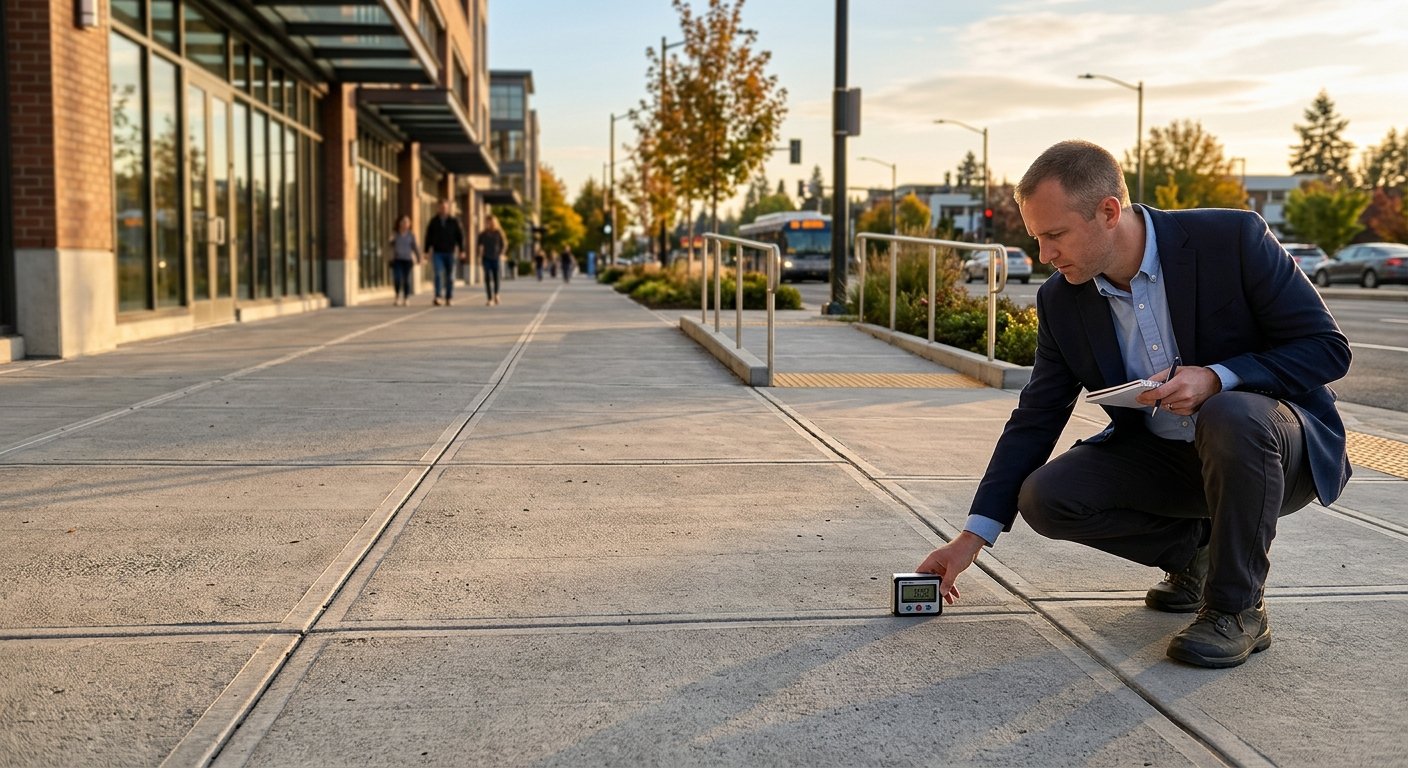
A single trip on an uneven sidewalk can result in a lawsuit that costs a property owner tens of thousands of dollars — and that’s before factoring in medical liability, legal fees, and reputational damage. Yet many commercial property owners and facility managers in Sacramento, Oakland, and Burlingame still don’t fully understand the ADA slope standards that govern their walkways. These requirements aren’t suggestions. They’re enforceable federal standards with real consequences for non-compliance.
This guide breaks down ADA sidewalk slope requirements in plain language, explains why proper slopes matter beyond just legal compliance, and outlines the most practical path to achieving and maintaining compliant walkways.
Why Sidewalk Slope Standards Exist
The Americans with Disabilities Act was enacted in 1990, and its accessibility guidelines for exterior walkways have been refined over the decades. The core purpose is straightforward: ensure that people using wheelchairs, walkers, crutches, or other mobility aids can navigate public and commercial spaces safely and independently.
Sidewalks that are too steep — or that slope laterally across the direction of travel — create serious hazards. For wheelchair users, an excessive cross-slope can cause uncontrolled lateral drift. For elderly pedestrians, an improperly graded surface increases fall risk significantly. According to the U.S. Access Board, these design standards are rooted in biomechanical research about the physical limits of people with mobility impairments.
Understanding the specific numbers — and what happens when surfaces deviate from them — is the first step toward meaningful compliance.
The Core ADA Slope Standards
Running Slope: The Direction of Travel
The running slope refers to the grade along the direction a pedestrian travels. Under ADA guidelines, the maximum running slope for an accessible route is 1:20 (5%). This means for every 20 inches of horizontal distance, the surface can rise or fall no more than 1 inch.
If a walkway exceeds this threshold and functions as a ramp, it must meet ramp-specific requirements — including edge protection, handrails where required, and level landing areas at the top and bottom. Ramps must not exceed a slope of 1:12 (8.33%), meaning no more than 1 inch of rise for every 12 inches of length.
This 1:12 ratio is a critical benchmark in sidewalk and ramp repair work. Achieving it precisely — not approximately — is what separates compliant repairs from cosmetic fixes.
Cross Slope: The Perpendicular Grade
Cross slope measures the tilt of a walkway perpendicular to the direction of travel. This is often the more dangerous of the two slope issues because it’s less visible but equally disruptive for mobility aid users.
ADA standards limit cross slopes to a maximum of 1:48 (2%). Surfaces that exceed this measurement push wheelchair users sideways and increase fall risk for those with balance impairments.
Many sidewalks that look level to the naked eye actually carry cross slopes that exceed this limit — particularly after years of ground settlement, tree root displacement, or frost heave. Regular ADA sidewalk inspections are the only reliable way to identify these non-compliant conditions before they become liability events.
Vertical Changes in Level: The ¼ Inch Rule
While not technically a slope measurement, vertical changes in level are closely tied to slope compliance. The ADA prohibits abrupt vertical changes greater than ¼ inch along an accessible route. Changes between ¼ inch and ½ inch must be beveled at a slope no steeper than 1:2.
This is the most commonly violated standard on commercial and municipal sidewalks. A raised edge of even ½ inch — caused by tree root uplift, settling, or frost heave — is enough to constitute a trip hazard and an ADA violation. For wheelchair and scooter users, these edges can cause a complete stop or tip-over.
Who Is Responsible for ADA Sidewalk Compliance?
Under Title II and Title III of the ADA, responsibility falls on different parties depending on the context. Municipalities and public agencies are covered under Title II and must maintain accessible routes in the public right-of-way. Private businesses and commercial property owners fall under Title III and are responsible for accessible paths connecting parking areas to building entrances.
The ADA.gov Title III guidance makes clear that ongoing maintenance is not optional — accessibility features that become non-compliant over time must be corrected. Property managers and HOA boards often underestimate how quickly concrete walkways can shift out of compliance due to root growth, moisture cycles, and subsurface settling.
In Sacramento, Oakland, and Burlingame, commercial property owners and municipal facilities departments face active enforcement risk. Filing a complaint with the Department of Justice or a civil rights lawsuit requires no prior notification. Proactive compliance is always more cost-effective than reactive repair after an incident.
What an ADA Sidewalk Inspection Actually Measures
A proper commercial ADA sidewalk compliance inspection goes beyond a visual walkthrough. Inspectors use digital levels, slope meters, and straight-edge tools to measure:
- Running slope along the primary direction of travel
- Cross slope at multiple points across the walkway width
- Vertical differential at all panel joints and transitions
- Surface texture and slip resistance (OSHA requires a minimum coefficient of friction for walkways in commercial settings)
- Curb ramp flare slopes and landing dimensions at driveway crossings
Many property owners discover during their first formal inspection that multiple sections of sidewalk are non-compliant — not because the original construction was substandard, but because concrete naturally shifts over time. Addressing these issues proactively is far less expensive than waiting for an ADA complaint or personal injury claim to force emergency repairs.
The Problem with Traditional Repair Methods
For decades, concrete grinding has been the default solution for trip hazards. Grinding removes material from the raised section of a panel to reduce the vertical differential, but it creates a sloped bevel rather than a flat transition. This bevel may address the immediate trip hazard, but it can introduce or worsen cross-slope problems — and it does nothing to restore the original level relationship between panels.
Full concrete replacement solves the structural problem comprehensively but at significant cost. Removing and replacing a section of sidewalk in a commercial district typically runs $800 to $1,500 or more per panel, depending on size and access. For a facility with dozens of non-compliant sections, replacement costs quickly become prohibitive.
There is a more precise and cost-effective alternative.
Patented Cutting Technology: Precise Slopes, Lower Cost
Precision Concrete Cutting uses a patented cutting method specifically engineered to address both trip hazards and slope compliance simultaneously. Unlike grinding, which shaves the surface unevenly, precision cutting removes a controlled, calculated wedge of concrete to create a true, flat ADA-compliant slope from the raised panel edge back to the adjacent panel surface.
The result is:
- Zero differential at the joint between panels
- A transition slope that meets the 1:12 ADA requirement
- OSHA-compliant slip resistance on the cut surface
- No disruption to surrounding concrete or infrastructure
This approach costs 70-90% less than full concrete replacement, with a fraction of the project timeline. Sidewalk sections that would take days to replace can be addressed in hours, minimizing disruption to tenants, customers, and pedestrian traffic. All concrete debris is recycled, reducing environmental impact compared to traditional demolition.
For property managers overseeing multiple locations across Sacramento, Oakland, or Burlingame, this method offers a scalable, budget-conscious path to achieving and maintaining sidewalk trip hazard compliance across an entire portfolio.
Frequently Asked Questions
What is the maximum allowable slope for an ADA-compliant sidewalk?
The maximum running slope for an accessible route is 1:20 (5%). If a walkway exceeds this and functions as a ramp, the maximum slope is 1:12 (8.33%). Cross slopes — perpendicular to travel — must not exceed 1:48 (2%).
How do I know if my sidewalk has an ADA slope violation?
Visual inspection is unreliable for slope measurement. A formal ADA sidewalk inspection uses precision leveling tools to measure running slope, cross slope, and vertical differentials at all panel joints. Any vertical change greater than ¼ inch is a violation that requires correction.
Is concrete grinding an ADA-compliant repair method?
Standard grinding creates a beveled surface that may reduce the vertical trip hazard but does not produce a flat, properly sloped transition. It often fails to achieve the precise 1:12 slope required for ADA compliance and can worsen cross-slope conditions. Patented precision cutting provides more accurate, compliant results.
Who is liable if someone falls on a non-compliant sidewalk?
Liability depends on jurisdiction and ownership. For commercial properties, the property owner or manager is typically responsible for accessible routes. Municipal sidewalks fall under the jurisdiction of the public agency. In either case, documented non-compliance with ADA slope standards significantly increases exposure in personal injury litigation.
How long does precision concrete cutting take compared to replacement?
Precision cutting repairs are typically completed in hours per section rather than the days required for removal and replacement. Sidewalks are accessible almost immediately after work is completed, with no curing period required.
The Proactive Compliance Advantage
For facility directors and property managers, the value of proactive ADA compliance extends well beyond avoiding fines. Documented inspection and repair programs demonstrate good faith efforts to maintain accessible properties — which carries legal and reputational weight in any dispute. They also protect your tenants, visitors, and the public from preventable injury.
Precision Concrete Cutting works with commercial property owners throughout Northern California to identify, document, and correct ADA slope violations efficiently. As a licensed and insured contractor using patented cutting technology, the team brings technical precision to every project — delivering compliant slopes, zero differentials, and measurable cost savings without the disruption of full replacement.
If your sidewalks in Sacramento, Oakland, or Burlingame haven’t been formally inspected for ADA slope compliance, now is the time to act. Contact Precision Concrete Cutting to schedule an assessment and take the guesswork out of compliance.