

A sidewalk repair priority matrix ranks trip hazards across multiple locations by scoring each defect against four criteria: ADA compliance risk, liability exposure, pedestrian foot traffic volume, and repair cost. Property managers and facilities directors who document this process create a defensible, repeatable system that demonstrates due diligence — and ensures the most dangerous conditions get corrected first.
- ADA standards define a trip hazard as any vertical change in walking surface exceeding ¼ inch — that threshold drives your scoring baseline.
- High foot traffic multiplies liability exposure, so volume must factor into every priority score.
- A documented matrix protects property owners and managers by showing a systematic, good-faith inspection process.
- Patented concrete cutting can resolve most trip hazards at 70–90% less cost than full panel replacement, preserving repair budgets across sites.
- Recycling concrete debris after cutting supports sustainability goals increasingly required in municipal and institutional contracts.
Why Multi-Site Properties Need a Formal Ranking System

When you manage five properties, the most urgent sidewalk defect is usually obvious. When you manage fifty, triage becomes genuinely difficult — and the consequences of guessing wrong include ADA enforcement actions, personal injury litigation, and reputational harm. A priority matrix removes guesswork by applying consistent criteria to every site.
Under the Americans with Disabilities Act, any vertical change in a pedestrian walking surface greater than ¼ inch constitutes a trip hazard and an accessibility barrier. The U.S. Access Board’s ADA Accessibility Standards also require that ramps and transitional slopes meet a maximum ratio of 1:12 — meaning one inch of rise for every twelve inches of run. Defects that violate either threshold carry the same legal weight whether they sit in front of a single storefront or across a campus of thirty buildings.
A formal matrix also satisfies a practical budgeting need. Repair funds are finite. When leadership asks why Site A was addressed before Site B, a scored document with documented criteria is far more defensible than an informal judgment call.
The Four Scoring Criteria
Assign each identified defect a score in each of the following categories, then sum the scores to produce a priority ranking. Weight the categories based on your organization’s risk tolerance — a school district administrator may weight pedestrian volume more heavily than an industrial facilities director.
1. ADA Compliance Risk
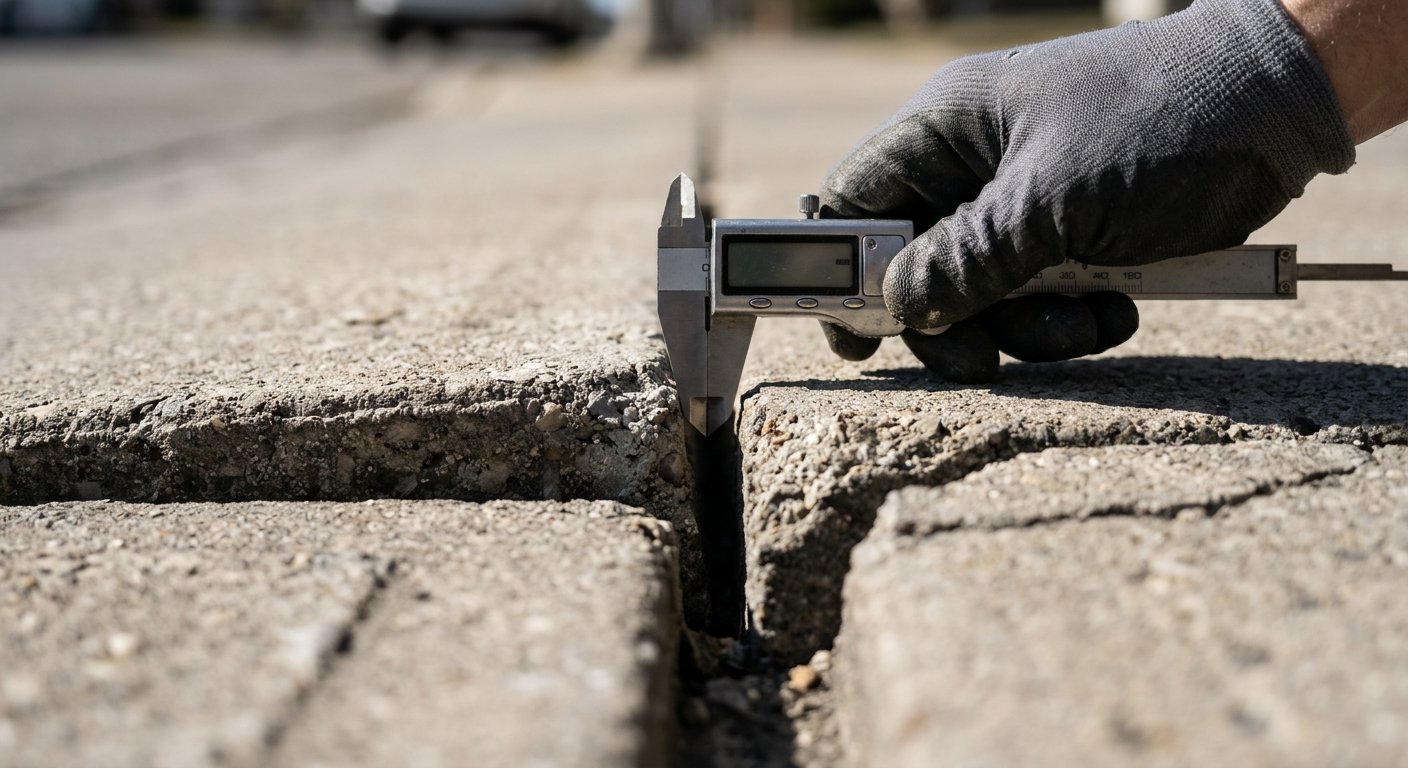
Measure the vertical differential of each defect. Any change exceeding ¼ inch is a compliance failure. Score defects on a scale where violations above ½ inch receive the highest urgency rating, defects between ¼ and ½ inch receive a mid-level score, and surface degradation below the threshold still merits a monitoring entry. Also note whether the defect affects an accessible route — those connecting parking, entrances, and public transit — since accessible routes carry heightened compliance obligations.
2. Liability Exposure
Liability exposure correlates with how discoverable and documented a defect is. A defect that has appeared in a prior inspection report, generated a complaint, or been photographed by a visitor carries a higher litigation risk than one identified for the first time. Score locations higher if they have prior notice attached — documented awareness without documented action is the pattern most likely to appear in a premises liability claim.
3. Pedestrian Foot Traffic Volume
A ½-inch lip at the entrance to a busy retail corridor poses a statistically greater injury risk than the same defect on a rarely-used service path. Categorize each site by daily foot traffic — high (main entrances, transit stops, retail frontage), medium (secondary paths, employee areas), and low (storage access, utility routes) — and reflect that categorization in your score.
4. Repair Cost and Feasibility
Not all defects are equal in complexity. Some can be resolved quickly with precision cutting; others involve underlying drainage or structural issues that require a different scope of work. When prioritizing across sites, a low-cost repair with a high-priority score should generally move ahead of an expensive repair with a moderate score — the math of risk-per-dollar spent matters to facilities budgets. Reviewing options for fixing uneven sidewalk panels before scoring can help you estimate feasibility more accurately.
A defect that scores high on ADA risk and pedestrian volume should be treated as an emergency regardless of cost. The liability math of a single serious injury far exceeds the cost of virtually any sidewalk repair.
Building the Matrix: A Step-by-Step Process

Conduct a systematic site audit
Walk every pedestrian surface at every location. Use a consistent inspection form that records location (GPS coordinates or site map reference), defect type, measured height differential, photo documentation, and the date of discovery. Standardized documentation is what converts an informal walk-through into a legally defensible inspection record.
Score each defect against the four criteria
Use a simple 1–5 scale for each criterion. ADA risk: 1 (below threshold, monitor) to 5 (violation on an accessible route). Liability exposure: 1 (first notice, no prior complaints) to 5 (prior written notice, prior incidents). Foot traffic: 1 (low volume) to 5 (main entrance or public transit adjacent). Repair feasibility: 5 (low cost, straightforward) to 1 (complex, higher cost). Sum the four scores for a total out of 20.
Rank and segment by urgency tier
Scores of 16–20 are Tier 1: address within 30 days. Scores of 11–15 are Tier 2: schedule within the current quarter. Scores of 6–10 are Tier 3: include in the next budget cycle. Below 6: document and monitor. Tier thresholds can be adjusted, but publish them internally and apply them consistently — arbitrary re-ranking after the fact undermines the entire system.
Select the appropriate repair method for each defect
For most trip hazards caused by panel displacement or root uplift, concrete cutting is the technically superior and cost-effective solution. Unlike grinding, which removes material unevenly and can leave surface texture that fails OSHA’s walking-working surface slip resistance requirements, a patented cutting method achieves zero differential between panels and produces slopes that comply with the ADA’s 1:12 standard. For a detailed comparison of repair methods, see our overview of sidewalk trip hazard repair approaches.
Document the repair and update the matrix
Once a defect is corrected, record the repair date, the method used, and the contractor. Archive the before-and-after photos with the original inspection record. This creates a continuous compliance file — useful both for ADA audit purposes and for demonstrating due diligence in any future litigation.
How the Patented Cutting Method Changes the Cost Equation
One reason multi-site priority matrices often stall is budget anxiety: if every Tier 1 defect requires panel replacement, the numbers become prohibitive. Precision Concrete Cutting’s patented cutting technology changes that calculation. By precisely removing a wedge of concrete at the trip hazard point and achieving a true zero differential, the method restores compliance without the cost, disruption, and waste of full panel removal and replacement.
The right repair method transforms a budget crisis into a manageable compliance program — site by site, defect by defect.
Concrete debris generated during cutting is recycled, which supports the environmental responsibility standards increasingly written into public contracts across Sacramento, Oakland, and Burlingame. Rapid completion also means that high-traffic areas on your priority list can be addressed with minimal disruption to daily operations — a factor that should itself influence how you score feasibility in your matrix. For a full overview of what ADA-compliant sidewalk repair involves, the ADA compliance sidewalk repair guide provides additional regulatory context.
When presenting your priority matrix to a board or municipal committee, include the estimated repair cost alongside each tier. Showing that most Tier 1 defects can be resolved through cutting rather than replacement often unlocks faster approval — the budget impact is dramatically lower than stakeholders expect.
| Criterion | Concrete Cutting | Full Panel Replacement |
|---|---|---|
| ADA compliance outcome | Zero differential, 1:12 slope | Zero differential, 1:12 slope |
| Relative cost | 70–90% less than replacement | Baseline cost |
| Site disruption | Minimal; rapid completion | Extended; curing period required |
| Debris handling | Recycled | Landfill disposal typical |
| Slip resistance | OSHA-compliant surface | Dependent on finish quality |
Frequently Asked Questions
What qualifies as a trip hazard under ADA standards?
The ADA defines a trip hazard as any vertical change in a pedestrian walking surface that exceeds ¼ inch. Changes between ¼ inch and ½ inch must be beveled; anything above ½ inch requires a ramp or repair to meet compliance. These thresholds apply to all surfaces on accessible routes connecting parking, building entrances, and public rights-of-way.
How often should multi-site properties conduct sidewalk inspections?
Most risk management frameworks recommend formal inspections at least annually, with additional inspections after significant weather events or any reported incident. High-traffic commercial properties in Sacramento, Oakland, and Burlingame may benefit from semi-annual inspections given the volume of pedestrian use. The key is consistency — documented inspections on a regular schedule support a due diligence defense.
Does concrete cutting actually achieve ADA compliance, or is it a temporary fix?
When performed correctly with precision equipment, concrete cutting achieves a true zero differential between panels and produces transitional slopes within the ADA’s 1:12 requirement. The result meets the same compliance standard as full panel replacement. The surface texture produced by the patented cutting method also meets OSHA slip resistance requirements for pedestrian walkways.
Can a priority matrix help defend against ADA enforcement complaints?
A documented priority matrix demonstrates that a property owner or manager has a systematic process for identifying and correcting accessibility barriers — which is a relevant factor in how enforcement agencies assess good-faith compliance efforts. It does not eliminate the obligation to fix violations, but it shows a structured, proactive approach rather than neglect.
What should be included in the inspection record for each defect?
Each record should include the site address, specific location on the property (referenced to a site map if possible), the measured height differential, a description of the defect type, date of discovery, the inspector’s name, and photographic documentation. After repair, add the repair date, method used, and contractor. This creates a continuous compliance file for each property.
Ready to Build Your Priority Matrix?
Precision Concrete Cutting serves property managers, municipal facilities, and commercial property owners throughout Sacramento, Oakland, and Burlingame — providing licensed, insured, ADA-compliant sidewalk repair using patented cutting technology.

About Precision Concrete Cutting
Precision Concrete Cutting provides ADA-compliant sidewalk repair and trip hazard correction services for property managers, municipal facilities, and commercial property owners throughout Northern California. Using a patented concrete cutting method, the company delivers cost-effective solutions that are 70-90% less expensive than replacement while achieving zero differential and ADA-compliant slopes. The approach emphasizes safety, regulatory compliance, environmental responsibility through debris recycling, and rapid completion that minimizes disruption. Visit pccnorcal.com →