
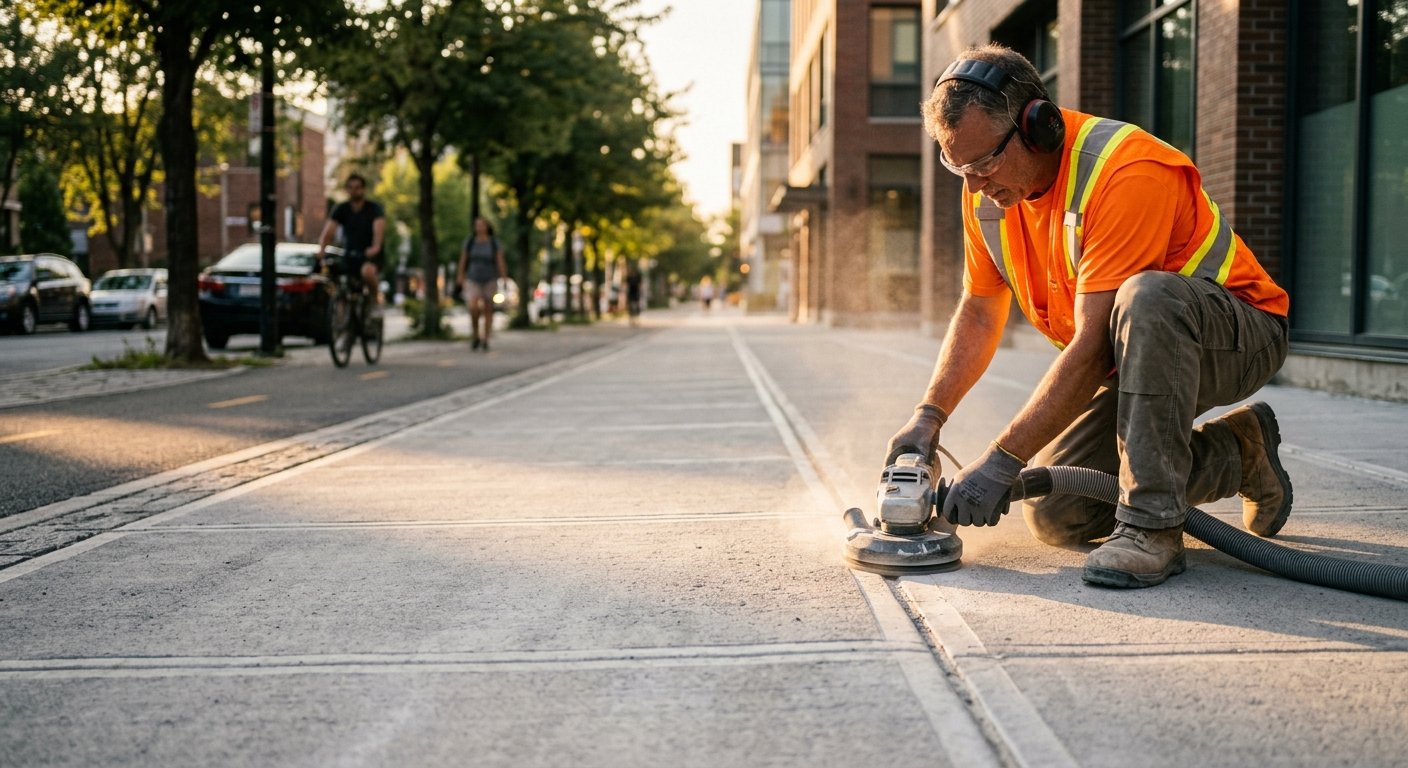
A quarter inch. That’s all it takes — a vertical change of just ¼ inch in a sidewalk surface — to create a legally actionable trip hazard under ADA standards. For property managers and municipal facilities directors, that small measurement carries enormous consequences: pedestrian injuries, costly litigation, regulatory citations, and the disruption of emergency repair projects that could have been handled more efficiently from the start.
When it comes to fixing uneven sidewalk panels and removing trip hazards, two primary methods dominate the conversation: conventional concrete grinding and precision concrete cutting. Understanding how these approaches differ — in technique, outcome, cost, and compliance — is essential before authorizing any sidewalk repair project in Sacramento, Oakland, Burlingame, or anywhere across Northern California.
What Is Concrete Grinding?
Concrete grinding is one of the older, more widely available methods for addressing raised edges and uneven surfaces. The process uses a rotating abrasive wheel or disc to shave material from the higher portion of a displaced slab, creating a beveled transition between two misaligned panels.
While grinding can quickly reduce the visible height of a trip hazard, the results have notable limitations:
- Beveled slopes often exceed ADA tolerances. The ADA requires that transition slopes not exceed 1:12 — meaning one inch of rise for every twelve inches of horizontal run. Grinding can struggle to achieve this consistently, particularly on tighter or heavily displaced joints.
- Surface texture changes. Abrasive grinding can leave a polished or uneven surface that reduces slip resistance, potentially creating a new hazard in place of the original one.
- Material removal is irreversible. Once concrete is ground away, that material is gone. The structural integrity of the affected area may be reduced, depending on how much material was removed.
- Compliance gaps remain. Without precision measurement and controlled cutting angles, many grinding jobs fall short of achieving a zero differential or a verified ADA-compliant slope — leaving property owners with a repaired but still non-compliant surface.
Grinding has its place for certain minor surface irregularities, but for property managers seeking documented ADA compliance and long-term liability risk mitigation, it frequently falls short.
How Precision Concrete Cutting Works
Precision concrete cutting is a fundamentally different approach — one that prioritizes controlled, measurable outcomes from the first cut. Rather than abrading the surface broadly, precision cutting uses a patented cutting technology to remove a precise wedge of material along a calculated slope, creating a flush transition that meets ADA-mandated specifications.
The key distinctions of the precision cutting method include:
- Zero differential at the joint. The cutting process eliminates the vertical edge entirely, producing a seamless transition between panels.
- ADA-compliant slope of 1:12. The cut angle is engineered to meet the 1:12 slope standard required under the Americans with Disabilities Act, ensuring the repair holds up under regulatory scrutiny.
- OSHA-compliant slip resistance. The cut surface maintains the texture and friction coefficient necessary to meet OSHA slip resistance standards — a critical factor that grinding can compromise.
- Debris recycling. Removed concrete material is collected and recycled, reducing landfill waste and supporting environmentally responsible site management.
- Rapid project completion. Because precision cutting is a direct intervention rather than a multi-step process, most repairs are completed quickly with minimal disruption to pedestrian traffic, business operations, or facility schedules.
For a deeper look at how this method addresses specific pavement displacement scenarios, visit Precision Concrete Cutting’s uneven concrete repair resource page.
Compliance Standards: What the ADA Actually Requires
Both property owners and facilities managers sometimes underestimate how specifically the ADA defines accessible walkway standards. According to the U.S. Access Board’s ADA guidelines, accessible routes must be stable, firm, and slip-resistant. Changes in level greater than ¼ inch must be beveled with a slope no greater than 1:2. Changes greater than ½ inch require a ramp with a maximum slope of 1:12.
This means that even a modestly raised slab edge that exceeds ¼ inch is not merely a cosmetic issue — it is a compliance failure. And when a pedestrian is injured on a non-compliant surface, the documentation of that failure becomes central to litigation.
Grinding rarely produces a verifiable, documented result that can be cited in compliance records. Precision cutting, by contrast, is engineered to exact tolerances, giving property managers and municipal departments the documentation and confidence they need to demonstrate due diligence.
Learn more about what ADA-compliant sidewalk standards mean for your property at the ADA compliance sidewalk guide.
Cost Comparison: Cutting vs. Replacement (and Grinding)
One of the most significant factors driving adoption of precision concrete cutting among commercial property owners and municipal public works departments is cost. Traditional concrete replacement — removing and re-pouring a damaged slab — remains the most disruptive and expensive repair option available.
Precision concrete cutting typically costs 70 to 90 percent less than full slab replacement. That’s not a marginal savings — for a municipality managing miles of aging sidewalks, or a property manager overseeing a large commercial campus, the difference can represent tens of thousands of dollars across a maintenance cycle.
Grinding costs may appear competitive at first glance, but when repairs fail compliance review or require follow-up work, the total expenditure often exceeds initial estimates. More critically, a non-compliant repair that results in a pedestrian injury introduces legal costs that dwarf any savings achieved by choosing a less precise method.
The more complete financial picture is this: precision cutting costs less than replacement, achieves better compliance outcomes than grinding, and reduces the long-term liability exposure that drives the most serious costs of deferred or inadequate sidewalk maintenance.
Who Benefits Most from Precision Cutting?
While any property with concrete walkways can benefit from a more accurate repair approach, certain stakeholder groups have the most to gain:
Municipal Public Works Departments
Cities managing public sidewalks in Sacramento, Oakland, and Burlingame face ongoing pressure to address trip hazards efficiently across large sidewalk networks. Precision cutting allows crews to complete more repairs per day, stretch maintenance budgets further, and maintain compliance documentation for audit purposes.
Commercial Property Owners and Managers
For retail centers, office campuses, and mixed-use developments, pedestrian safety is directly tied to liability exposure and tenant satisfaction. ADA-compliant sidewalk repair through precision cutting provides an efficient resolution that keeps facilities accessible and reduces the risk of slip-and-fall claims.
School Districts and Institutional Facilities
School campuses see high pedestrian volume from students, parents, and staff — including individuals using wheelchairs and other mobility aids. Meeting ADA standards on school walkways isn’t optional; precision cutting ensures those standards are met without costly replacement projects.
HOA Boards and Residential Communities
Homeowners associations responsible for shared sidewalks and pathways can proactively address trip hazards before they generate complaints or injury claims. Cost-effective precision cutting makes it easier to act promptly rather than deferring repairs that compound over time.
For a comprehensive overview of how trip hazards are identified and addressed, see the sidewalk trip hazard repair guide.
Environmental Responsibility in Sidewalk Repair
Concrete is one of the most widely used construction materials in the world, and its disposal contributes significantly to construction waste streams. According to data from the U.S. Environmental Protection Agency, construction and demolition debris accounts for a substantial portion of landfill material nationwide.
Precision concrete cutting generates concrete debris that is collected and recycled — diverting material from landfills and aligning with sustainability goals increasingly prioritized by municipalities, school districts, and commercial property owners with environmental mandates or green building certifications.
For facilities teams tracking sustainability metrics or managing properties under LEED frameworks, this distinction matters beyond simple cost comparison.
Frequently Asked Questions
What is the ADA standard for sidewalk trip hazards?
Under ADA guidelines, any vertical change in level exceeding ¼ inch on an accessible route constitutes a trip hazard. Changes between ¼ inch and ½ inch must be beveled at a maximum slope of 1:2. Any vertical change greater than ½ inch requires a ramped transition with a slope not exceeding 1:12. Precision concrete cutting is engineered to achieve these specific tolerances.
How is precision concrete cutting different from standard grinding?
Grinding uses an abrasive disc to shave down a raised slab edge, often producing an inconsistent slope that may not meet ADA compliance standards and can reduce surface slip resistance. Precision cutting uses a patented method to remove a precisely calculated wedge of concrete, achieving a zero differential and a verified 1:12 ADA-compliant slope with maintained surface texture.
How much does precision cutting cost compared to replacement?
Precision concrete cutting typically costs 70 to 90 percent less than full concrete slab replacement. For large-scale maintenance projects covering multiple trip hazards across a facility or sidewalk network, these savings can be substantial — while still delivering fully ADA-compliant results.
Is precision concrete cutting appropriate for high-traffic commercial areas?
Yes. Because precision cutting is completed rapidly and requires minimal disruption to surrounding surfaces, it is well-suited to high-traffic commercial environments, municipal sidewalks, and institutional campuses where extended closures are not practical.
Does the debris from precision cutting create a disposal issue?
No. Concrete material removed during the cutting process is collected and recycled, eliminating disposal concerns and supporting environmentally responsible facility management practices.
Making the Right Choice for Your Sidewalk Repair Needs
When evaluating how to address trip hazards and uneven concrete, the choice between grinding and precision cutting isn’t simply a matter of cost per square foot. It’s a decision that affects regulatory compliance, pedestrian safety, long-term liability exposure, and the efficiency of your facility’s maintenance budget.
Grinding may address the immediate appearance of a hazard but often falls short of the documented, verifiable ADA compliance that protects property owners from ongoing risk. Precision cutting delivers measurable outcomes — zero differential, confirmed ADA-compliant slopes, maintained slip resistance, and recycled debris — backed by licensed, insured professionals using patented technology designed specifically for this purpose.
Precision Concrete Cutting serves property managers, municipalities, and commercial facility teams throughout Sacramento, Oakland, and Burlingame, delivering ADA-compliant sidewalk repairs that are cost-effective, technically superior, and built for lasting compliance.
Ready to address trip hazards on your property? Contact Precision Concrete Cutting today to schedule an assessment and discover how precision cutting can resolve your sidewalk safety concerns efficiently and cost-effectively.