
A pedestrian trips on an uneven sidewalk panel outside your commercial property. Within weeks, you receive a demand letter from their attorney. What happens next depends almost entirely on what documentation you have — and when you gathered it.
For property managers, facilities directors, HOA boards, and municipal public works departments, sidewalk liability is a measurable financial risk. In California, premises liability claims related to trip hazards can result in substantial settlements, legal fees, and reputational damage. The good news: a systematic documentation strategy, combined with proactive sidewalk maintenance, is one of the most effective forms of risk mitigation available.
This guide walks through exactly how to document sidewalk conditions, what records matter most in a liability defense, and why correcting trip hazards before an incident occurs is always the smarter path.
Why Sidewalk Documentation Matters Legally
California premises liability law generally holds property owners responsible for maintaining walkways in a reasonably safe condition. When a trip hazard exists — and an injury follows — plaintiffs typically argue that the owner knew or should have known about the hazard and failed to act.
Your documentation directly addresses that legal question. Strong records can demonstrate:
- You conducted regular inspections and identified hazards promptly
- You acted on hazard reports within a reasonable timeframe
- You maintained an ongoing maintenance program rather than ignoring conditions
- Repairs were completed to ADA-compliant standards before any incident occurred
Conversely, the absence of records can imply neglect. Courts and insurance adjusters both look for evidence of reasonable care. Without it, your legal exposure increases significantly.
According to the ADA Title II regulations, public entities and commercial facilities are required to maintain accessible routes in operable condition. This regulatory obligation applies across Sacramento, Oakland, Burlingame, and other Northern California municipalities. Documentation is not just good practice — for ADA-covered entities, it’s effectively a compliance requirement.
The ADA Standard You Need to Know
Before documenting hazards, understand what constitutes a legally significant trip hazard. Under ADA guidelines, a vertical change of more than ¼ inch in a walking surface qualifies as a trip hazard. Vertical changes between ¼ inch and ½ inch must be beveled at a slope no steeper than 1:2. Anything exceeding ½ inch of vertical displacement requires correction.
In practical terms, that means a sidewalk panel that has risen or settled even slightly due to tree root intrusion or soil movement can create both an ADA violation and a liability exposure. For ADA-compliant sidewalk repair, the standard requires achieving zero differential at the transition between panels and compliant slopes across the walking surface.
Documenting the exact measurements of each hazard — before and after repair — creates a clear record that you identified the problem accurately and corrected it to code.
Step-by-Step: How to Document Sidewalk Hazards
1. Conduct Systematic Inspections
Reactive inspections after a complaint are better than nothing — but scheduled, proactive inspections are far more defensible. Establish a routine inspection schedule appropriate for your property type:
- High-traffic commercial properties: Quarterly inspections minimum
- Municipal walkways and school campuses: Semi-annual inspections at minimum, with additional checks after significant weather events
- HOA common areas: Annual inspections with records maintained by the board
During each inspection, walk the entire perimeter and any sidewalk areas for which your property bears responsibility. Do not limit your review to areas already known to be problematic.
2. Photograph Every Hazard
Photography is your most important documentation tool. For each identified hazard, capture:
- Wide-angle shots showing the hazard in context of the surrounding walkway
- Close-up shots that clearly show the vertical displacement or surface defect
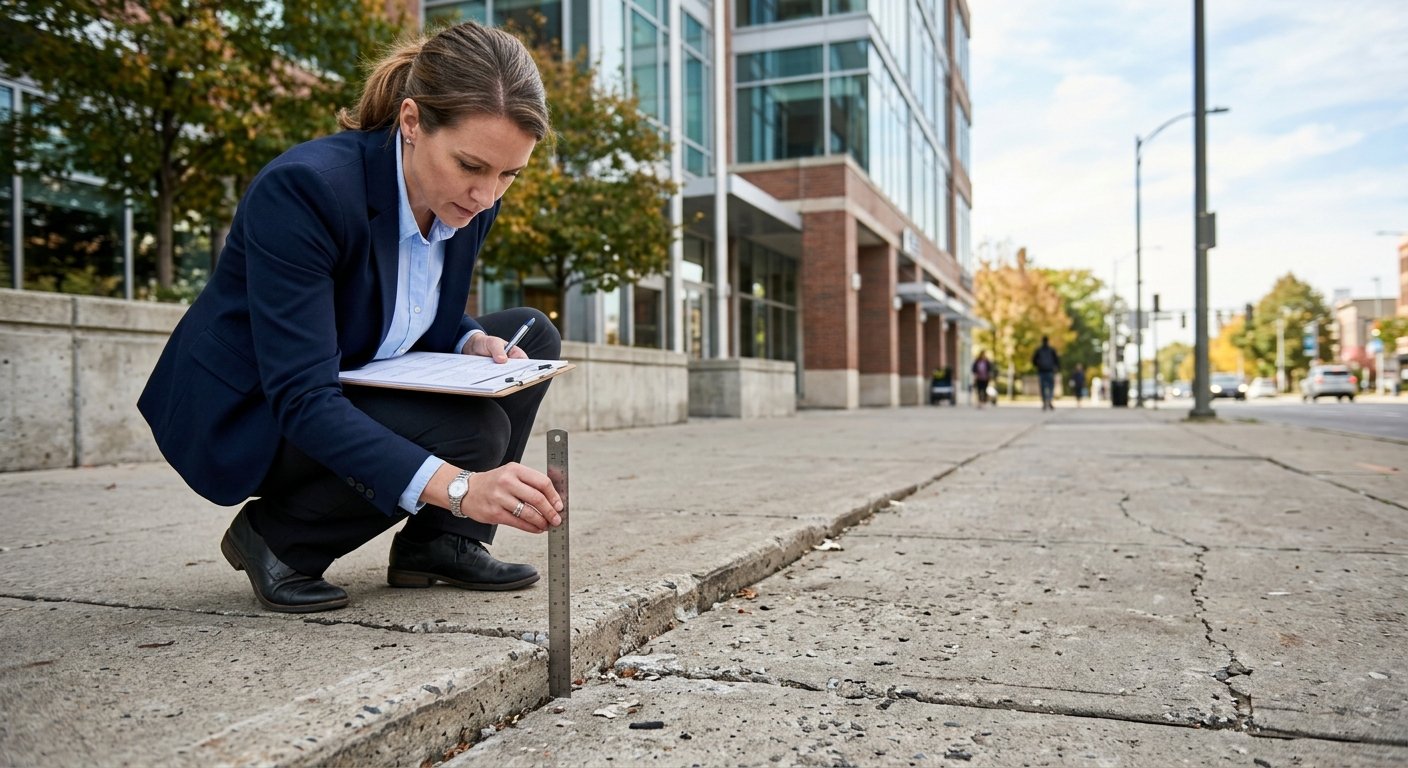
- A reference object for scale — a ruler or tape measure placed alongside the hazard is ideal
- Photographs from the direction a pedestrian would approach
Use your smartphone’s metadata to automatically timestamp and geotag each photo. Store images in a dedicated folder organized by location and date. Never delete original files.
3. Measure and Record Dimensions
Visual documentation alone is not enough. Use a straightedge and tape measure or digital level to record:
- The height of vertical displacement in inches (or fractions thereof)
- The length of the affected panel or crack
- The slope of the surface where relevant
- The GPS coordinates or property address and specific location on the property
Document these measurements in a written log that corresponds to your photographs. A spreadsheet format works well and is easy to update over time.
4. Create a Formal Hazard Log
Each inspection should produce a written record that includes:
- Date and time of inspection
- Name of the inspector
- Specific locations of all hazards identified
- Measurements for each hazard
- Severity assessment (minor, moderate, significant)
- Recommended action and priority level
- Reference to corresponding photographs
Maintain these logs with your property records. In the event of litigation, you want to be able to produce a clear chronological file showing every inspection, every identified hazard, and every corrective action taken.
5. Document All Repairs
When you fix uneven sidewalk sections, the repair record is just as important as the hazard record. Retain:
- The contractor’s work order and scope of work
- Before and after photographs
- Confirmation that the repair achieved ADA-compliant measurements
- The date repairs were completed
- Copies of the contractor’s license and insurance documentation
For sidewalk trip hazard repair performed using a patented concrete cutting method, the result is a zero differential surface with ADA-compliant slopes — a measurable, documentable outcome that provides strong evidence the hazard was corrected to code.
Interim Measures While Awaiting Repair
When a hazard is identified but repair cannot be completed immediately, interim measures must be documented as well. These may include:
- Temporary warning signage placed at the hazard location
- Photographic record of the signage in place
- Written log entry noting the date signage was installed
- A documented timeline for when repairs are scheduled
Interim measures do not eliminate liability, but they demonstrate that you took the hazard seriously and acted to warn pedestrians while repair was pending. Courts generally view this more favorably than finding no response whatsoever.
Why Proactive Repair Is the Best Documentation Strategy
There is a fundamental limit to how much documentation alone can protect you: it cannot undo a hazard that already caused an injury. The strongest liability defense is a sidewalk that was repaired before any incident occurred.
Many property managers assume that commercial sidewalk repair requires expensive concrete replacement, making proactive maintenance feel financially prohibitive. In reality, a patented concrete cutting approach can eliminate trip hazards at 70–90% less cost than full replacement — without the disruption of pouring new slabs or waiting for cure times.
The process grinds and cuts the raised panel edge to create a gradual slope meeting the ADA’s 1:12 standard, achieving zero differential between panels. The result passes both ADA compliance standards and OSHA slip-resistance requirements. Concrete debris from the process is recycled, reducing waste and environmental impact. For property managers in Sacramento, Oakland, and Burlingame responsible for large sidewalk inventories, this approach makes proactive hazard elimination genuinely cost-effective.
The OSHA walking-working surfaces standards provide additional regulatory context for why slip resistance and surface continuity matter beyond ADA compliance alone — particularly for facilities where employees or contractors access outdoor walkways.
Frequently Asked Questions
What counts as a trip hazard under California law?
While state law does not specify a precise universal threshold, the ADA standard of ¼ inch vertical displacement is widely used as a benchmark. Courts often reference this measurement in premises liability cases involving pedestrian walkways. Any vertical change exceeding ½ inch represents a significant hazard requiring prompt correction.
How often should I inspect sidewalks on a commercial property?
For most commercial properties, quarterly inspections are a reasonable baseline. Higher-traffic locations, properties with mature trees near walkways, or facilities serving elderly or mobility-impaired visitors may warrant more frequent checks. The key is consistency and written documentation of every inspection.
Can documentation alone protect me from a liability claim?
Documentation strengthens your defense by demonstrating reasonable care, but it does not guarantee a favorable outcome in every case. The most effective risk management combines thorough documentation with timely repair of identified hazards. Showing that you found a hazard and quickly corrected it to ADA-compliant standards is a far stronger position than documentation alone.
What should I keep after a sidewalk repair is completed?
Retain the contractor’s work order, before-and-after photographs, confirmation of ADA-compliant measurements, repair completion date, and proof of the contractor’s licensing and insurance. Store these alongside your inspection logs as part of your property’s permanent maintenance records.
Is concrete cutting a recognized repair method for ADA compliance?
Yes. When performed correctly, precision concrete cutting reduces raised panel edges to a slope meeting the ADA’s 1:12 standard with zero differential between panels — achieving full ADA compliance without the cost and disruption of concrete replacement. The method is applicable to a wide range of trip hazard conditions on commercial and municipal sidewalks.
Take the Proactive Approach to Sidewalk Safety
Effective liability defense starts long before a claim is filed. It starts with a scheduled inspection program, careful documentation of every hazard, and timely repair to ADA-compliant standards. For properties in Sacramento, Oakland, Burlingame, and the broader Northern California region, Precision Concrete Cutting provides licensed and insured sidewalk trip hazard correction using a patented cutting method that delivers measurable, code-compliant results at a fraction of replacement cost.
If you have sidewalks with uneven panels, raised edges, or surfaces that haven’t been inspected recently, don’t wait for a complaint or a claim to prompt action. Contact Precision Concrete Cutting to schedule an assessment and build the documentation trail that demonstrates your commitment to sidewalk safety and ADA compliance.