
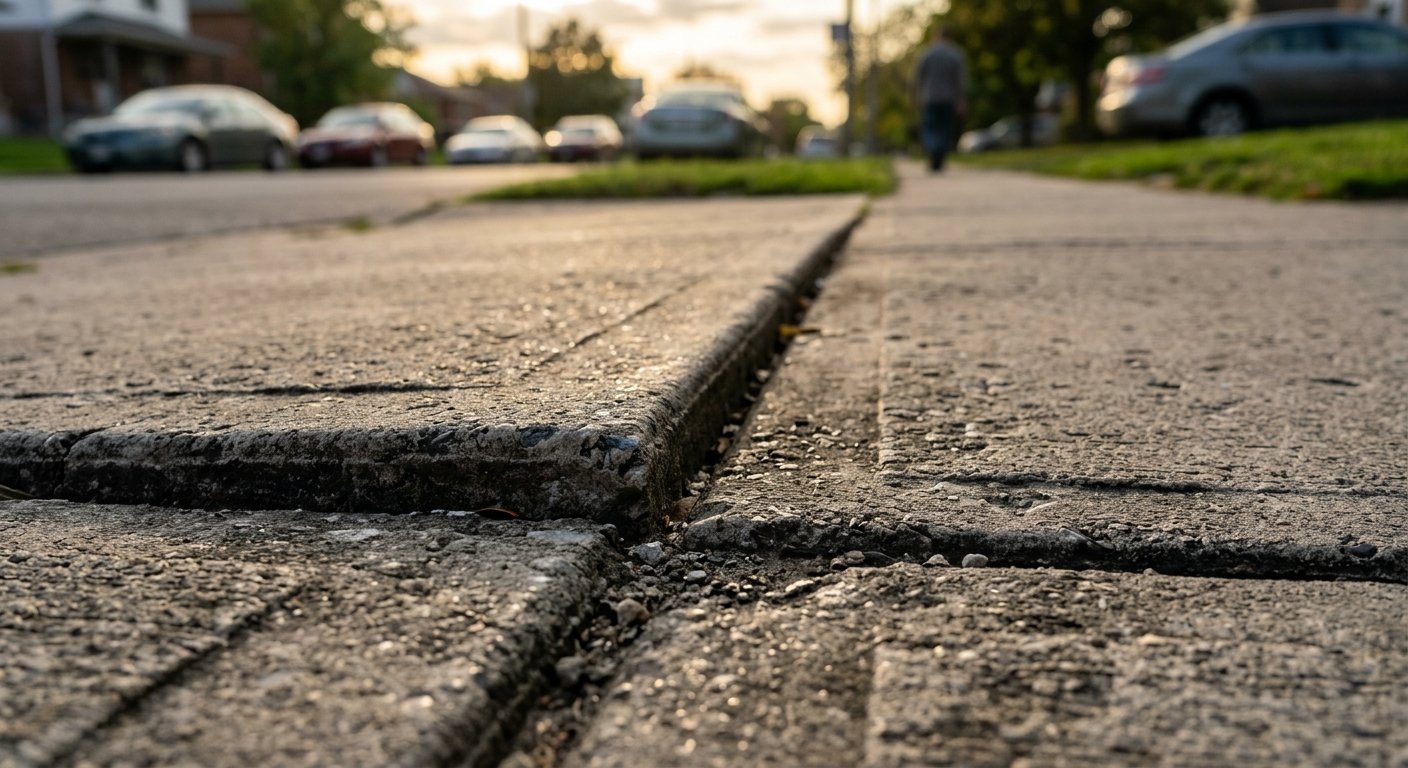
A sidewalk slab that has shifted just a quarter inch above its neighbor is no longer a minor cosmetic problem — it’s a legally defined trip hazard. Under the Americans with Disabilities Act, any vertical change of ¼ inch or greater in a pedestrian walkway must be corrected. For property managers, facilities directors, and municipal public works departments, that threshold carries real liability exposure and compliance obligations.
The good news: uneven concrete sidewalk repair does not require tearing out and replacing entire slabs. Modern concrete cutting methods resolve most trip hazards faster, more affordably, and with better long-term results than traditional approaches. This guide walks through how to identify, evaluate, and fix uneven sidewalk slabs — and explains why the repair method you choose makes a significant difference.
Why Sidewalk Slabs Become Uneven
Understanding the cause of displacement helps determine the right repair strategy. Concrete sidewalk slabs shift out of alignment for several reasons:
- Tree root intrusion: Root systems growing beneath slabs create upward pressure, lifting sections unevenly over time.
- Soil erosion and settlement: Water runoff, poor drainage, and soil compaction loss create voids beneath slabs, causing them to sink or tilt.
- Freeze-thaw cycles: Repeated expansion and contraction of subsurface moisture shifts slab position seasonally.
- Heavy load stress: Vehicle crossings, heavy equipment, and concentrated foot traffic accelerate differential settlement.
- Age and subgrade failure: Over time, the compacted base beneath concrete naturally degrades.
Identifying the cause is important because some root causes — like ongoing tree root growth or active soil erosion — may require additional mitigation alongside the surface repair itself.
How to Identify a Trip Hazard
A visual inspection is a starting point, but formal assessment requires measurement. Use a straightedge or level and a tape measure to check vertical displacement at every slab joint along a walkway. The ADA’s 2010 Standards for Accessible Design set the compliance threshold at ¼ inch for abrupt vertical changes. Changes between ¼ inch and ½ inch must be beveled; anything exceeding ½ inch requires full correction.
During inspection, also note:
- Crack patterns that indicate ongoing movement versus settled displacement
- Spalling, scaling, or surface deterioration that affects structural integrity
- Drainage patterns that may be contributing to subsurface erosion
- The overall slab condition — thickness, reinforcement exposure, and brittleness
Property managers conducting routine facility assessments should document every measurement. This documentation supports both maintenance planning and demonstrates due diligence if a liability claim arises.
The Three Common Repair Methods — Compared
1. Concrete Grinding
Surface grinding removes material from the raised slab edge to reduce the height differential. It’s a fast, lower-cost option for small lips, but it creates a sloped transition rather than a level surface. Grinding also thins the concrete at the edge, which can accelerate future cracking and spalling. For minor lips at or just above the ¼ inch threshold, grinding can work — but it does not address the underlying displacement and typically does not achieve a true zero-differential result.
2. Mudjacking or Foam Lifting
These methods inject material beneath a sunken slab to raise it back toward grade. Mudjacking uses a cement-soil slurry; polyurethane foam injection is a newer variation. Both can be effective when a slab has sunk due to void formation beneath it, but they carry limitations. Neither method works when a slab has been pushed upward by root intrusion, and results depend heavily on subgrade conditions. Uneven lifting is possible, and the underlying cause often persists.
3. Precision Concrete Cutting
This method addresses the raised slab — the one that has been lifted above grade — by cutting it down to match the adjacent surface precisely. Using a patented cutting process, trained technicians remove material in a controlled, measured manner to achieve zero differential and ADA-compliant transitional slopes of 1:12, which meets both federal accessibility standards and OSHA slip-resistance requirements.
For most trip hazard corrections in commercial, municipal, and institutional settings, precision concrete cutting delivers superior results. It eliminates the hazard permanently at that point of displacement, achieves measurable ADA compliance, and does so at a cost that is 70 to 90 percent less than full slab replacement. Learn more about this approach on our sidewalk trip hazard repair service page.
Step-by-Step: How Professional Trip Hazard Correction Works
When a qualified contractor uses precision cutting to fix uneven sidewalk slabs, the process follows a structured sequence:
- Site assessment and measurement: Technicians measure every displacement along the walkway, document conditions, and identify which slabs require cutting versus which may need other interventions.
- Work zone setup: Safety signage and barriers are placed to protect pedestrians and workers during repair. This step is particularly critical in high-traffic areas like school campuses, retail corridors, and municipal facilities.
- Precision cutting: Using patented equipment, technicians cut the raised slab edge at a calculated angle that transitions from the raised height down to the adjacent slab’s level. The cut achieves the 1:12 slope specification for ADA compliance.
- Surface finishing: The cut surface is finished to meet OSHA’s slip-resistance standards — no smooth or polished result that could create a wet-surface hazard.
- Debris collection and recycling: All concrete debris is collected on-site. Precision Concrete Cutting recycles this material, diverting it from landfill — an environmental benefit that supports sustainability goals for municipal and institutional clients.
- Documentation: Reputable contractors provide before-and-after documentation confirming measurements and ADA compliance, which property owners can retain for liability records.
Most projects are completed rapidly with minimal disruption to building occupants, pedestrians, or operations — a significant advantage over replacement work, which requires curing time and extended access restrictions.
ADA Compliance: What Property Owners Must Know
The ADA is not the only regulation that governs sidewalk accessibility. California law and local municipal codes impose additional obligations on property owners, particularly in commercial and multifamily contexts. Under California Building Code accessibility standards, many of which are more stringent than federal minimums, the duty to maintain accessible paths of travel falls squarely on the property owner.
Key compliance requirements to understand:
- Vertical changes of ¼ inch or more require correction at all accessible route transitions
- Beveled transitions must not exceed a 1:2 slope ratio
- Running slopes of accessible sidewalks should not exceed 1:20; cross slopes should not exceed 1:48
- Compliant repairs must maintain these standards — not just eliminate the visible lip
For a comprehensive overview of ADA sidewalk obligations, visit our ADA compliance sidewalk resource page.
Sidewalk Repair Cost: What to Expect
Repair costs vary based on the number of trip hazards, accessibility of the site, slab conditions, and the method used. However, the cost comparison between methods is consistent: precision cutting is dramatically less expensive than replacement.
Full concrete slab replacement requires demolition, hauling, forming, pouring, and a curing period. Labor, materials, and project duration all add up quickly. Precision cutting eliminates most of those cost centers. For a facility managing dozens or hundreds of trip hazards across a property portfolio — such as a school district, HOA community, or municipal parks department — the savings at scale are substantial.
More detail on commercial sidewalk repair costs and scope considerations is available on our commercial sidewalk repair page.
Frequently Asked Questions
What qualifies as a trip hazard on a sidewalk?
Under ADA standards, any abrupt vertical change of ¼ inch or more between adjacent sidewalk surfaces qualifies as a trip hazard requiring correction. This threshold applies to all accessible pedestrian routes, including public sidewalks, building entrances, parking lot walkways, and campus pathways.
Is concrete cutting better than grinding for trip hazard repair?
In most cases, yes. Grinding removes surface material but creates a sloped transition that may not achieve zero differential or full ADA compliance. Precision concrete cutting uses a controlled, angled cut to achieve the required 1:12 slope while preserving more of the slab’s structural thickness and delivering measurable compliance documentation.
How long does sidewalk trip hazard repair take?
Most individual trip hazard corrections using precision cutting are completed in minutes per location, with full projects often finished within a single workday. Unlike slab replacement, there is no concrete curing period required, so walkways return to full use immediately after work is complete.
Does concrete cutting repair address the root cause of slab displacement?
Precision cutting corrects the hazard at the surface. If the displacement is caused by an ongoing issue — such as active tree root growth — additional steps such as root barriers or root pruning may be recommended alongside the repair. A qualified contractor will assess underlying causes during site inspection.
Who is liable for an uneven sidewalk injury?
Liability depends on jurisdiction and the location of the sidewalk, but in California, commercial property owners, municipalities, and institutions generally bear responsibility for maintaining accessible, hazard-free walkways on or adjacent to their property. Failure to address known trip hazards increases liability exposure significantly. Proactive repair and documentation of compliance are the most effective risk mitigation strategies.
Serving Sacramento, Oakland, and Burlingame
Precision Concrete Cutting serves property managers, municipal facilities, and commercial property owners throughout Northern California — including Sacramento, Oakland, and Burlingame. Our licensed and insured team uses a patented cutting method to deliver ADA-compliant trip hazard corrections that protect your property, your occupants, and your compliance standing.
If you’ve identified uneven sidewalk slabs on your property or want a professional assessment of your walkways, contact us today. We’ll provide a clear evaluation and cost-effective path to compliance — without the expense or disruption of full replacement.

About Precision Concrete Cutting
Precision Concrete Cutting provides ADA-compliant sidewalk repair and trip hazard correction services for property managers, municipal facilities, and commercial property owners throughout Northern California. Using a patented concrete cutting method, the company delivers cost-effective solutions that are 70-90% less expensive than replacement while achieving zero differential and ADA-compliant slopes. The approach emphasizes safety, regulatory compliance, environmental responsibility through debris recycling, and rapid completion that minimizes disruption. Visit pccnorcal.com →