
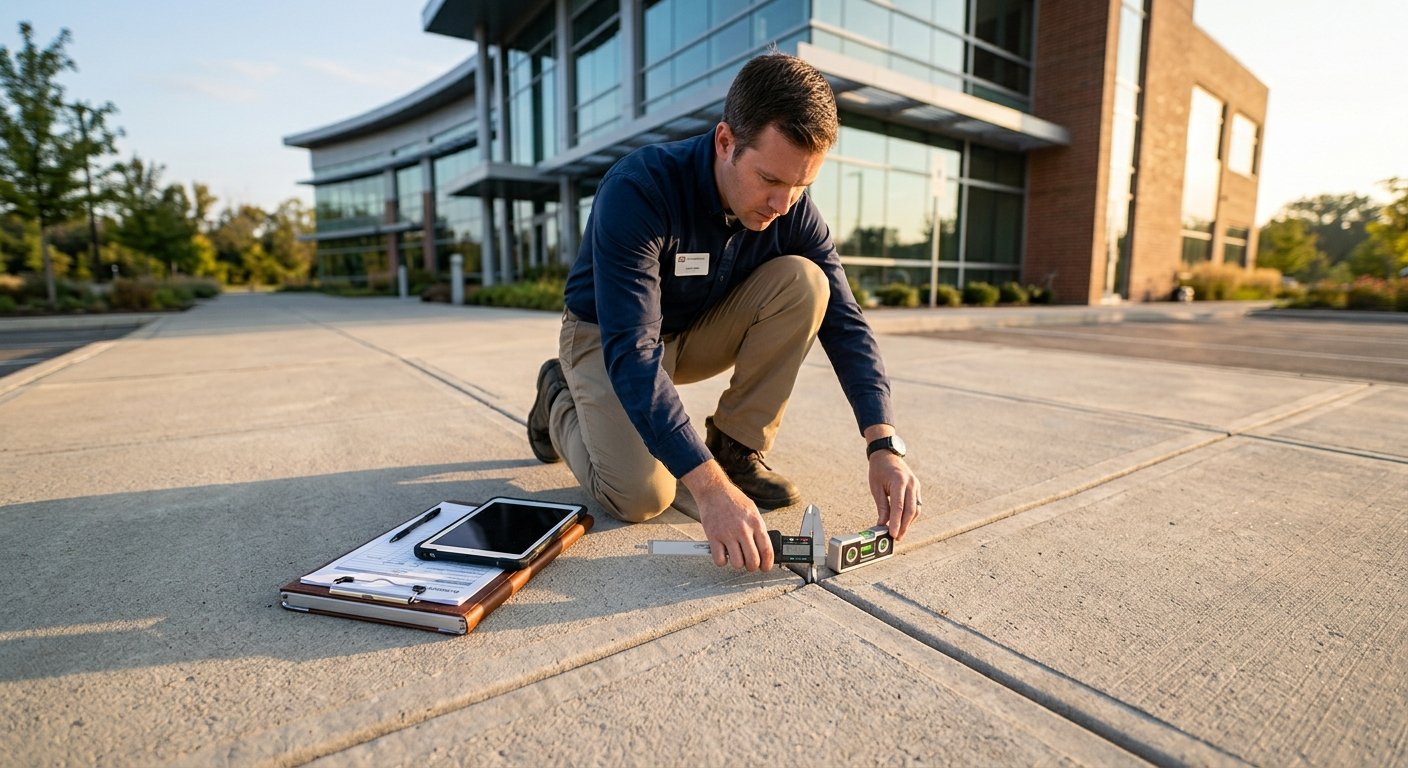
Passing a commercial sidewalk ADA audit requires your walkways to meet specific dimensional standards: no vertical changes exceeding ¼ inch, cross-slopes no steeper than 2%, and running slopes no greater than 1:20 on accessible routes. Property managers, facilities directors, and municipal public works departments in Sacramento, Oakland, and Burlingame must address these thresholds proactively — because auditors and plaintiffs’ attorneys measure them precisely.
- ADA standards define a trip hazard as any vertical surface change exceeding ¼ inch — a threshold auditors measure with simple gauges.
- Sidewalk slope ADA requirements limit cross-slopes to 2% and running slopes to 5% on accessible routes (1:12 on ramps).
- Precision concrete cutting can resolve most trip hazards at 70–90% less cost than full slab replacement.
- Proactive inspection and repair reduces liability exposure significantly before an audit or incident occurs.
- All repaired surfaces must maintain OSHA-compliant slip resistance — not just eliminate the height differential.
What ADA Auditors Actually Measure
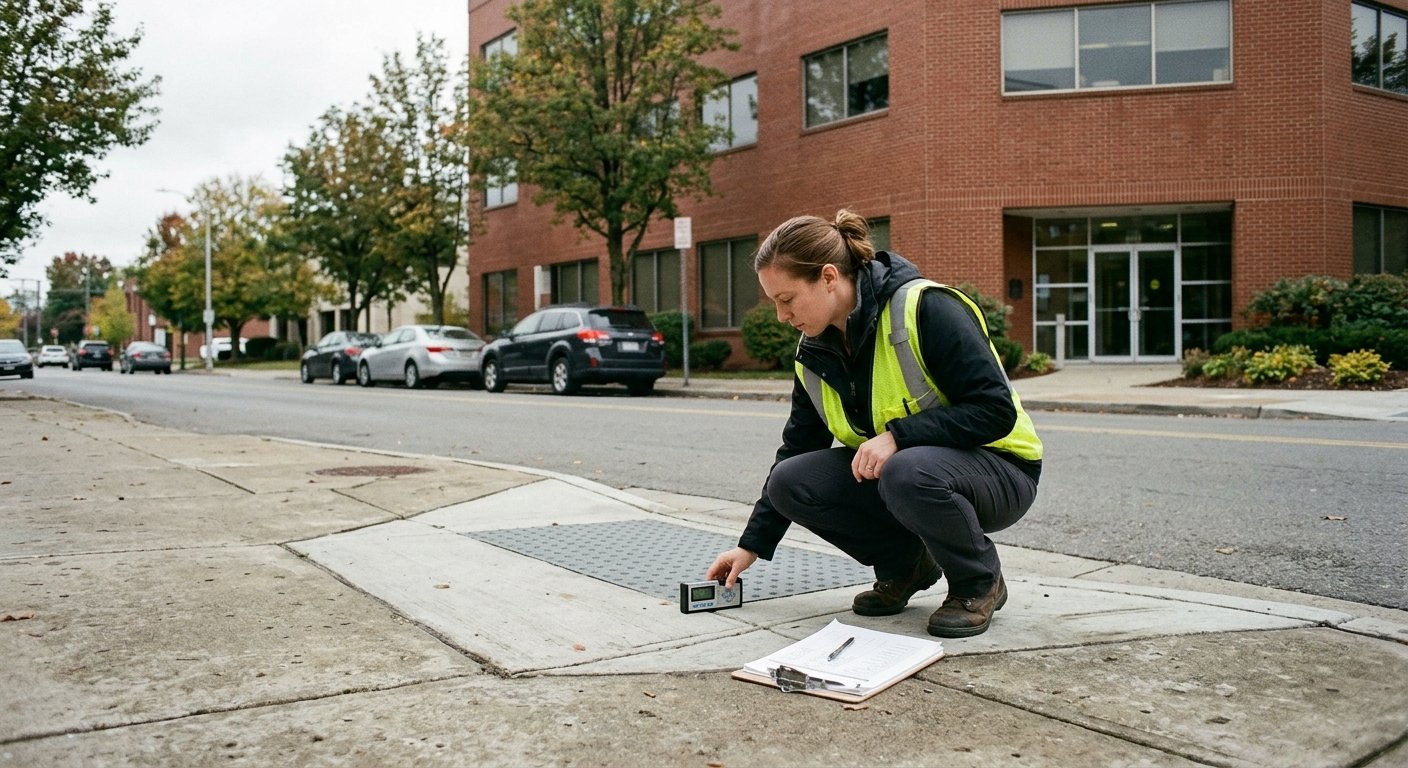
A commercial ADA sidewalk inspection is not a casual walk-through. Auditors arrive with digital slope meters, feeler gauges, and measured documentation protocols drawn directly from the U.S. Access Board’s ADA Accessibility Standards. They are looking for specific, measurable failures — not general impressions of neglect.
The primary targets during any ada sidewalk inspection fall into three categories: vertical discontinuities (trip hazards), slope deviations, and surface texture failures. Understanding each one allows property managers to audit their own properties before an official review — or before a personal injury lawsuit forces the issue.
Vertical Discontinuities
The ADA is precise: a vertical change of more than ¼ inch between adjacent concrete panels constitutes a trip hazard. Changes between ¼ inch and ½ inch must be beveled at a 1:2 slope. Anything over ½ inch must be fully remediated. Tree root heaving, freeze-thaw cycles, and soil settlement routinely create these conditions in commercial walkways throughout Northern California — sometimes within a single season.
Slope Violations
Sidewalk slope ADA requirements specify that accessible routes must have running slopes no steeper than 1:20 (5%) and cross-slopes no steeper than 1:50 (2%). Ramps are governed separately and must not exceed 1:12. Auditors flag any deviation from these thresholds as a barrier to access. Subtle cross-slopes are among the most commonly overlooked violations during self-assessments, largely because they are invisible to the naked eye but easily detected with a digital level.
Cross-slope violations are the most frequently missed issue during self-assessments. A panel that appears level can still carry a 3–4% cross-slope — enough to fail an audit and create genuine instability risk for wheelchair users.
Surface Texture and Slip Resistance
Even after a vertical differential is corrected, the repaired surface must maintain adequate slip resistance to meet OSHA standards. Grinding methods that leave a polished face can actually introduce a new compliance failure while fixing the original one. This is why the method used to correct a trip hazard matters as much as the correction itself.
The Five Steps of a Self-Audit

Before an official ada compliance sidewalk inspection occurs, facilities managers can systematically assess their own walkways. A structured walkthrough using the same tools and criteria auditors use will identify deficiencies — and allow time for cost-effective remediation rather than emergency response.
Map the accessible route
Identify every path a person using a mobility device would follow from parking areas to building entrances. Document the full route, including curb ramps, crosswalks, and transitions to interior surfaces.
Measure vertical differentials at every joint
Use a ¼ inch gauge at every panel-to-panel transition. Flag anything at or above the threshold. Photograph and document GPS coordinates or precise locations for each deficiency.
Measure running and cross-slopes
A digital slope meter or smart level app calibrated to ±0.1% accuracy is sufficient for preliminary assessment. Check each panel in both directions.
Evaluate surface condition
Look for spalling, exposed aggregate, or deterioration that could affect slip resistance. Note areas where previous grinding has created a smooth, polished finish.
Prioritize by risk and traffic volume
Not every deficiency carries equal liability. High-traffic entries, school drop-off zones, and hospital approaches warrant urgent attention. Rank your deficiency list accordingly before requesting repair estimates.
Why the Repair Method Determines Whether You Actually Pass
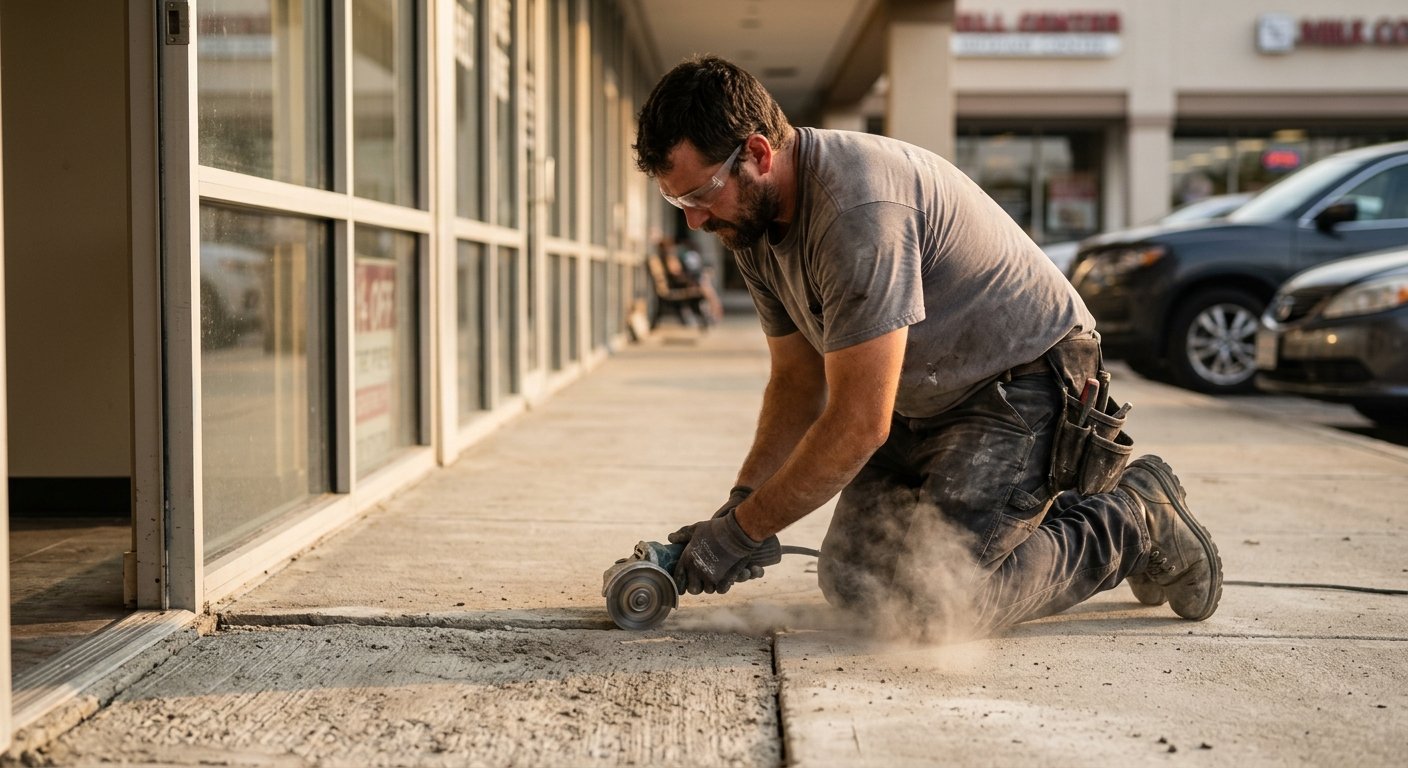
Many property managers assume that any visible correction will satisfy an auditor. This is a costly misconception. Auditors verify outcomes — not intentions. A repair that reduces a ½ inch differential to ⅜ inch still fails. A slope correction that creates a polished surface still fails on slip resistance grounds. The repair method must achieve zero differential at joints and restore ADA-compliant slopes precisely.
A repair that reduces a violation from ½ inch to ⅜ inch does not pass the audit — it just documents that work was attempted.
Traditional concrete grinding reduces the raised edge but often leaves a beveled face that catches water, deteriorates unevenly, and still falls short of zero differential. Full slab replacement achieves a clean result but at substantial cost and with significant disruption to business operations.
Precision concrete cutting — the patented method used by Precision Concrete Cutting — approaches the problem differently. Rather than grinding down the raised surface unevenly, the cutting process removes material in a controlled, calibrated manner that achieves zero differential at the joint and restores an ADA-compliant 1:12 slope transition. The result satisfies auditor measurement criteria, not just visual inspection.
| Criterion | Traditional Grinding | Precision Concrete Cutting |
|---|---|---|
| Vertical differential achieved | Reduced, not always zero | Zero differential |
| Slope compliance | Variable | ADA-compliant 1:12 slope |
| Slip resistance | Can reduce texture | OSHA-compliant surface preserved |
| Cost vs. replacement | Moderate savings | 70–90% less than replacement |
| Debris handling | Varies by contractor | Recycled — environmentally responsible |
| Disruption to operations | Moderate | Minimal; rapid completion |
Cost and Liability: The Business Case for Proactive Repair
The U.S. Department of Justice ADA enforcement program allows individuals to file complaints — and private lawsuits — against commercial property owners for accessibility barriers. In California, Unruh Civil Rights Act claims frequently accompany ADA complaints, and statutory damages can apply per visit, per violation. A single unfixed trip hazard on an accessible route can generate significant legal exposure.
Against that backdrop, sidewalk trip hazard repair is not a maintenance line item — it is a risk management strategy. The cost of correcting a panel through precision cutting is a fraction of what a single legal settlement or remediation order can demand. For school districts, municipal facilities, and commercial property owners serving the public, the calculus strongly favors proactive remediation.
The 2010 ADA Standards for Accessible Design remain the controlling federal standard for commercial sidewalk compliance. California’s building code imposes additional requirements in several categories. Property managers in Sacramento, Oakland, and Burlingame should work with contractors who understand both layers of regulation — not just federal minimums.
Schedule your self-audit after the first heavy rain of the season. Water pooling reveals cross-slope problems and surface drainage failures that are invisible during dry conditions — and that auditors will find regardless of season.
What to Expect from a Professional Inspection and Repair
When you engage a licensed and insured concrete cutting contractor for a commercial ada sidewalk compliance assessment, the process should begin with a systematic site walkthrough that documents deficiencies in writing — not just a verbal estimate. Each identified trip hazard should be measured and recorded, with photographic evidence.
Repair scopes should clearly specify the outcome standard: zero differential, ADA-compliant slope, and OSHA-compliant slip resistance. Vague language like “grinding as needed” does not guarantee a passing result. Insist on outcome-based specifications so you can verify compliance after work is completed — and so you have documentation if the audit occurs afterward.
For facilities managers overseeing large campuses or municipal infrastructure, prioritization planning matters. A phased repair schedule that addresses the highest-risk and highest-traffic areas first allows budget to be deployed efficiently while reducing overall liability exposure incrementally. Learn more about how we approach sidewalk trip hazard repair for commercial properties, or explore our detailed overview of ADA compliance sidewalk requirements and how the cutting method addresses them. For properties with complex commercial sidewalk needs, our commercial sidewalk repair resource covers the full scope of services available.
Frequently Asked Questions
What triggers an ADA sidewalk audit for commercial properties?
Audits can be triggered by a complaint filed with the Department of Justice, a private lawsuit, a tenant request, or a proactive accessibility review by a local municipality. In California, private enforcement under the Unruh Civil Rights Act also drives many compliance reviews. Any member of the public who encounters a barrier can initiate a complaint.
Can I fix uneven sidewalk panels without replacing the entire slab?
In most cases, yes. When the displacement is caused by root intrusion, soil settlement, or minor heaving, precision concrete cutting can correct the differential at the joint without slab removal. The raised panel is cut to achieve zero differential and an ADA-compliant slope. Full replacement is typically necessary only when a slab is structurally compromised or severely deteriorated.
How do slope requirements apply to existing sidewalks versus new construction?
New construction must meet full ADA slope standards from the outset. Existing sidewalks are subject to barrier removal requirements when alterations occur nearby, or when removal is “readily achievable” under ADA guidelines. In California, enforcement standards for existing facilities are actively applied, so waiting for a formal alteration project is not a reliable compliance strategy.
Does repairing a trip hazard with cutting affect the surrounding panels?
Precision concrete cutting is a localized repair that addresses only the raised edge of the offending panel. Adjacent panels are not disturbed. The cut creates a smooth, sloped transition that blends functionally with the surrounding walkway surface while meeting ADA dimensional requirements.
How long does a commercial sidewalk repair project typically take?
Most commercial trip hazard correction projects using the precision cutting method are completed in a single visit per area, with minimal disruption to pedestrian flow or business operations. Large-scale municipal or campus projects may require phased scheduling, but individual hazard corrections are typically completed rapidly compared to replacement timelines.
Ready to Prepare for Your Next ADA Audit?
Precision Concrete Cutting serves Sacramento, Oakland, and Burlingame with licensed, insured sidewalk trip hazard repair using our patented cutting method — contact us to schedule a professional site assessment before an audit finds what you haven’t.

About Precision Concrete Cutting
Precision Concrete Cutting provides ADA-compliant sidewalk repair and trip hazard correction services for property managers, municipal facilities, and commercial property owners throughout Northern California. Using a patented concrete cutting method, the company delivers cost-effective solutions that are 70-90% less expensive than replacement while achieving zero differential and ADA-compliant slopes. The approach emphasizes safety, regulatory compliance, environmental responsibility through debris recycling, and rapid completion that minimizes disruption. Visit pccnorcal.com →