
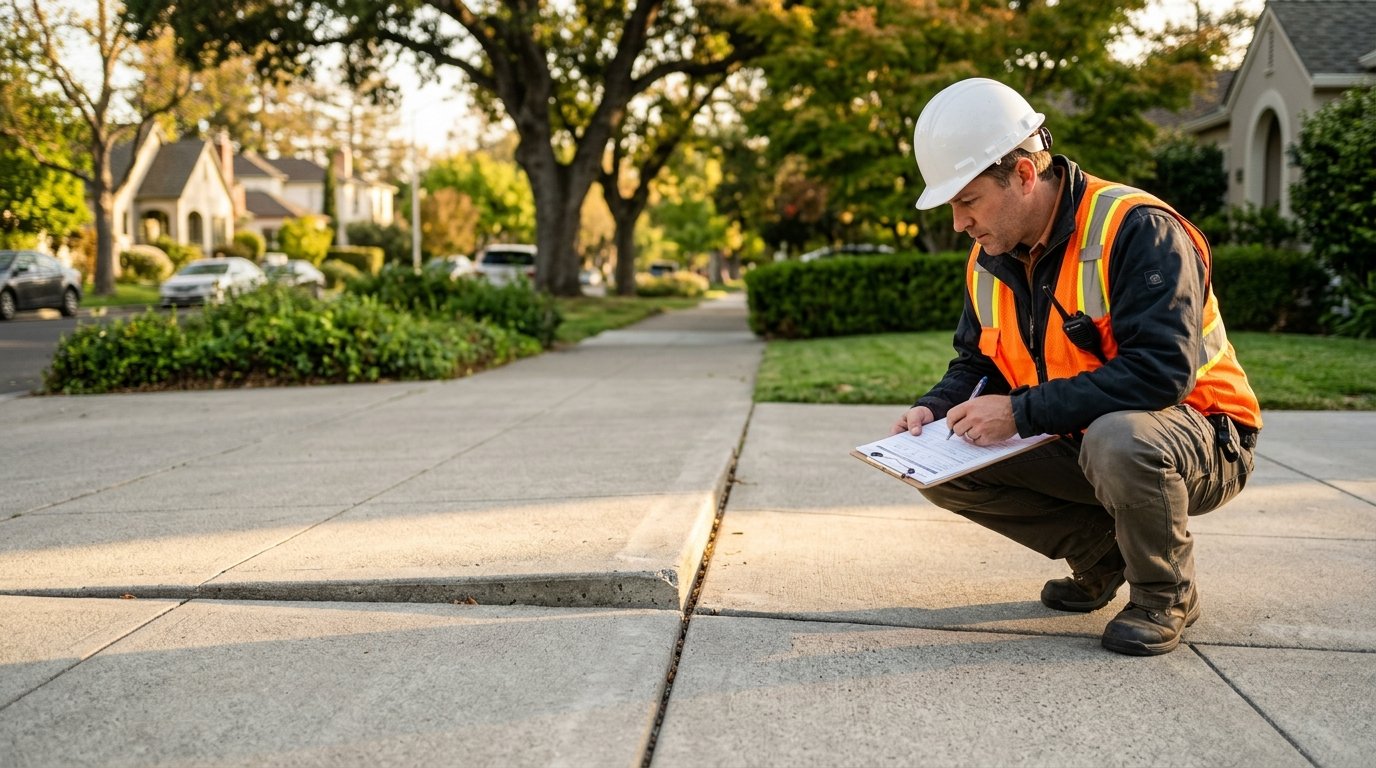
A single raised sidewalk panel — just half an inch of vertical displacement — can expose your property to a six-figure premises liability lawsuit. According to the National Safety Council, falls are the third leading cause of unintentional injury-related death in the United States, and trip hazards on walkways are among the most preventable contributors. For property managers, facilities directors, and municipal public works departments throughout Northern California, sidewalk safety isn’t just a maintenance issue — it’s a legal and financial imperative.
The good news is that modern sidewalk trip hazard repair has evolved significantly. Property owners no longer have to choose between expensive full concrete replacement or inadequate patching. A precision concrete cutting method now delivers ADA-compliant results at a fraction of traditional costs — and does it faster, cleaner, and with measurable, verifiable outcomes.
What Defines a Trip Hazard?
Under the Americans with Disabilities Act, a vertical change in a walking surface of ¼ inch or more constitutes a trip hazard. For beveled transitions, the threshold rises to ½ inch when the slope does not exceed 1:2. These aren’t arbitrary numbers — they reflect real data on what causes pedestrians, particularly those using mobility aids, to lose their footing.
The ADA regulations apply broadly to any public accommodation, commercial facility, or government entity. That means schools, hospitals, retail centers, apartment complexes, office parks, and municipal sidewalks all carry an obligation to maintain accessible, hazard-free walking surfaces. Non-compliance isn’t just a risk at the time of an accident — proactive ADA inspections and civil complaints can result in costly remediation orders even without an injury event.
Common causes of sidewalk displacement in Northern California include tree root intrusion beneath slabs, soil settling after seismic activity, drainage erosion, and the natural expansion and contraction of concrete over time. Once a panel shifts, it creates a lip that becomes progressively more dangerous with each wet season.
Why Traditional Approaches Fall Short
Full Concrete Replacement
For decades, property owners were told their only real option for serious displacement was to tear out the affected slab and pour new concrete. Replacement is disruptive, expensive, and time-consuming. It requires demolition, debris hauling, forming, pouring, curing, and lane closures that can last days or weeks. And ironically, new concrete doesn’t guarantee a smoother transition — improper forming or settling after installation can recreate the same problem within a few years.
Concrete Grinding
Surface grinding removes the raised edge by abrading the higher slab down to meet the lower one. While faster than replacement, traditional grinding creates a ramp with limitations: it removes surface material without restoring slope compliance, often leaves rough surface texture that affects slip resistance, and typically doesn’t achieve the zero-differential result required for full ADA conformance. It is also a reactive, surface-level solution that doesn’t address the geometry of the transition precisely.
The Precision Cutting Difference
Precision concrete cutting takes a fundamentally different approach. Rather than grinding down material randomly or demolishing the slab entirely, the patented cutting method creates a precisely engineered bevel or ramp across the raised panel edge. The result is a controlled transition that achieves zero differential at the joint and an ADA-compliant slope of 1:12 — the standard required for accessible ramp transitions.
This approach delivers several measurable advantages:
- ADA compliance: The 1:12 slope standard meets federal accessibility requirements, reducing exposure to ADA civil complaints and premises liability claims.
- OSHA-compliant slip resistance: The cut surface maintains appropriate texture to meet slip resistance standards, unlike overly polished grinding results.
- Speed of completion: Most repairs are completed in a single mobilization, with no curing time required — walkways are typically accessible the same day work concludes.
- Cost savings of 70–90% versus replacement: Eliminating demolition, hauling, forming, and pouring dramatically reduces both material and labor costs.
- Environmental responsibility: Concrete debris generated during cutting is collected and recycled, keeping material out of landfills and reducing the project’s environmental footprint.
For facility managers overseeing multiple properties or large campuses — such as school districts, healthcare systems, or municipal public works departments — this combination of compliance documentation, speed, and cost efficiency makes precision cutting the logical choice for scaled sidewalk repair programs.
Sidewalk Liability: What Property Owners Need to Know
In California, property owners and municipalities bear a duty of care to maintain safe walkways. When a trip hazard causes injury, plaintiffs typically argue that the property owner knew or should have known about the defect and failed to act. Courts have consistently found that even minimal displacement — ¼ inch or slightly above — can be sufficient to establish negligence when injury results.
The financial exposure from a single trip-and-fall claim can easily reach tens of thousands of dollars in medical costs, legal fees, and settlement payments, before any judgment is rendered. Documented neglect — for example, a deferred maintenance request that sat unaddressed — significantly amplifies liability exposure.
Proactive sidewalk repair reframes this equation. Rather than reacting to an incident, property owners who document regular inspections and address identified hazards can demonstrate reasonable care. That documentation — inspection records, repair dates, compliance verification — is a meaningful defense asset if a claim is ever filed. Our sidewalk trip hazard repair services include documentation suitable for compliance records.
Who Needs Sidewalk Trip Hazard Repair?
The short answer is: anyone responsible for public or semi-public pedestrian access. Specifically, in Sacramento, Oakland, and Burlingame, common clients include:
- Commercial property owners with retail tenants, parking structures, or pedestrian-facing storefronts
- Property management companies overseeing apartment complexes, HOAs, or multi-tenant commercial buildings
- School districts and university campuses with high pedestrian volume and mandatory ADA obligations
- Municipal public works departments responsible for maintaining public sidewalks and right-of-way surfaces
- Healthcare facilities serving patients with mobility limitations, where slip-and-fall risk carries acute consequences
For commercial properties specifically, our commercial sidewalk repair solutions are designed to work around business operations with minimal disruption to tenants and customers.
ADA Compliance Is Not Optional
The ADA has been federal law since 1990, and enforcement has intensified rather than eased over the decades. California’s own accessibility laws, under the California Building Code and the Unruh Civil Rights Act, in many cases impose stricter requirements and broader remedies than federal statute alone. Serial ADA litigation in California has made it particularly important for commercial property owners to conduct proactive accessibility audits of their sidewalks and common areas.
According to the U.S. Access Board, accessible routes — including sidewalks and pedestrian pathways — must be kept free of changes in level that exceed ADA thresholds. Routine maintenance doesn’t satisfy this obligation if known defects remain unaddressed. Repairs must achieve compliant geometry, not just approximate improvement.
Our ADA compliance sidewalk services are designed specifically to meet these standards with verifiable, measurable results — not estimates or approximations.
Frequently Asked Questions
What is the ADA threshold for a sidewalk trip hazard?
The ADA defines a trip hazard as any vertical change in a walking surface of ¼ inch or more. For beveled transitions with a slope no steeper than 1:2, the allowable change increases to ½ inch. Any displacement at or beyond the ¼-inch threshold creates legal exposure and accessibility barriers that must be corrected to achieve compliance.
How much does sidewalk trip hazard repair cost compared to replacement?
Precision concrete cutting typically costs 70–90% less than full slab replacement. Replacement requires demolition, debris removal, forming, pouring, and extended curing periods. Cutting eliminates most of those steps, delivering compliant results with significantly lower labor and material costs — and no disruption from multi-day closures.
Will the repaired area meet ADA slope requirements?
Yes. The patented cutting method used by Precision Concrete Cutting is engineered to achieve a 1:12 ADA-compliant slope and zero differential at the joint. This is a measurable, verifiable outcome — not an approximation — making it suitable for compliance documentation purposes.
How long does sidewalk trip hazard repair take?
Most repairs can be completed in a single mobilization. Unlike concrete replacement, there is no curing period, meaning pedestrian access is typically restored the same day work is completed. For large-scale programs covering multiple locations, phased scheduling can be arranged to minimize disruption.
Is the repaired surface safe for pedestrians in wet conditions?
The precision cutting process produces a surface texture that maintains OSHA-compliant slip resistance — an important distinction from over-polished grinding methods. The resulting surface is safe for pedestrian use in normal wet and dry conditions consistent with an outdoor concrete walkway.
Take a Proactive Approach to Sidewalk Safety
Waiting for an incident to prompt action is the most expensive approach a property owner or facilities manager can take. The cost of a single premises liability claim, combined with the reputational impact and remediation orders that follow, far exceeds what a systematic sidewalk inspection and repair program would cost.
Precision Concrete Cutting is licensed, insured, and equipped with a patented concrete cutting method that delivers ADA-compliant results across Sacramento, Oakland, and Burlingame. Whether you’re managing one building or an entire municipal sidewalk network, our team provides efficient, documented, cost-effective solutions that address trip hazards before they become liabilities.
Contact Precision Concrete Cutting today to schedule a site evaluation and get a clear picture of your property’s trip hazard exposure — and what it will cost to correct it.