
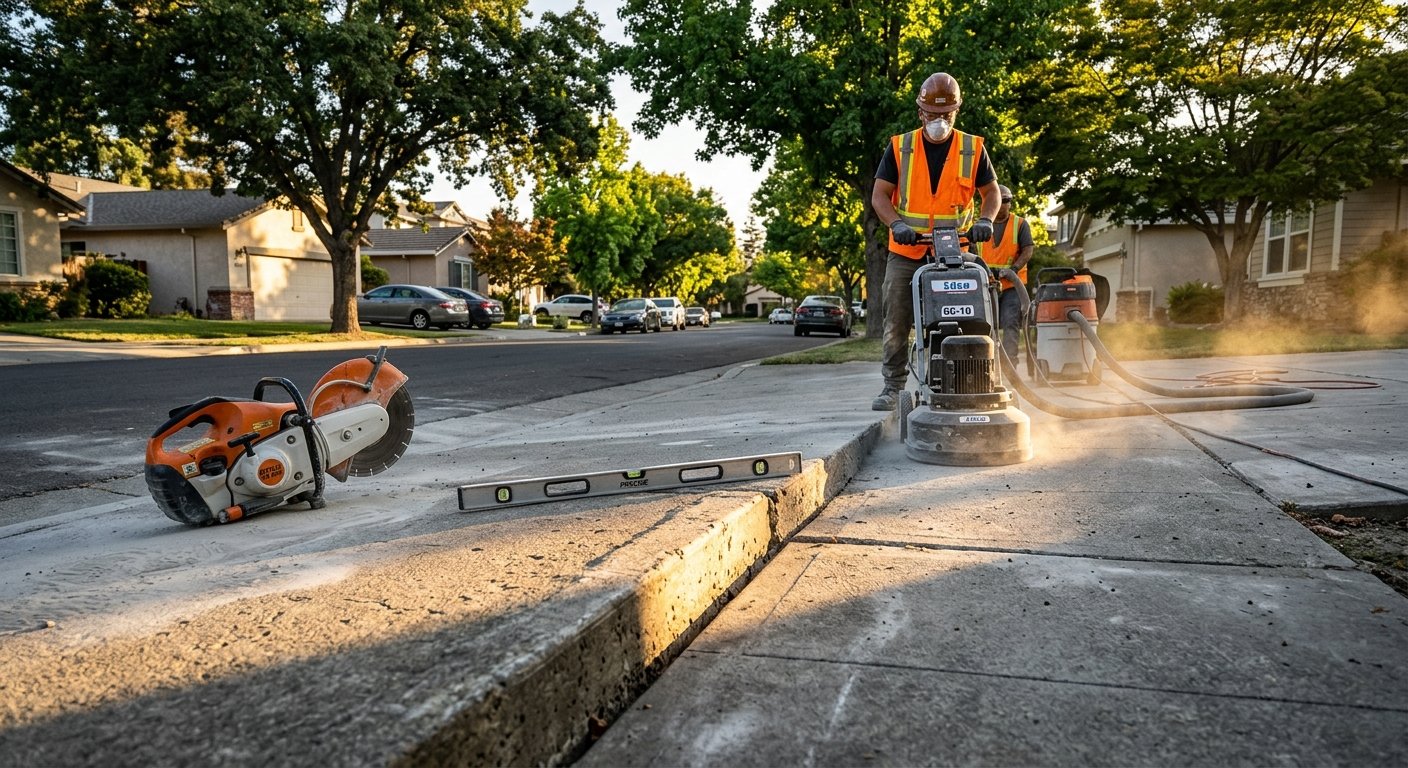
A quarter-inch. That’s all it takes. According to the Americans with Disabilities Act, a vertical change of just ¼ inch in a walking surface constitutes a trip hazard — and a potential liability. For property managers, facilities directors, and municipal public works departments across Northern California, that small measurement carries significant consequences in 2026.
Uneven sidewalks don’t develop overnight, but the risks they create are immediate. Whether caused by tree root intrusion, soil settling, freeze-thaw cycles, or years of heavy foot traffic, displaced concrete panels create dangerous conditions for pedestrians — and expensive exposure for property owners who fail to address them. This guide explains how uneven concrete sidewalk repair works, what it costs, and why the right repair method matters more than most people realize.
Why Sidewalks Become Uneven
Understanding the cause of displacement helps property managers choose the right repair approach and anticipate future maintenance needs. The most common causes of uneven sidewalks in Northern California include:
- Tree root intrusion: Roots growing beneath concrete slabs exert significant upward pressure, lifting panels and creating abrupt edges between sections.
- Soil erosion and settlement: Water movement beneath slabs removes supporting soil, causing panels to sink or tilt at irregular angles.
- Expansive clay soils: Common in Sacramento and the surrounding region, clay soils expand when wet and contract when dry, creating repetitive stress that displaces concrete over time.
- Utility work and trenching: Improperly compacted backfill after utility repairs often leads to slab settlement in the years following installation.
- Age and wear: Concrete that has served its functional lifespan develops surface deterioration, cracking, and panel separation.
Regardless of the cause, the result is the same: a vertical lip or uneven surface that creates fall risk and triggers ADA compliance concerns.
The Legal and Liability Reality in 2026
Trip-and-fall incidents remain among the most common premises liability claims filed against commercial property owners and municipalities. The Occupational Safety and Health Administration maintains walking surface standards that overlap with ADA requirements in many commercial and public access environments, reinforcing the compliance obligations facilities managers face.
Under ADA guidelines, accessible routes must maintain:
- Maximum vertical changes of ¼ inch with no bevel, or up to ½ inch with a 1:2 bevel
- Cross slopes no greater than 1:48
- Running slopes compliant with 1:20 for accessible routes (or 1:12 where ramp designation applies)
- Slip-resistant surfaces under both wet and dry conditions
For property owners in Sacramento, Oakland, and Burlingame, these standards apply to parking lots, building entrances, walkways, and public-facing sidewalks. Failing to address known hazards after reasonable notice significantly increases liability exposure. Proactive sidewalk maintenance isn’t just good property management — it’s a documented risk mitigation strategy.
Traditional Repair Methods and Their Limitations
When a trip hazard is identified, the default response from many contractors is one of two approaches: concrete grinding or full panel replacement. Both have meaningful drawbacks that property managers should understand before committing to a repair strategy.
Concrete Grinding
Grinding removes material from the raised edge of a displaced slab to reduce the height differential. While it eliminates the immediate hazard, standard grinding creates a beveled transition that may still fall outside ADA slope requirements. It also removes surface texture, potentially reducing slip resistance. Grinding is a surface-level intervention — it doesn’t address the underlying displacement and often requires repeat treatment as the slab continues to shift.
Full Concrete Replacement
Replacing a damaged or displaced panel is the most comprehensive option, but it comes at significant cost. Panel replacement requires demolition, disposal, forming, pouring, and curing — a multi-day process that disrupts pedestrian access and carries a price tag that can be 70 to 90 percent higher than precision cutting methods. For municipalities or commercial properties managing dozens of repair locations, replacement costs scale quickly and can delay necessary repairs when budgets are limited.
The Precision Cutting Method: How It Works
Precision Concrete Cutting uses a patented concrete cutting technology that delivers a fundamentally different outcome than grinding or replacement. Rather than removing surface material or demolishing slabs, the method precisely cuts a tapered section from the raised panel, creating a smooth transition that achieves zero differential and meets ADA-compliant slope requirements of 1:12.
The key advantages of this approach include:
- ADA-compliant results: The cut achieves zero vertical differential and an OSHA-compliant slip-resistant finish — not an approximation of compliance, but measurable conformance to ADA standards.
- Cost-effective repairs: Sidewalk repair cost using this method runs 70-90% less than full panel replacement, making it the most practical solution for properties managing multiple trip hazard locations.
- Speed of completion: Most repairs are completed in a single visit with minimal disruption to pedestrian traffic — a significant advantage for high-traffic commercial properties and public facilities.
- Environmental responsibility: Concrete debris generated during cutting is collected and recycled rather than sent to landfill, supporting sustainable facility management practices.
- Preservation of existing infrastructure: Because the method works with the existing slab rather than replacing it, surrounding infrastructure and landscaping are left undisturbed.
For facilities directors managing ADA compliance across large campuses or municipalities maintaining miles of public sidewalk, this combination of precision, cost efficiency, and compliance documentation represents a meaningful operational improvement over legacy repair methods. Learn more about how this approach applies to specific situations on the uneven concrete repair service page.
Identifying Trip Hazards Before They Become Claims
Proactive identification of hazards is the foundation of an effective sidewalk maintenance program. Property managers and public works departments should conduct routine visual inspections using these practical criteria:
- Any visible lip or step between adjacent concrete panels — particularly edges greater than ¼ inch
- Cracked panels with surface displacement or differential settlement
- Sidewalk sections adjacent to mature trees where root growth is likely
- Areas near utility access points where soil compaction may be incomplete
- Sections showing surface spalling, cracking, or texture loss that reduces slip resistance
When hazards are identified, documentation matters. Recording the location, measuring the differential, and initiating a repair order demonstrates reasonable care — which is directly relevant to liability defense if an incident occurs before repairs can be completed.
For a detailed look at identifying and addressing walkway hazards, the sidewalk trip hazard repair resource provides additional guidance specific to commercial and public access environments.
Repair Considerations for Commercial Properties
Commercial property owners face a distinct set of considerations beyond municipal sidewalks. Tenant lease agreements, insurance requirements, and high pedestrian volumes create compounding urgency around sidewalk condition. Shopping centers, office parks, medical campuses, and mixed-use developments in Sacramento, Oakland, and Burlingame share common exposure: high daily foot traffic across aging concrete infrastructure.
For commercial applications, the patented cutting approach offers particular value because repairs can be completed without closing tenant access, relocating displays, or disrupting loading zones for extended periods. The precision nature of the cut also means repairs integrate cleanly with the surrounding surface — an important consideration for properties where visual presentation matters alongside compliance.
The commercial sidewalk repair page outlines how this service is structured for commercial property portfolios, including HOA communities and mixed-use developments.
Frequently Asked Questions
What qualifies as a trip hazard under ADA guidelines?
Under the Americans with Disabilities Act, any vertical change greater than ¼ inch in a walking surface is considered a trip hazard. Changes between ¼ inch and ½ inch are permitted only with a 1:2 bevel. Any vertical differential exceeding ½ inch requires correction through beveling, cutting, or other compliant methods regardless of bevel angle.
How does precision concrete cutting differ from standard grinding?
Standard grinding reduces the height of a raised edge but often creates a slope that doesn’t meet ADA requirements and removes the textured surface finish that provides slip resistance. The patented cutting method removes a precisely calculated taper from the raised slab edge, achieving zero differential and a 1:12 ADA-compliant slope with a slip-resistant finish that meets OSHA standards.
What is the typical sidewalk repair cost compared to replacement?
Precision cutting-based repairs typically cost 70-90% less than full concrete panel replacement. The exact cost depends on the number of hazard locations, severity of displacement, and site conditions — but the savings relative to demolition and replacement are consistent and substantial for most properties.
How long does uneven concrete sidewalk repair take?
Most individual trip hazard corrections are completed within a single visit, with minimal disruption to pedestrian traffic. Properties with multiple hazard locations across a larger footprint can typically be addressed in a sequenced schedule that keeps access disruption to a minimum.
Are the repairs environmentally responsible?
Yes. Concrete debris produced during the cutting process is collected on-site and recycled rather than sent to a landfill. This aligns with sustainability goals maintained by many commercial properties, municipalities, and institutional facilities.
Take the Next Step Toward Compliant, Safer Sidewalks
Uneven sidewalks are a manageable problem — but only when addressed with the right method. Precision Concrete Cutting serves property managers, public works departments, and commercial property owners across Sacramento, Oakland, and Burlingame with a licensed, insured, and patented approach to trip hazard elimination that delivers ADA-compliant results at a fraction of replacement cost.
If your property has identified trip hazards, scheduled a facility inspection, or received a compliance notice, the next step is a professional assessment. Contact Precision Concrete Cutting to schedule an evaluation and receive a detailed repair plan that addresses your specific hazard locations, budget, and compliance requirements.