
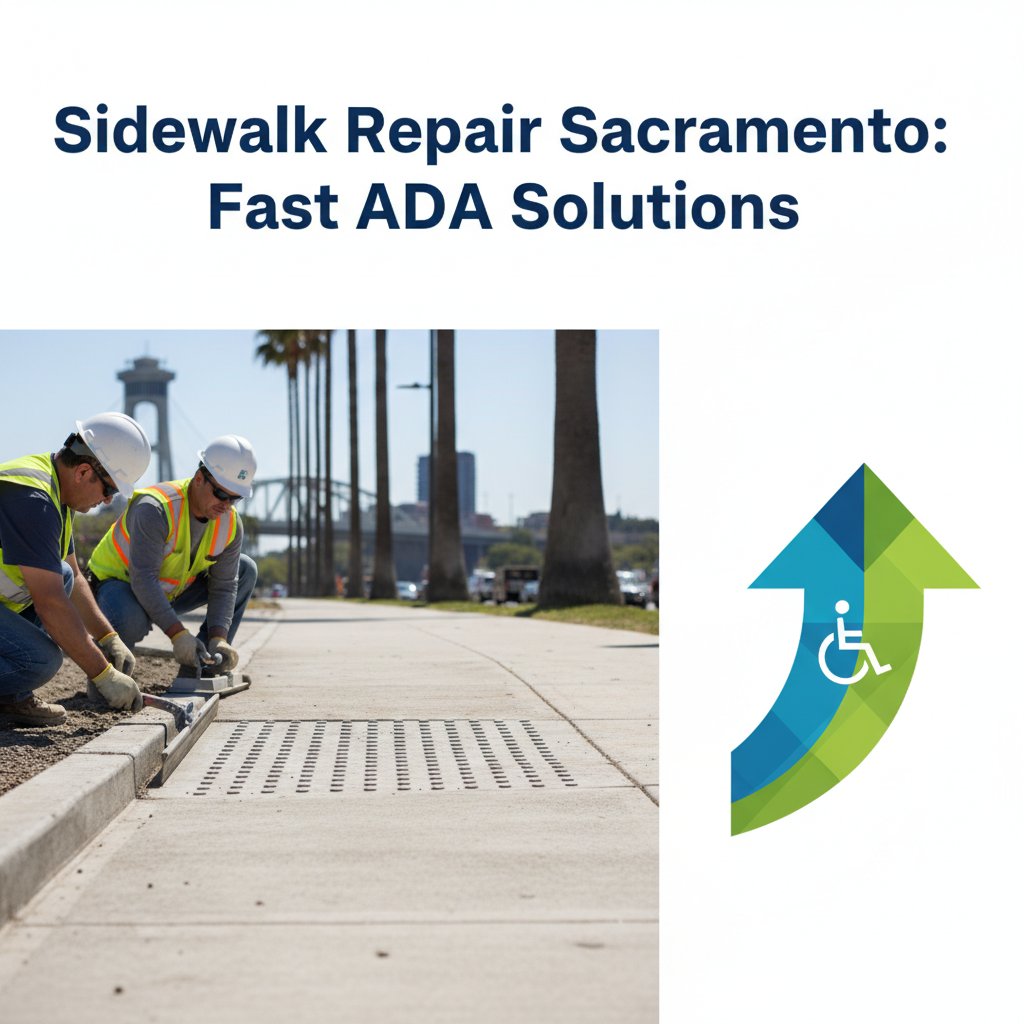
Sacramento property managers face a persistent challenge: concrete sidewalks that develop trip hazards over time due to soil settlement, tree root intrusion, and California’s unique soil conditions. With the Americans with Disabilities Act strictly enforcing a maximum vertical displacement of ¼ inch, even minor sidewalk lifting creates immediate compliance issues and significant liability exposure. Understanding modern repair options can save Sacramento property owners thousands while ensuring pedestrian safety.
Understanding Sacramento’s Sidewalk Trip Hazard Problem
Northern California’s expansive clay soils create unique challenges for concrete walkways. During dry periods, soil contracts and pulls away from foundations. When winter rains arrive, soil expands unevenly, causing concrete panels to shift at different rates. This cyclical movement creates the uneven surfaces that plague Sacramento sidewalks.
Tree roots compound the issue. Sacramento’s urban canopy, while beautiful, generates substantial root systems that migrate toward irrigation sources beneath sidewalks. As roots expand, they exert tremendous upward force, lifting concrete panels and creating dangerous elevation changes.
These conditions aren’t merely aesthetic concerns. Property owners carry legal responsibility for maintaining safe pedestrian pathways. When someone trips and sustains injury on your sidewalk, liability extends beyond just the injured party—workers’ compensation claims, ADA violation penalties, and premises liability lawsuits can result in substantial financial consequences.
ADA Compliance Requirements for Sacramento Sidewalks
The ADA establishes clear thresholds for acceptable sidewalk conditions. Any vertical displacement exceeding ¼ inch constitutes a trip hazard requiring immediate remediation. This measurement applies to all transitions between concrete panels, asphalt-to-concrete interfaces, and any surface irregularities within pedestrian pathways.
Beyond trip hazards, ADA regulations specify slope requirements for accessibility. Ramps and transitions must maintain a maximum slope ratio of 1:12, meaning one inch of rise for every twelve inches of horizontal distance. Steeper slopes fail compliance standards and prevent wheelchair users from safely navigating walkways.
Sacramento municipal codes align with federal ADA standards, placing maintenance responsibility squarely on property owners. Commercial properties, multifamily housing complexes, schools, and public facilities face particular scrutiny during inspections. Violations trigger correction orders with strict timelines, and failure to comply results in daily fines until remediation occurs.
Traditional Sidewalk Repair Methods and Their Limitations
Complete Replacement Approach
Conventional sidewalk repair typically involves demolishing affected panels and pouring new concrete. This method certainly eliminates trip hazards, but comes with substantial drawbacks for Sacramento property managers.
Replacement costs range from $8 to $15 per square foot in the Sacramento region as of 2026, depending on site access and concrete specifications. A typical 100-square-foot section costs $800 to $1,500 for materials and labor alone. Add excavation, hauling, disposal fees, and extended cure times, and costs escalate rapidly.
Timeline represents another critical concern. Concrete requires 7-14 days to cure sufficiently for pedestrian traffic, and 28 days for full strength development. During this period, property owners must maintain barriers, redirect foot traffic, and manage accessibility challenges. For commercial properties, this disruption affects customer access and potentially revenues.
Environmental impact deserves consideration. Concrete disposal contributes to landfill waste, while new concrete production generates substantial carbon emissions. Sacramento’s sustainability initiatives increasingly emphasize waste reduction, making demolition-heavy approaches less attractive.
Concrete Grinding Limitations
Grinding represents a less invasive alternative where machines shave down elevated panels to match adjacent surfaces. While faster and cheaper than replacement, grinding creates its own problems.
The process removes surface material, thinning concrete panels and potentially compromising structural integrity. More significantly, grinding often produces sloped transitions that violate OSHA slip resistance standards. These beveled edges become hazardous when wet, creating different safety concerns than the original trip hazard.
Grinding also generates substantial dust, requiring containment measures and creating cleanup challenges. The resulting surface lacks the finished appearance of original concrete, leaving visible degradation that impacts property aesthetics.
Precision Concrete Cutting: The Superior Solution for Sacramento
Advanced precision concrete cutting technology addresses Sacramento sidewalk repair with remarkable efficiency. This patented method removes specific sections from elevated panels, allowing them to settle into proper alignment with adjacent surfaces.
The process begins with precise measurement and marking. Technicians identify exact elevation differentials and calculate optimal cut locations. Specialized equipment then makes surgical cuts through concrete panels at predetermined locations and depths.
Once cuts are complete, controlled pressure settles the panel sections into correct position. The result achieves zero vertical differential—completely eliminating trip hazards rather than simply reducing them. This precision ensures full ADA compliance with no transition exceeding the ¼ inch threshold.
ADA Compliant Slope Achievement
Unlike grinding that creates beveled transitions, precision cutting maintains proper surface geometry. When slope transitions are necessary, the method achieves exact 1:12 ratios required for ADA compliance. This mathematical precision proves impossible with grinding techniques that rely on operator judgment and equipment limitations.
Surface slip resistance remains intact because the cutting method preserves original concrete finish. No material removal from the walking surface means OSHA-compliant traction characteristics continue protecting pedestrians in all weather conditions.
Cost Analysis: Cutting Versus Replacement in Sacramento
Financial considerations drive most maintenance decisions, and precision concrete cutting delivers compelling savings for Sacramento property managers.
The cutting method typically costs 70-90% less than complete replacement. Where replacement might cost $1,200 for a 100-square-foot section, cutting accomplishes the same safety outcome for $120-$360. This dramatic cost difference stems from eliminated demolition, reduced labor hours, zero material costs, and no disposal fees.
For properties managing multiple trip hazards across extensive walkways, these savings multiply substantially. A commercial property with twenty problematic panels might face $24,000 in replacement costs versus $2,400-$7,200 for cutting repairs—a difference that significantly impacts annual maintenance budgets.
Speed represents another cost factor. Precision cutting completes most repairs in hours rather than weeks. Immediate pedestrian access eliminates disruption costs, barrier expenses, and liability exposure during extended repair periods. Property managers avoid the soft costs associated with redirected traffic, customer inconvenience, and accessibility complaints.
Environmental Benefits for Sacramento Properties
Sacramento’s commitment to sustainability makes environmental impact a relevant consideration for property managers and municipal facilities.
Precision cutting generates minimal waste. Small concrete sections removed during the process are recycled rather than landfilled, supporting circular economy principles. No new concrete production means zero emissions associated with cement manufacturing—a substantial environmental advantage given concrete’s significant carbon footprint.
The method eliminates heavy equipment requirements beyond specialized cutting tools. No excavators, concrete trucks, or extensive machinery means reduced fuel consumption and site disturbance. For properties pursuing green building certifications or sustainability reporting, these environmental benefits provide measurable impact.
Proactive Sidewalk Maintenance Strategies
Addressing trip hazards reactively—after injuries occur or violations are cited—costs more than preventive maintenance programs. Sacramento property managers benefit from systematic sidewalk assessment protocols.
Annual inspections identify emerging issues before they escalate. Walking entire pedestrian networks with measurement tools flags panels approaching the ¼ inch threshold. Early intervention prevents minor settling from becoming major hazards requiring extensive repair.
Tree root management complements concrete maintenance. Strategic root pruning and installation of root barriers prevent future lifting. When combined with precision cutting to address existing elevation changes, this integrated approach provides long-term sidewalk stability.
Documentation protects against liability claims. Maintaining inspection records, repair histories, and photographic evidence demonstrates good-faith efforts to maintain safe conditions. Should incidents occur despite maintenance efforts, this documentation provides crucial legal protection.
Selecting Qualified Sacramento Sidewalk Repair Providers
Not all concrete contractors offer precision cutting capabilities. This specialized technique requires specific equipment and technical expertise that traditional concrete companies may lack.
When evaluating providers, verify their experience with ADA compliance requirements. Contractors should demonstrate knowledge of slope ratios, vertical displacement thresholds, and accessibility standards beyond basic concrete work.
Request references from similar properties. A contractor experienced with commercial complexes understands different requirements than residential specialists. Municipal facility experience indicates familiarity with public sector compliance standards and documentation needs.
Insurance coverage deserves verification. Adequate liability protection and workers’ compensation insurance protect property owners from contractor-related incidents during repair work.
Frequently Asked Questions About Sacramento Sidewalk Repair
How quickly can trip hazards be repaired using precision cutting?
Most precision cutting repairs complete within 2-4 hours for typical residential or commercial applications. Sidewalks are immediately available for pedestrian traffic following completion, eliminating extended closure periods required by replacement methods.
Does cutting weaken the concrete panel?
Strategic cuts made by experienced technicians do not compromise structural integrity. The method removes minimal material from non-critical areas while maintaining panel strength for normal pedestrian and maintenance vehicle loads.
What causes Sacramento sidewalks to develop trip hazards?
Clay soil expansion and contraction, tree root growth, inadequate base preparation, and differential settling from irrigation or drainage issues all contribute to uneven concrete panels throughout Northern California.
Is precision cutting suitable for all trip hazard situations?
Most elevation differentials respond well to cutting techniques. Severely damaged concrete with structural cracks, spalling, or deterioration may require replacement. Professional assessment determines the appropriate repair method for specific conditions.
Take Action to Eliminate Sidewalk Liability
Sacramento property managers cannot afford to ignore sidewalk trip hazards. Between ADA compliance requirements, premises liability exposure, and duty-of-care obligations to pedestrians, uneven concrete represents an unacceptable risk.
Precision concrete cutting provides the logical solution—eliminating trip hazards completely while preserving budgets and minimizing disruption. The technology delivers ADA-compliant results at a fraction of replacement costs, with immediate pedestrian access and superior environmental profile.
Schedule a professional sidewalk assessment to identify current trip hazards and develop a remediation plan. Proactive maintenance protects pedestrians, demonstrates regulatory compliance, and prevents the substantial costs associated with injury claims or violation penalties. Your sidewalk safety solution is available now, delivering the fast, affordable, compliant results your Sacramento property requires.