
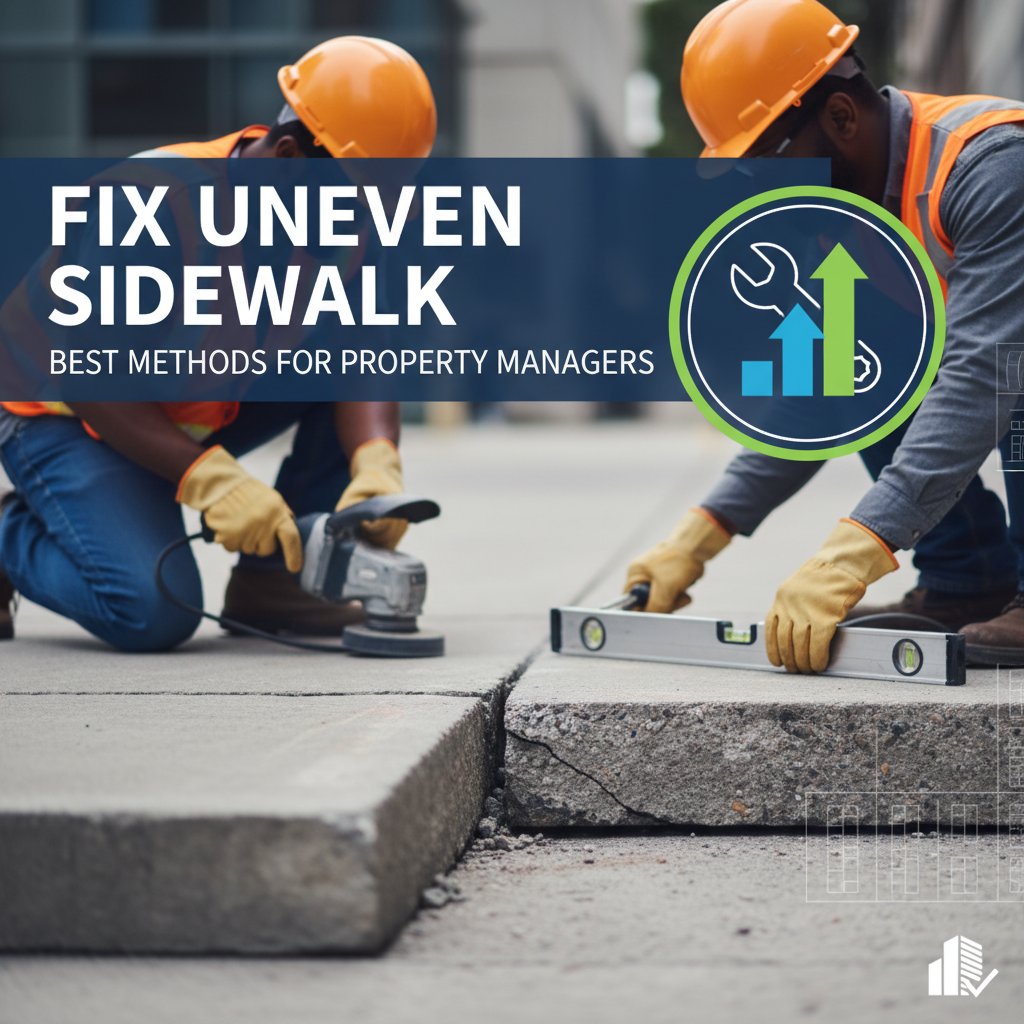
Uneven sidewalks represent one of the most common liability exposures facing property managers today. According to the National Floor Safety Institute, falls account for over 8 million emergency room visits annually, with uneven walking surfaces being a leading cause. For property managers responsible for maintaining safe premises, understanding how to fix uneven sidewalk sections efficiently and cost-effectively isn’t just about aesthetics—it’s about protecting people and minimizing legal risk.
When concrete sidewalk panels settle, heave, or develop lips between sections, they create trip hazards that can result in serious injuries and costly lawsuits. The Americans with Disabilities Act (ADA) establishes clear standards: any vertical displacement exceeding ¼ inch constitutes a trip hazard requiring remediation. Property managers face a critical decision when these issues arise: which repair method delivers the best combination of safety, compliance, durability, and cost-effectiveness?
Understanding Why Sidewalks Become Uneven
Before exploring repair solutions, understanding the root causes helps property managers make informed decisions about uneven concrete sidewalk repair. Soil erosion beneath concrete slabs is the primary culprit, caused by water infiltration, poor drainage, or natural settlement. Tree roots frequently push sections upward, creating dangerous height differentials. Freeze-thaw cycles in certain climates compound these issues by expanding and contracting the ground beneath walkways.
The problem rarely resolves itself. Once a sidewalk becomes uneven, the issue typically worsens over time as water continues eroding supporting soil and foot traffic accelerates deterioration. Proactive maintenance prevents minor issues from becoming major hazards requiring more expensive interventions.
Traditional Repair Methods: Limitations and Costs
Complete Sidewalk Replacement
Full replacement involves demolishing affected sections and pouring new concrete. While this creates brand-new surfaces, the approach carries significant disadvantages for property managers working within budget constraints.
Uneven sidewalk repair cost for complete replacement typically ranges from $8 to $15 per square foot, depending on regional labor rates and site accessibility. A 100-square-foot section could cost $800 to $1,500 or more. Additional expenses include debris removal, disposal fees, and extended closure periods disrupting normal property operations.
Replacement projects require 3-7 days for curing before the sidewalk becomes usable again. This extended downtime creates inconvenience for tenants, visitors, and pedestrians, potentially impacting property operations and tenant satisfaction. The process also generates substantial waste—approximately 2.5 tons of concrete debris per 100 square feet—creating environmental concerns and disposal challenges.
Traditional Concrete Grinding
Conventional concrete sidewalk grinding reduces the height of raised sections using diamond-tipped equipment. This method addresses vertical displacement more affordably than replacement, typically costing $3 to $7 per square foot.
However, traditional grinding creates several problems. The process generates significant airborne silica dust, posing health risks requiring extensive containment measures and cleanup. Ground surfaces often become smooth and slippery, potentially failing to meet OSHA slip resistance standards that require a coefficient of friction of at least 0.5 for walking surfaces.
More critically, traditional grinding only removes height—it doesn’t create ADA-compliant transition slopes. The resulting surface may still present accessibility barriers, leaving property managers with compliance concerns despite the expense.
The Advanced Solution: Precision Cutting Technology
A patented cutting method has emerged as the superior approach to sidewalk concrete leveling, addressing the shortcomings of traditional methods while delivering exceptional results. This technique uses specialized diamond-blade equipment to precisely remove material and create perfectly beveled transitions between uneven sections.
How the Cutting Method Works
The process begins with a thorough assessment of vertical displacement across affected areas. Technicians then use precision cutting equipment to remove material from raised sections, creating smooth transitions that eliminate trip hazards entirely—achieving zero differential between panels.
Unlike grinding that simply reduces height, this method engineers specific slope angles. For ADA compliance, transitions follow the required 1:12 ratio (one inch of rise per twelve inches of run), ensuring wheelchair users, individuals with mobility devices, and pedestrians can traverse the surface safely.
The cutting process also incorporates texturing that maintains OSHA-compliant slip resistance, addressing both trip hazards and slip risks simultaneously. This comprehensive approach delivers surfaces that meet multiple safety standards in a single application.
Cost Advantages That Impact Your Bottom Line
Property managers consistently cite budget constraints as their primary maintenance challenge. The cutting method delivers dramatic cost savings compared to replacement—typically 70-90% less expensive.
Where replacement might cost $1,200 for a 100-square-foot section, the cutting method typically ranges from $120 to $360 for the same area. For properties with extensive sidewalk systems, these savings multiply quickly. A property with 1,000 square feet of uneven sidewalk could save $9,000 or more by choosing cutting over replacement.
The speed advantage compounds financial benefits. Most cutting projects complete in hours rather than days, with surfaces immediately usable after work finishes. No curing time means no extended closures, maintaining normal property operations and avoiding tenant complaints or revenue impacts.
Environmental Responsibility and Sustainability
As corporate sustainability initiatives gain importance in 2026, the environmental profile of maintenance decisions matters increasingly to property managers, ownership groups, and tenants alike.
The cutting method produces minimal waste—only the thin layer of removed concrete, typically measured in pounds rather than tons. Responsible contractors recycle this debris, diverting it from landfills and supporting circular economy principles.
By preserving existing concrete rather than demolishing and replacing it, this approach avoids the substantial carbon footprint associated with new concrete production. Cement manufacturing contributes approximately 8% of global CO2 emissions, making concrete preservation a meaningful sustainability action.
Properties pursuing LEED certification, Green Globes, or other sustainability frameworks can document these environmental benefits, potentially contributing to certification credits related to waste reduction and materials conservation.
ADA Compliance: Non-Negotiable for Property Managers
The ADA establishes clear accessibility requirements for public accommodations and commercial properties. Understanding these standards is essential for property managers seeking to fix uneven sidewalk sections in compliance with federal law.
Any vertical change exceeding ¼ inch requires remediation. Simply ignoring minor lips and height differences isn’t an option—it’s a violation that exposes property owners to complaints, lawsuits, and potential penalties.
When remediation is necessary, the solution must create compliant transitions. The 1:12 slope ratio represents the maximum grade for accessible routes without requiring handrails. Steeper transitions create accessibility barriers that violate ADA requirements even if they eliminate the original trip hazard.
The precision cutting method explicitly engineers these compliant slopes, providing property managers with documented ADA conformance. This compliance isn’t just about avoiding penalties—it’s about ensuring all individuals can access and use your property safely and independently.
Liability Reduction and Risk Management
Premises liability claims related to trip-and-fall incidents can result in substantial settlements and judgments. Beyond direct costs, these incidents damage reputation, increase insurance premiums, and consume management time in litigation.
Property managers have a duty to maintain reasonably safe conditions and address known hazards within reasonable timeframes. Once you’re aware of an uneven sidewalk, documenting and remedying it becomes a risk management priority.
The ¼ inch ADA threshold provides clear guidance: anything exceeding this measurement requires action. Regular sidewalk inspections identifying and documenting these conditions—followed by prompt remediation—demonstrate the reasonable care that protects against negligence claims.
The cutting method’s ability to eliminate height differentials entirely (achieving zero differential) provides the maximum safety benefit, effectively removing the hazard rather than simply reducing it. This complete remediation offers stronger liability protection than partial solutions.
Choosing the Right Contractor for Sidewalk Leveling
The quality of uneven concrete sidewalk repair depends heavily on contractor expertise and equipment. Property managers should evaluate several factors when selecting a service provider.
Look for contractors with specialized equipment designed specifically for precision concrete cutting and leveling. Generic grinding equipment cannot achieve the same results as purpose-built cutting systems.
Verify that contractors understand ADA slope requirements and OSHA slip resistance standards. The best equipment means nothing if operators don’t apply it correctly to achieve compliant results.
Request documentation of previous projects, including before-and-after measurements demonstrating eliminated height differentials and created slope ratios. Reputable contractors provide this evidence readily.
Consider the contractor’s dust control and cleanup procedures. Even advanced cutting methods produce some debris, but professional operators contain and remove it thoroughly, leaving properties clean and ready for immediate use.
Long-Term Maintenance Strategies
Fixing existing problems represents just one component of effective sidewalk management. Property managers benefit from implementing proactive maintenance programs that identify and address issues before they become serious hazards.
Schedule annual sidewalk inspections, documenting conditions with photos and measurements. This creates baseline data for tracking changes and provides evidence of reasonable maintenance practices.
Address drainage issues that contribute to soil erosion beneath concrete. Proper water management prevents many settling problems before they create uneven surfaces.
Consider tree root management in landscaped areas adjacent to sidewalks. Root barriers installed during landscaping projects prevent future heaving, though existing root intrusion may require more immediate solutions.
Budget for preventive maintenance rather than waiting for emergency repairs. Addressing minor settlement early costs less than remedying severe displacement later, and demonstrates the proactive risk management that insurers and property owners value.
Taking Action on Sidewalk Safety
Uneven sidewalks present clear risks that property managers cannot afford to ignore. The combination of liability exposure, ADA compliance requirements, and duty-of-care obligations makes prompt remediation essential when trip hazards exist.
The cutting method offers property managers an optimal solution: dramatic cost savings compared to replacement, immediate usability without curing delays, environmental responsibility through waste reduction, and superior results including ADA-compliant slopes and zero height differential.
For properties with uneven concrete sidewalks, the question isn’t whether to fix them—it’s which method delivers the best value while ensuring safety and compliance. The evidence clearly favors precision cutting technology over traditional grinding or expensive replacement.
Evaluate your property’s sidewalks today. Identify sections with vertical displacement exceeding ¼ inch, document their locations and measurements, and consult with qualified contractors specializing in advanced cutting methods. Your tenants, visitors, and bottom line will all benefit from choosing the most effective solution to fix uneven sidewalk hazards permanently.