
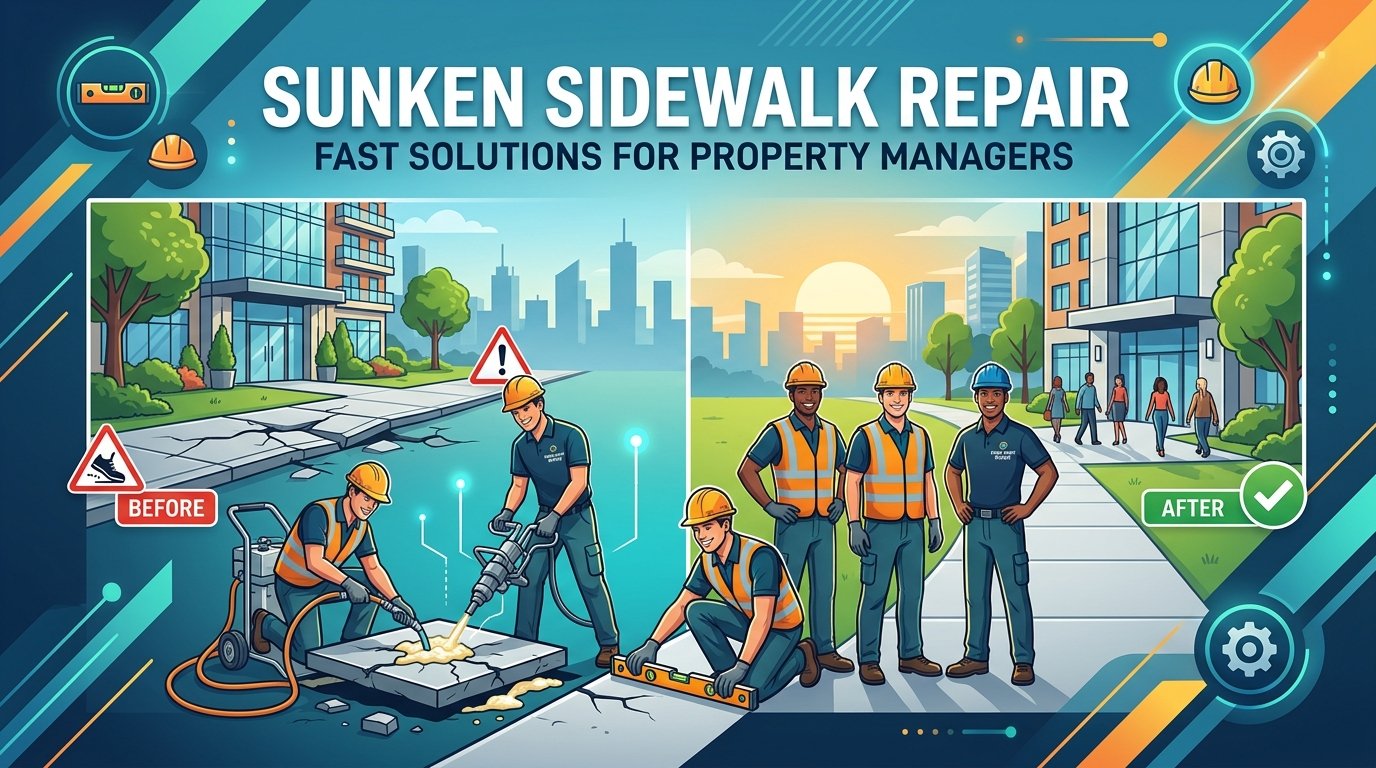
A sunken sidewalk presents more than just an eyesore—it creates a serious liability risk that can cost property managers thousands in legal settlements. When concrete slabs settle and create vertical height differences, they become trip hazards that violate ADA regulations and expose property owners to significant legal exposure. According to the ADA, any vertical displacement exceeding ¼ inch constitutes a trip hazard requiring immediate remediation.
Property managers face a critical challenge: addressing these hazards quickly and cost-effectively while maintaining full regulatory compliance. Traditional repair methods like complete replacement can shut down walkways for days and drain maintenance budgets. Fortunately, modern concrete settlement repair techniques offer faster, more economical solutions that restore safety without the disruption.
Understanding Why Sidewalks Sink
Concrete settlement repair begins with understanding the root cause. Sidewalk slabs don’t fail—the soil beneath them does. Several factors contribute to concrete settlement:
- Soil erosion: Water runoff gradually washes away supporting soil underneath slabs
- Soil compaction: Poorly compacted fill soil during initial construction continues settling over time
- Expansive clay: Certain soil types expand when wet and contract when dry, creating voids
- Tree root interference: Growing roots can displace soil and shift concrete sections
- Drainage issues: Improper grading directs water underneath slabs, accelerating erosion
For property managers overseeing commercial properties, school campuses, or municipal facilities, these issues compound over time. What starts as a minor settling problem becomes a documented hazard requiring immediate attention once it exceeds regulatory thresholds.
The High Cost of Ignoring Sunken Concrete
Postponing sunken sidewalk repair carries substantial financial risk. Trip-and-fall accidents account for millions in annual settlement costs across commercial properties. When an incident occurs on a documented hazard, property owners face difficult liability arguments.
Beyond legal exposure, there are regulatory compliance concerns. The Americans with Disabilities Act mandates accessible routes of travel throughout commercial properties and public spaces. Sunken slabs that create vertical height differences violate these requirements, exposing properties to ADA complaints and potential Justice Department enforcement actions.
Insurance implications also matter. Some commercial liability policies require proactive hazard mitigation. Documented hazards left unaddressed can complicate claims or affect coverage terms during policy renewals.
Traditional Repair Methods: Limitations for Property Managers
When facing concrete settlement issues, property managers have historically considered two primary options: complete replacement or mud jacking (also called slab jacking).
Complete Sidewalk Replacement
Total replacement involves demolishing existing concrete, re-excavating, and pouring new slabs. While this addresses underlying soil issues, it presents significant drawbacks:
- Extended timeline of 5-7 days including cure time before the walkway reopens
- Substantial costs ranging from $8-15 per square foot
- Major disruption to pedestrian traffic and business operations
- Hauling and disposal fees for demolished concrete
- Environmental impact from new concrete production and waste generation
For property managers overseeing active commercial facilities, multi-day closures create serious operational challenges and tenant complaints.
Mud Jacking or Slab Jacking
This traditional leveling method pumps a slurry mixture underneath settled slabs to raise them back to grade. While faster than replacement, mud jacking has limitations:
- Limited precision makes achieving exact zero-differential challenging
- Heavy slurry adds weight to already compromised soil
- Large injection holes (1.5-2 inches) remain visible after repair
- Cannot address severe settling or create compliant ADA slopes
- Material can wash away if drainage issues aren’t resolved
Many property managers discover that mud jacking provides temporary relief but doesn’t deliver the permanent, ADA-compliant results they need.
Advanced Concrete Leveling Repair: The Cutting Method
A patented concrete cutting approach offers property managers a superior alternative that addresses sunken sidewalk repair challenges with unprecedented precision and speed. This method doesn’t lift settled concrete—it strategically removes material from higher sections to create smooth, compliant transitions.
How Sidewalk Concrete Cutting Works
The process uses specialized diamond-blade equipment to precisely cut and remove concrete material from raised slabs adjacent to settled sections. Rather than attempting to lift sunken areas, the technique reduces height differentials by carefully profiling the higher surface.
This approach creates perfectly sloped transitions that meet ADA requirements of 1:12 (one inch of rise per twelve inches of run) while achieving absolute zero differential at transition points. The result eliminates trip hazards completely while maintaining OSHA-compliant slip resistance through controlled surface profiling.
Advantages Over Traditional Methods
For property managers evaluating repair options, the cutting method delivers distinct operational and financial advantages:
Cost Savings: This approach costs 70-90% less than complete sidewalk replacement. A typical commercial sidewalk repair project that would cost $12,000 for replacement can be completed for $2,000-3,500 using the cutting method. For facility managers working within tight maintenance budgets, these savings are significant.
Speed and Minimal Disruption: Most commercial sidewalk repair projects finish in a single day with walkways reopening immediately after completion. There’s no cure time, no multi-day closures, and no extended disruption to tenants or visitors.
Superior ADA Compliance: The precision cutting achieves exact 1:12 slopes and zero-differential transitions that exceed ADA requirements. Property managers gain documentation of full compliance rather than approximate solutions.
Environmental Responsibility: All removed concrete debris is recycled rather than sent to landfills. No new concrete production is required, dramatically reducing the carbon footprint compared to replacement projects.
Permanent Results: Unlike leveling methods that depend on underlying soil stability, the cutting method creates permanent geometric solutions. The repair doesn’t rely on fill materials that might settle or wash away.
When to Choose Different Repair Approaches
While the cutting method solves most sunken sidewalk challenges, property managers should understand when different approaches apply:
Cutting Method is Ideal For:
- Vertical displacements from ¼ inch up to 2+ inches
- Situations requiring immediate ADA compliance
- High-traffic areas where extended closures are unacceptable
- Budget-conscious projects seeking maximum value
- Properties with ongoing operations that cannot accommodate disruption
Consider Alternatives When:
- Concrete is severely cracked or structurally compromised
- Active settling continues due to ongoing soil issues
- Slabs have settled more than 3-4 inches below grade
- Drainage problems require excavation to install proper systems
Implementing a Proactive Sidewalk Maintenance Program
Forward-thinking property managers don’t wait for complaints or incidents to address concrete settlement. A proactive approach includes:
Regular Inspections: Quarterly walkway assessments identify emerging trip hazards before they exceed regulatory thresholds. Document all observations with measurements and photographs.
Priority Classification: Categorize identified hazards by severity. Any vertical displacement exceeding ¼ inch requires immediate attention. Lesser issues can be scheduled for upcoming maintenance cycles.
Prompt Remediation: Address documented hazards quickly. The time between identification and repair creates the highest liability exposure.
Comprehensive Documentation: Maintain detailed records of all inspections, identified hazards, and completed repairs. This documentation proves proactive management if liability questions arise.
Budget Planning: Include concrete maintenance in annual capital planning. The cost-effectiveness of modern repair methods makes proactive maintenance financially viable.
Evaluating Repair Contractors for Commercial Projects
Property managers should assess potential contractors based on several critical factors:
ADA Compliance Expertise: Contractors must demonstrate thorough understanding of accessibility requirements and ability to achieve compliant slopes and transitions.
Commercial Experience: Look for proven experience with commercial properties, municipal facilities, and high-traffic environments where operational continuity matters.
Insurance and Bonding: Verify adequate general liability coverage and workers’ compensation. Request certificates of insurance before work begins.
Timeline Commitments: Confirm realistic completion schedules and verify the contractor’s capacity to minimize operational disruption.
Warranty Terms: Understand what warranties cover and for how long. Quality contractors stand behind their work.
References: Request and contact references from similar commercial or institutional properties.
ROI Considerations for Facility Directors
When presenting business trip hazard removal projects to leadership, property managers should emphasize comprehensive return on investment:
Risk Mitigation Value: A single trip-and-fall settlement can exceed $50,000. Proactive repair costs represent fraction-of-a-percent insurance against these exposures.
Regulatory Compliance: Documented ADA compliance protects against enforcement actions and complaints that can result in costly remediation orders.
Operational Continuity: Fast repair methods prevent extended closures that disrupt business operations and frustrate tenants.
Asset Preservation: Addressing settlement issues promptly prevents accelerated deterioration of adjacent slabs and reduces long-term maintenance costs.
Budget Efficiency: Modern repair methods stretch maintenance budgets further, allowing facility managers to address more issues within existing allocations.
Taking Action on Concrete Settlement Issues
Sunken sidewalk repair shouldn’t be complicated or prohibitively expensive. Modern concrete leveling repair techniques provide property managers with practical solutions that address safety concerns, achieve full ADA compliance, and preserve maintenance budgets.
The key is moving from reactive to proactive management. Rather than waiting for incidents or complaints, implement regular inspection protocols and address identified hazards promptly. The combination of systematic monitoring and cost-effective repair methods makes comprehensive trip hazard management achievable even within constrained budgets.
Don’t let sunken concrete create liability exposure for your property. Professional concrete settlement repair using advanced cutting methods delivers permanent, compliant results in a single day at a fraction of replacement costs. Contact qualified sidewalk repair specialists to assess your property’s walkways and develop a comprehensive remediation plan that protects your organization while maintaining operational continuity.