
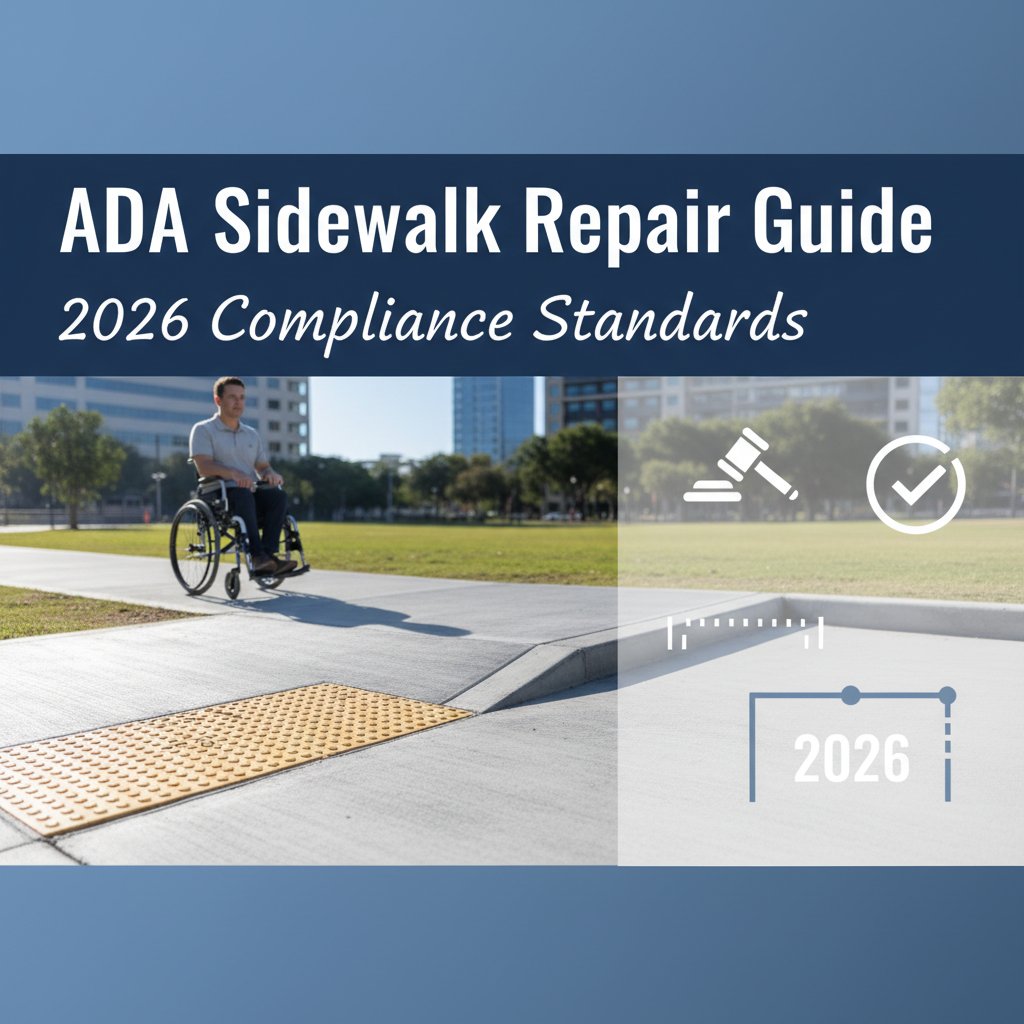
Property managers and municipal decision-makers face mounting pressure to address sidewalk accessibility as ADA enforcement intensifies in 2026. The Americans with Disabilities Act mandates that public walkways remain free of barriers that prevent access for individuals with mobility challenges, and non-compliance carries serious financial and legal consequences. Understanding handicap accessible sidewalk repair requirements isn’t just about avoiding liability—it’s about creating inclusive communities where everyone can navigate safely.
Understanding ADA Sidewalk Requirements in 2026
The ADA establishes clear standards for sidewalk accessibility that property owners and municipalities must follow. According to the ADA Accessibility Guidelines (ADAAG), any vertical change exceeding ¼ inch constitutes a trip hazard requiring immediate remediation. This seemingly small measurement has significant implications for concrete walkways throughout your property.
When vertical displacement exceeds this ¼-inch threshold, you have three options: repair the surface to meet compliance standards, install a beveled transition, or replace the affected section entirely. The choice you make directly impacts your budget, project timeline, and long-term maintenance costs.
Critical ADA Compliance Standards for Sidewalks
- Maximum Cross Slope: 2% grade (1:50 ratio) across the width of the walkway
- Maximum Running Slope: 5% grade (1:20 ratio) along the path of travel
- Minimum Clear Width: 36 inches of continuous accessible route
- Surface Requirements: Stable, firm, and slip-resistant under all conditions
- Vertical Changes: No greater than ¼ inch without remediation
- Beveled Transitions: Changes between ¼ inch and ½ inch must have a 1:2 maximum slope
These specifications aren’t suggestions—they’re federally mandated requirements backed by the Department of Justice. Facilities must demonstrate ongoing compliance, particularly for government entities, educational institutions, and commercial properties open to the public.
The Liability Reality of Non-Compliant Sidewalks
Trip-and-fall incidents represent one of the most common premises liability claims in the United States. When these accidents occur on sidewalks with documented ADA violations, property owners face significantly higher settlement costs and reduced legal defensibility. Recent court decisions have awarded plaintiffs substantial damages when properties failed to maintain ADA compliant concrete repair standards.
Beyond individual injury claims, the Department of Justice has increased enforcement actions against entities with inaccessible facilities. Civil penalties can reach $75,000 for first violations and $150,000 for subsequent violations. Many municipalities and property management companies now face Title II and Title III compliance reviews that specifically examine sidewalk conditions.
Insurance carriers have responded by scrutinizing sidewalk maintenance practices during underwriting. Properties with documented trip hazards may face higher premiums, coverage exclusions, or policy non-renewal. Proactive handicap accessible sidewalk repair demonstrates risk management that insurers value.
Traditional Repair Methods: Limitations and Costs
When addressing sidewalk ada compliance standards, property managers traditionally choose between grinding and replacement. Each method has distinct drawbacks that impact both immediate costs and long-term performance.
Concrete Grinding Limitations
Grinding involves removing material from the raised side of a displacement to create a gradual transition. While less expensive than replacement, grinding creates several problems:
- Removes the hardened surface layer, exposing weaker concrete underneath
- Creates rough textures that accelerate wear and accumulate debris
- Cannot address underlying soil settlement issues
- Often fails to achieve true zero-differential transitions
- May not meet OSHA slip-resistance requirements when wet
- Requires repeated maintenance as settlement continues
Most critically, grinding merely treats symptoms rather than addressing root causes. The soil conditions or tree root pressure that created the original displacement continue affecting the concrete, meaning the trip hazard will likely return.
Complete Replacement Costs
Full concrete replacement ensures ADA compliance but carries substantial costs. Property owners typically pay $8-15 per square foot for removal and replacement, depending on regional labor rates and concrete prices in 2026. A standard 100-square-foot section costs $800-1,500, not including additional expenses for permits, traffic control, or extended closure periods.
Replacement projects also require 3-7 days of curing time before the sidewalk can safely accommodate pedestrian traffic, creating accessibility interruptions and potential alternative route requirements under ADA standards.
The Precision Cutting Method: Advanced ADA Accessibility Sidewalk Repair
Modern precision cutting technology has transformed how forward-thinking property managers approach ada compliant concrete repair. This patented method uses specialized equipment to cut and reset displaced concrete panels to exact specifications, eliminating trip hazards while preserving the existing concrete.
The process involves creating strategic cuts around the affected panel, lifting or lowering it to match adjacent sections, and stabilizing the underlying substrate. This approach achieves true zero-differential transitions that meet or exceed ADA requirements.
Technical Advantages of Precision Cutting
The cutting method delivers measurable performance benefits:
- Perfect Zero Differential: Panels align flush with adjacent surfaces, eliminating all trip hazards
- ADA-Compliant Slopes: Achieves precise 1:12 ratios for accessibility requirements
- OSHA Slip Resistance: Maintains original surface texture and coefficient of friction
- Substrate Stabilization: Addresses underlying settlement with engineered fill materials
- Structural Preservation: Retains the hardened surface layer for maximum durability
Unlike grinding or replacement, this method solves the underlying problem while maintaining the concrete’s original strength and appearance. The result is a permanent repair that extends the service life of your sidewalk infrastructure.
Cost Analysis: Investment Comparison for 2026
Financial considerations drive most maintenance decisions, and handicap accessible sidewalk repair using precision cutting delivers substantial savings compared to traditional approaches.
The cutting method typically costs 70-90% less than complete replacement. Where replacement might cost $1,200 for a 100-square-foot section, precision cutting accomplishes the same accessibility outcome for $250-350. These savings multiply across properties with multiple trip hazards, often reducing total project costs by tens of thousands of dollars.
Consider a commercial property with 15 displaced panels requiring remediation. Replacement costs would reach $15,000-18,000, while precision cutting addresses all locations for approximately $3,500-4,500. The $11,000+ savings can fund other critical maintenance priorities or improve your facility’s financial performance.
Speed and Operational Impact
The cutting method’s efficiency creates additional value beyond direct cost savings. Most repairs complete in 2-3 hours with immediate usability—no curing time, no extended closures, no disruption to building access. This speed proves especially valuable for high-traffic locations where sidewalk closures impact business operations or create secondary ADA concerns about accessible routing.
Environmental Responsibility in Concrete Repair
Sustainability considerations increasingly influence facility management decisions. Precision cutting supports environmental objectives that many organizations have established for 2026 and beyond.
By preserving existing concrete rather than demolishing and replacing it, this method dramatically reduces construction waste. The debris generated during cutting—primarily concrete dust and small fragments—can be recycled as aggregate for other applications rather than consuming landfill capacity.
The process also eliminates the carbon footprint associated with manufacturing new concrete, one of the construction industry’s most energy-intensive products. Each square foot of preserved concrete avoids approximately 7 pounds of CO2 emissions from cement production.
For organizations tracking LEED credits, sustainability reporting metrics, or corporate environmental commitments, choosing low-impact repair methods demonstrates measurable progress toward ecological goals.
Proactive Maintenance: The Strategic Approach
The most successful property managers view ada accessibility sidewalk repair as a proactive maintenance discipline rather than reactive crisis management. Regular sidewalk inspections identify developing trip hazards before they create liability exposure or ADA violations.
Implementing a systematic assessment program provides several advantages:
- Early detection when repairs are simpler and less expensive
- Documented compliance efforts that strengthen legal defensibility
- Scheduled repairs that minimize operational disruption
- Budget predictability for capital planning
- Reduced emergency repair situations
Many facilities conduct quarterly walkway assessments using simple tools—a ¼-inch gauge and documentation forms—to identify locations requiring attention. This systematic approach ensures nothing escapes notice until it becomes a safety incident.
Frequently Asked Questions About ADA Sidewalk Compliance
What exactly qualifies as an ADA trip hazard?
Any vertical displacement exceeding ¼ inch between adjacent surfaces constitutes a trip hazard under ADA standards. This applies to concrete panels, expansion joints, utility covers, and transitions between different walking surfaces. Measurements should be taken at the most severe point of displacement.
How quickly must identified trip hazards be repaired?
The ADA doesn’t specify exact timelines, but requires prompt remediation of known barriers. Once a property owner has notice of a trip hazard—through inspection, complaint, or incident—failure to address it reasonably quickly increases liability exposure. Most risk management experts recommend remediation within 30-60 days of identification for documented hazards.
Can temporary solutions like warning signs achieve compliance?
Temporary measures like warning cones or tape don’t constitute ADA compliance and may actually increase liability by demonstrating the property owner knew about the hazard but failed to properly address it. Temporary solutions should only be used during the brief period between hazard identification and permanent repair completion.
Who is responsible for sidewalk ADA compliance?
Responsibility depends on location and ownership. Property owners typically maintain sidewalks on private property and immediately adjacent public sidewalks in many jurisdictions. Municipalities generally handle public sidewalks in rights-of-way. However, local ordinances vary significantly, so confirming specific obligations with your jurisdiction is essential.
Selecting a Qualified ADA Repair Contractor
The quality of handicap accessible sidewalk repair depends heavily on contractor expertise. When evaluating service providers, consider these qualifications:
- Specific experience with ADA compliance requirements and measurement standards
- Proven track record with precision cutting or advanced repair methodologies
- Appropriate licensing, bonding, and insurance coverage
- Understanding of local building codes and permit requirements
- Ability to provide compliance documentation for your records
- References from similar facilities or properties
Request detailed proposals that specify the repair method, expected outcomes, timeline, and warranty terms. The lowest bid isn’t always the best value if the repair method doesn’t deliver long-term ADA compliance or requires repeated maintenance.
Take Action on Sidewalk Safety and Compliance
Sidewalk accessibility isn’t optional—it’s a legal requirement and moral obligation. Every day your property maintains non-compliant walking surfaces, you face liability exposure and fail community members who depend on accessible infrastructure.
The good news is that achieving ada sidewalk requirements doesn’t require budget-breaking replacement projects. Modern precision cutting technology delivers superior results at a fraction of traditional costs while supporting your environmental objectives and minimizing operational disruption.
Start by conducting a thorough sidewalk assessment to identify current compliance gaps. Document each location requiring attention with photographs and measurements. Then consult with qualified contractors who specialize in cost-effective, compliant repair solutions that address both immediate hazards and underlying causes.
Your commitment to accessible, safe walkways protects people, reduces risk, and demonstrates the inclusive values that define responsible property stewardship in 2026. The question isn’t whether to address sidewalk accessibility—it’s which repair method will deliver the best long-term value for your specific situation.