
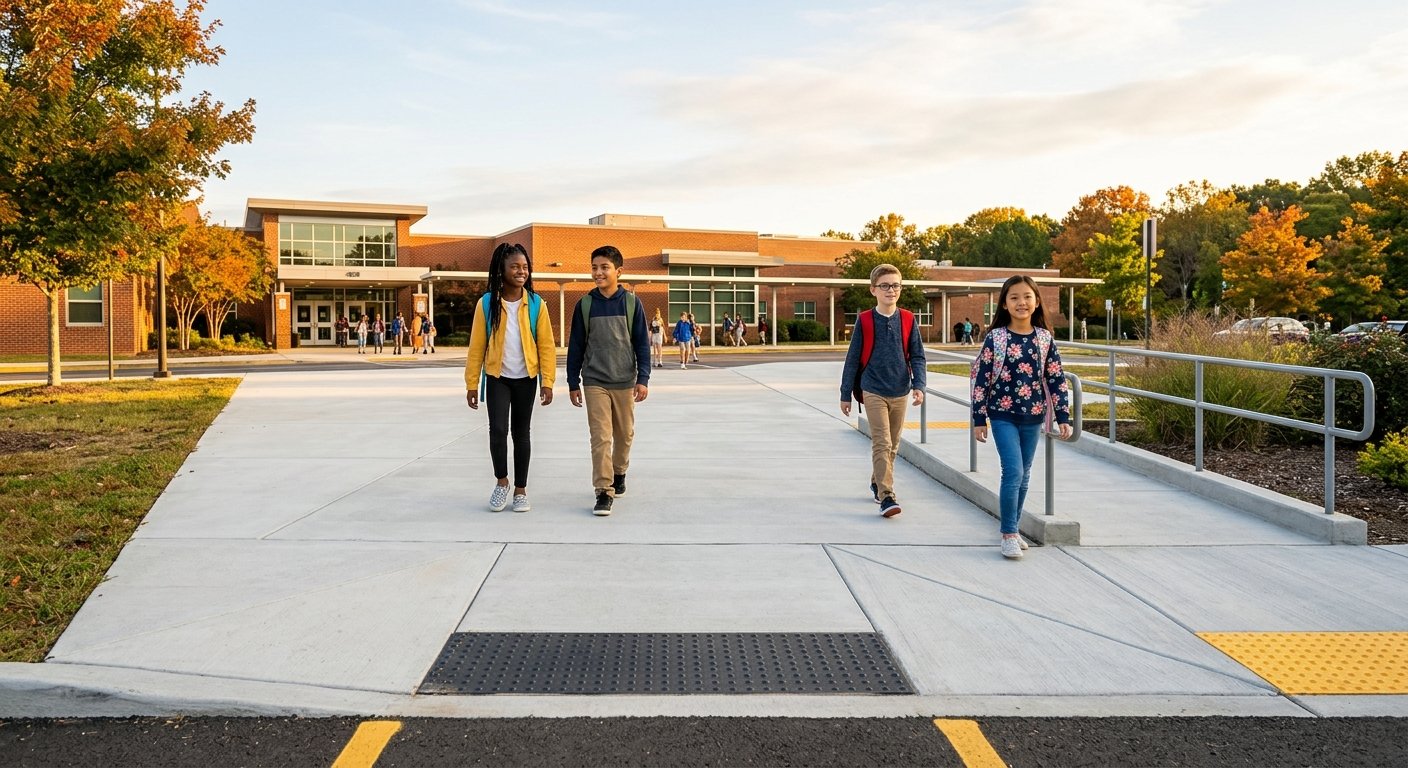
School districts are legally required to maintain sidewalks and pedestrian pathways that meet ADA accessibility standards. Any vertical change of more than ¼ inch in a walking surface qualifies as a trip hazard under federal guidelines—creating both a safety risk and a liability exposure for the district. Proactive sidewalk repair protects students, staff, and visitors while keeping facilities compliant with the Americans with Disabilities Act.
- ADA regulations define a trip hazard as any vertical displacement exceeding ¼ inch on a pedestrian walking surface.
- School districts face significant liability when known hazards go unaddressed—documentation of awareness without action is particularly damaging.
- Concrete cutting (grinding and beveling) resolves most trip hazards at a fraction of replacement cost while achieving ADA-compliant slopes.
- Recycling concrete debris after repairs supports school district sustainability commitments and reduces landfill impact.
- A structured inspection and repair cycle is the most defensible risk-management strategy for facilities directors.
Why School Districts Face Unique Sidewalk Liability
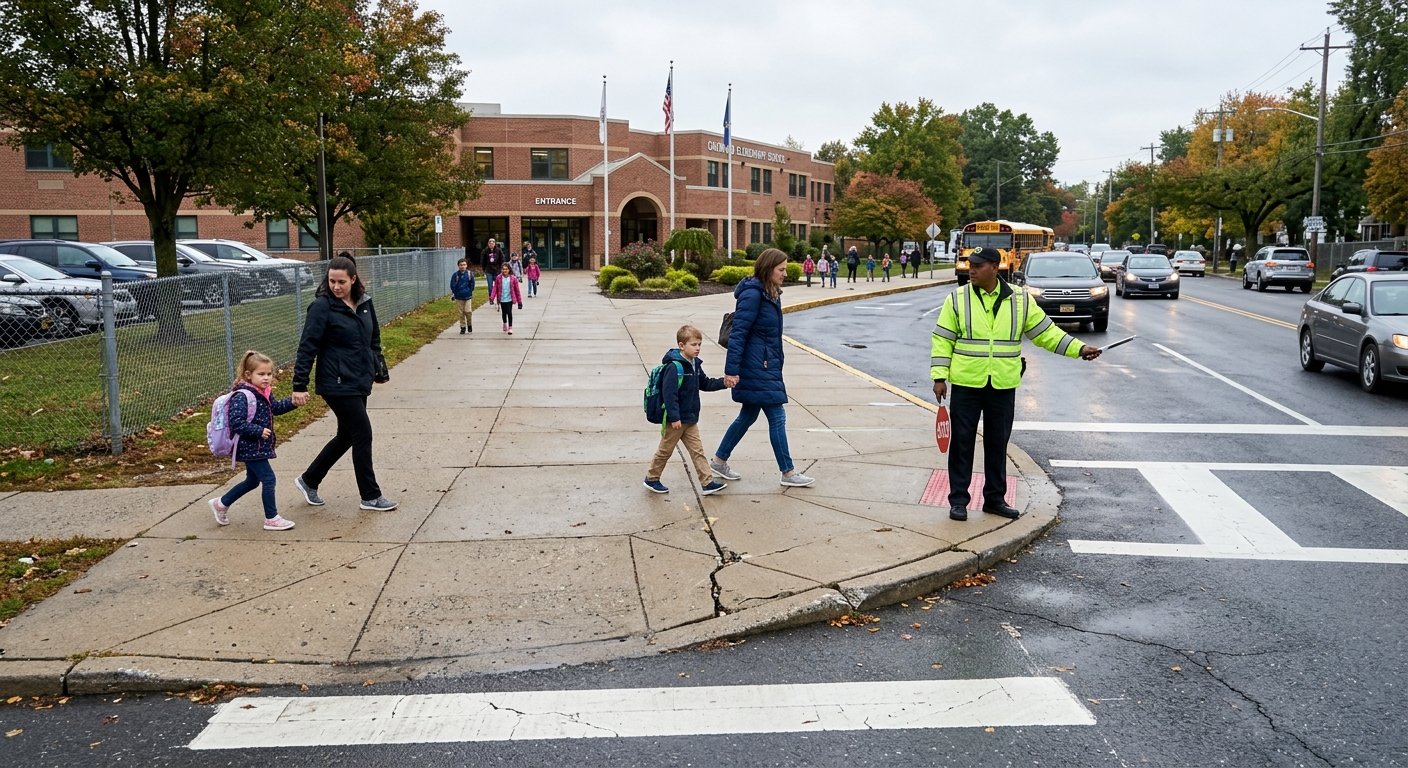
Public school campuses generate enormous pedestrian traffic daily—students moving between buildings, parents arriving for drop-off, delivery personnel, and visitors attending events. Unlike a private office building that controls access hours, a school campus often has walkers present from early morning through evening activities. That volume, combined with the age range of users (including young children and individuals using mobility devices), makes every uneven sidewalk segment a higher-stakes hazard.
Under the Americans with Disabilities Act, public entities—including school districts—are obligated to ensure their programs, services, and facilities are accessible to individuals with disabilities. Sidewalks, ramps, and pedestrian pathways are explicitly part of that obligation. A district that receives a complaint or experiences an injury on a documented hazard can face both ADA enforcement action and civil litigation.
Documenting a trip hazard through an inspection report and then delaying repair significantly increases liability. Courts and ADA enforcement agencies treat awareness without action as evidence of negligence. Prompt repair after identification is the most defensible position a district can take.
The financial consequences of inaction extend beyond legal settlements. Districts may also face mandatory ADA remediation orders requiring costly replacement of entire pathway segments—when targeted repairs made early could have resolved the same hazards at far lower cost. Understanding sidewalk trip hazard repair options before an incident occurs is the starting point for responsible facilities management.
The ADA Standards That Govern School Walkways
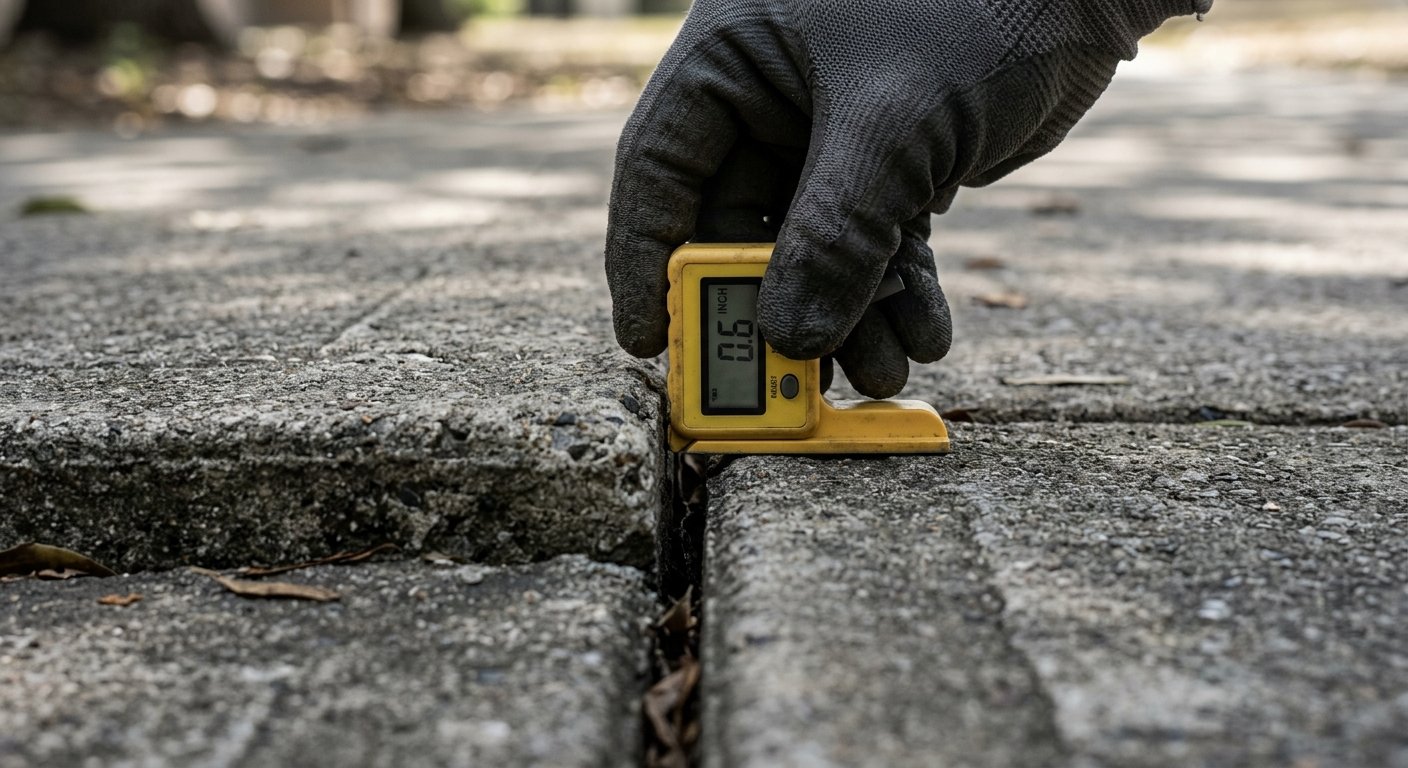
Facilities directors overseeing school campuses need a working knowledge of the specific thresholds that define compliance. The U.S. Access Board’s ADA Accessibility Guidelines set clear parameters for pedestrian surfaces:
- Vertical changes up to ¼ inch: Permitted without modification.
- Vertical changes between ¼ inch and ½ inch: Must be beveled at a slope no steeper than 1:2.
- Vertical changes exceeding ½ inch: Must be fully ramped with a maximum slope of 1:12.
- Cross-slope on accessible routes: Must not exceed 1:48 (approximately 2%).
- Surface requirement: Firm, stable, and slip-resistant under all anticipated conditions.
These standards apply to every accessible route on campus—not just the main entrance. Paths connecting classrooms, cafeterias, gymnasiums, portables, and parking areas all fall within scope. A single displaced concrete panel near a portable classroom can place the entire accessible route out of compliance.
A single displaced concrete panel near a portable classroom can place the entire accessible route out of compliance.
How Concrete Cutting Resolves Trip Hazards More Effectively
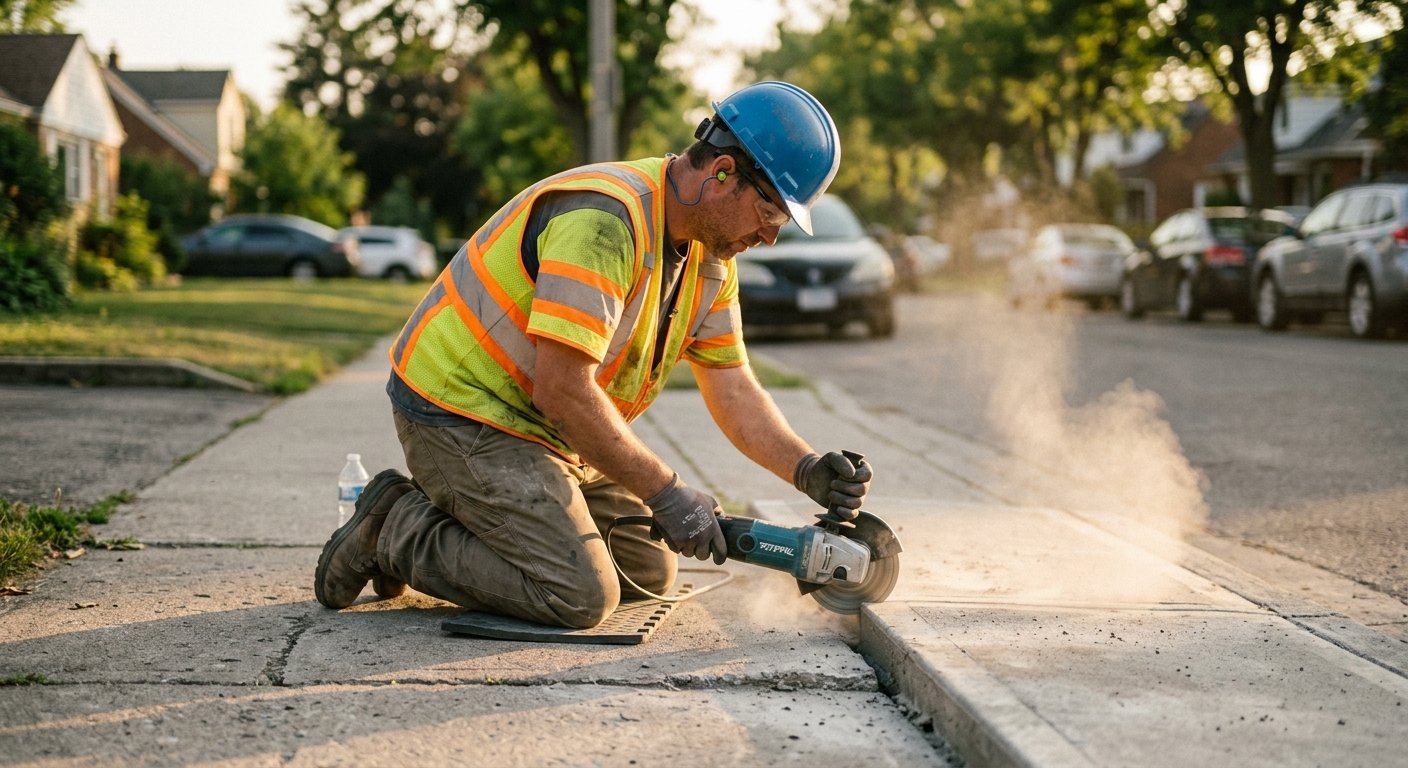
When a sidewalk panel heaves or settles—typically because of tree root intrusion or soil movement—the traditional responses have been full panel replacement or grinding. Replacement is disruptive and expensive. Grinding removes material uniformly, but it rarely achieves a true ADA-compliant transition because it cannot create the precise beveled slope the regulations require.
Precision concrete cutting uses a patented method that addresses the displacement directly. The raised edge is precisely cut and beveled to create a smooth, compliant transition meeting the 1:12 slope standard. The result is a surface that achieves zero differential at the joint, meets OSHA slip-resistance requirements, and eliminates the hazard without removing and replacing the entire panel.
| Factor | Concrete Cutting Method | Full Panel Replacement |
|---|---|---|
| Disruption to campus | Minimal — hours, not days | Significant — equipment, curing time |
| ADA-compliant slope achieved | Yes — precision 1:12 bevel | Depends on installation quality |
| Zero differential at joint | Yes | Not guaranteed |
| Environmental impact | Low — debris recycled | Higher — concrete waste to landfill |
| Underlying cause addressed | Repair targets the hazard directly | New panel subject to same forces |
For school districts managing tight maintenance budgets across multiple campuses, the cost difference between cutting and replacement is a compelling operational consideration. Districts can address more hazards per budget cycle using targeted cutting repairs, improving overall campus safety rather than exhausting funds on a single panel replacement. Learn more about how this approach works in commercial settings at our commercial sidewalk repair resource.
Building a Proactive Inspection and Repair Program
Reactive repairs—responding only after a fall or a complaint—leave districts chronically behind on compliance. A structured inspection cycle changes that dynamic and creates the documentation trail that demonstrates due diligence.
Map all accessible routes
Create a comprehensive campus map identifying every pedestrian pathway, ramp, and accessible route. Include service paths, parking lot connections, and routes to portables. This becomes the foundation of your inspection program.
Conduct a baseline condition survey
Walk every route and document vertical displacements, surface cracking, cross-slope concerns, and damaged ramps. Photograph and measure each deficiency. A licensed contractor can assist with identifying ADA threshold violations.
Prioritize by severity and traffic volume
Hazards on high-traffic routes—main entrances, cafeteria approaches, gymnasium pathways—should be addressed first. Rank repairs by displacement size and pedestrian exposure.
Schedule and complete repairs
Engage a licensed, insured contractor with demonstrated ADA compliance expertise. Concrete cutting repairs typically complete quickly, allowing districts to schedule work during non-instructional hours or school breaks.
Establish an annual re-inspection cycle
Tree roots continue growing. Soil continues shifting. An annual walkthrough of all accessible routes catches new displacement before it reaches the ½ inch threshold, keeping repairs in the less-costly cutting category rather than escalating to replacement.
Schedule your annual sidewalk inspection in late summer, before the school year begins. This timing allows repairs to be completed during lower-traffic periods and ensures the campus is in its best condition when daily student movement resumes.
Environmental Responsibility in School District Repairs
Many California school districts operate under sustainability commitments that include construction and maintenance waste reduction. Full concrete panel replacement generates substantial solid waste, with removed panels typically sent to landfill. Concrete cutting generates far less material, and responsible contractors recycle the concrete debris rather than disposing of it.
For districts that report sustainability metrics or participate in green building programs, choosing repair methods that minimize waste aligns maintenance decisions with institutional values. It also reduces the permitting and disposal costs that can add to replacement project budgets. Our approach to ADA-compliant sidewalk repair incorporates debris recycling as a standard practice, not an add-on.
Frequently Asked Questions
What qualifies as a trip hazard on a school campus sidewalk?
Under ADA guidelines, any vertical displacement exceeding ¼ inch on a pedestrian walking surface qualifies as a trip hazard requiring remediation. Displacements between ¼ and ½ inch must be beveled; anything over ½ inch must be fully ramped. Surface cracking, spalling, and cross-slope issues can also create compliance failures even without significant vertical change.
How quickly can trip hazard repairs be completed on a school campus?
Concrete cutting repairs typically complete within hours rather than days, making it feasible to schedule work during non-instructional periods, evenings, or school breaks. Unlike full panel replacement, there is no curing time required before the repaired surface can be used—reducing the disruption to normal campus operations.
Is grinding the same as the patented cutting method?
No. Standard grinding removes material uniformly across a surface but rarely achieves a precise ADA-compliant bevel at the joint. The patented cutting method is specifically designed to create the exact slope required—1:12 maximum—achieving zero differential at the transition and meeting both ADA and OSHA slip-resistance standards. This precision is what makes cutting a more reliable compliance solution than grinding alone.
Does fixing uneven sidewalk panels also address the underlying cause?
Cutting and beveling a raised panel eliminates the specific hazard it creates. The underlying cause—typically tree root growth or soil movement—is a separate question. Districts should assess whether root barriers or soil stabilization are warranted for sections that repeatedly develop displacement. Your contractor can advise on whether the repair location is likely to require future attention.
What documentation should school districts maintain after sidewalk repairs?
Districts should retain before-and-after photographs, measurements confirming the displacement has been brought into compliance, the contractor’s license and insurance documentation, and the date of completion. This file demonstrates that the district identified a hazard, engaged a qualified contractor, and resolved it promptly—the three elements of a defensible maintenance record.
Serving Northern California School Districts
Precision Concrete Cutting is a licensed and insured contractor serving Sacramento, Oakland, Burlingame, and surrounding Northern California communities. Using a patented concrete cutting method, the team delivers precise, ADA-compliant sidewalk hazard corrections that meet the slope, differential, and slip-resistance requirements school districts need—with minimal disruption to campus operations and a commitment to recycling all concrete debris.
Facilities directors managing multiple campuses or a backlog of deferred maintenance will find that targeted cutting repairs allow more hazards to be addressed per budget cycle than traditional replacement approaches. The result is a safer campus, a stronger compliance posture, and documentation that demonstrates proactive risk management.
Schedule a Campus Sidewalk Assessment
Contact Precision Concrete Cutting to discuss your district’s accessible route conditions and get a clear picture of your repair priorities.

About Precision Concrete Cutting
Precision Concrete Cutting provides ADA-compliant sidewalk repair and trip hazard correction services for property managers, municipal facilities, and commercial property owners throughout Northern California. Using a patented concrete cutting method, the company delivers cost-effective solutions that are 70-90% less expensive than replacement while achieving zero differential and ADA-compliant slopes. The approach emphasizes safety, regulatory compliance, environmental responsibility through debris recycling, and rapid completion that minimizes disruption. Visit pccnorcal.com →