
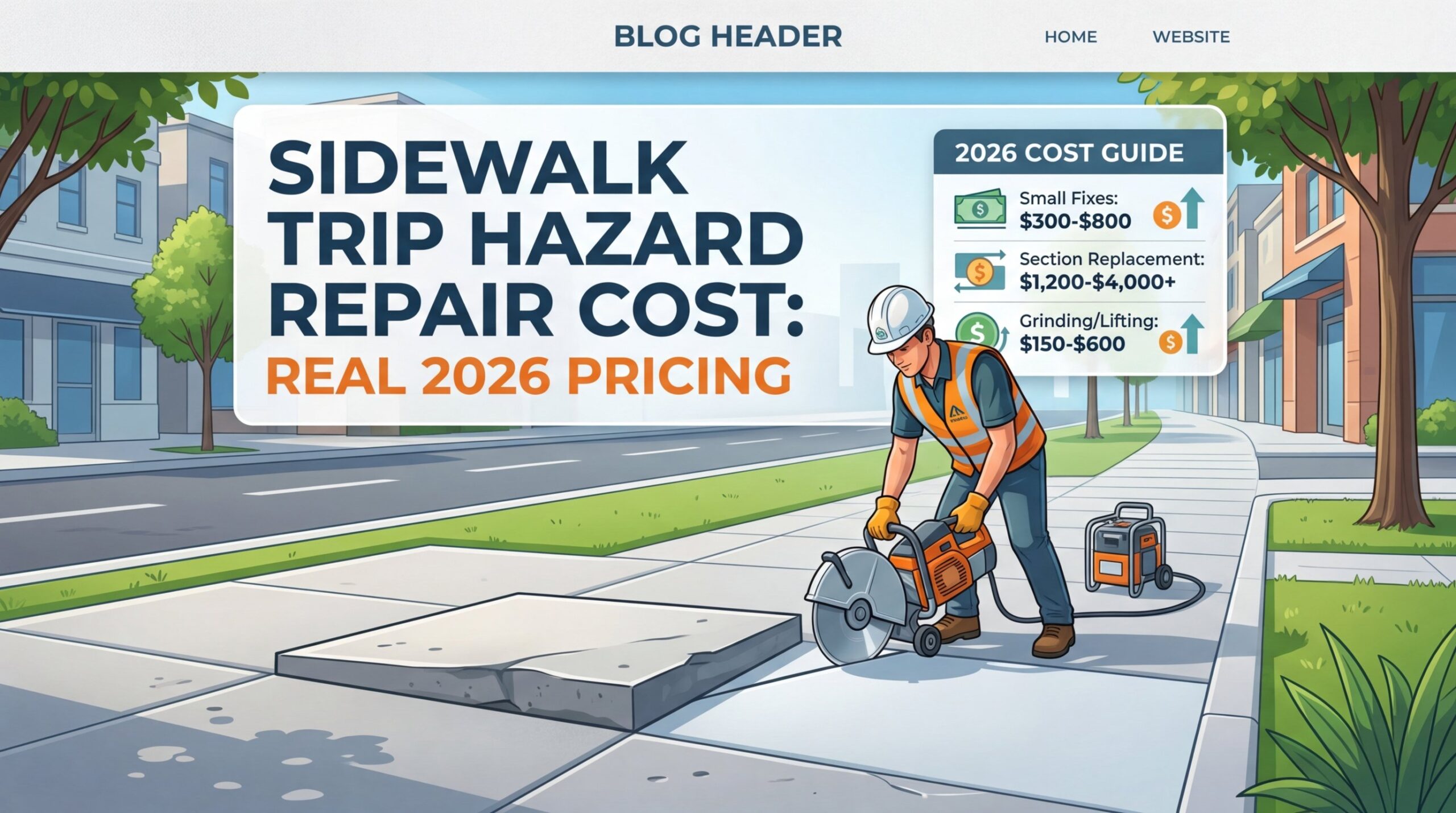
Property managers and facility directors face a common dilemma: sidewalk trip hazards that create liability exposure and ADA compliance issues. The critical question isn’t whether to fix them—it’s how much repair will actually cost. In 2026, sidewalk trip hazard repair pricing varies dramatically depending on the method you choose, with differences that can impact your budget by thousands of dollars.
Understanding real-world pricing helps you make informed decisions that protect both your budget and your organization from potential lawsuits. This comprehensive breakdown examines actual costs for different repair methods, helping you evaluate options based on your specific situation.
Understanding Trip Hazard Regulations and Liability
Before diving into costs, it’s essential to understand what legally constitutes a trip hazard. According to ADA guidelines, any vertical displacement of ¼ inch or greater between adjacent concrete sections creates a non-compliant condition. This seemingly minor measurement carries significant weight in premises liability cases.
Property owners who ignore these hazards face substantial risk. Slip-and-fall claims related to uneven sidewalks average between $30,000 and $50,000 in settlements, with some cases exceeding six figures when serious injuries occur. Beyond direct costs, litigation consumes time, increases insurance premiums, and damages organizational reputation.
Proactive maintenance through timely sidewalk trip hazard repair isn’t just about compliance—it’s a strategic investment in risk management that consistently costs less than reactive responses to injuries and lawsuits.
Traditional Concrete Replacement: The Expensive Standard
For decades, complete concrete replacement represented the default solution for uneven sidewalk repair. This method involves breaking out damaged sections, removing debris, preparing the base, pouring new concrete, and waiting for curing.
Replacement Cost Breakdown for 2026
Current market rates for concrete replacement typically range from $8 to $15 per square foot, depending on geographic location, accessibility, and project scope. For a standard 100-square-foot section of sidewalk, expect these costs:
- Labor and demolition: $400-$700
- Concrete materials: $300-$500
- Base preparation and grading: $150-$250
- Disposal fees: $200-$350
- Finishing and curing: $150-$200
Total estimated cost for replacement: $1,200-$2,000 per 100 square feet, or approximately $1,600 average.
These figures don’t account for additional expenses like permits, inspection fees, traffic control in busy areas, or extended timelines. Concrete replacement also requires 3-7 days of curing before the surface can handle foot traffic, creating accessibility disruptions that impact businesses and residents.
The environmental impact deserves consideration too. Concrete production contributes significantly to carbon emissions, and disposal of broken concrete adds to landfill burden—factors increasingly important to organizations with sustainability commitments.
Concrete Grinding: The Mid-Range Option
Concrete grinding emerged as a faster, less expensive alternative to replacement. This method uses specialized equipment to grind down raised sections until they’re flush with adjacent panels, eliminating the vertical differential that creates trip hazards.
Grinding Cost Analysis
Professional concrete leveling repair through grinding typically costs $3 to $6 per square foot in 2026. For that same 100-square-foot section, you’re looking at $300-$600—substantially less than replacement.
Grinding offers clear advantages over replacement: faster completion (usually same-day), immediate usability after work concludes, and lower cost. However, significant limitations exist that many property managers discover after the fact.
The Hidden Problems with Traditional Grinding
Standard grinding equipment creates slopes ranging from 1:4 to 1:8—far steeper than the ADA-compliant 1:12 ratio required for accessibility. This means you’ve spent money to fix uneven sidewalk issues, yet remain non-compliant with federal regulations.
Additionally, grinding often produces surfaces with inadequate slip resistance. The smooth finish created by grinding wheels can actually increase slip hazards, especially when wet. This trades one liability concern for another, leaving property owners vulnerable.
Surface appearance presents another issue. Grinding leaves visible marks and discoloration where material was removed, creating an unattractive patchwork appearance that detracts from property aesthetics—particularly problematic for commercial properties, schools, and municipal areas where appearance matters.
Advanced Cutting Method: Superior Results at Lower Cost
The patented cutting method represents a technological leap in sidewalk repair cost efficiency. Rather than grinding away material or replacing entire sections, precision cutting removes exact amounts of concrete to create perfectly compliant transitions.
How the Cutting Method Works
Specialized diamond-blade equipment makes precise cuts that remove raised lips and create proper transitions between uneven panels. The process achieves a true zero differential—meaning completely flush surfaces—with slopes that meet or exceed the 1:12 ADA requirement.
The cutting process also produces textured surfaces that maintain OSHA-compliant slip resistance values, actually improving safety rather than compromising it. Unlike grinding, cutting preserves the original concrete finish appearance, making repairs virtually invisible.
Real Pricing for the Cutting Method
The most compelling aspect of this concrete grinding alternative is the cost structure. Pricing typically ranges from $1.50 to $3.00 per square foot—representing 70-90% savings compared to replacement and 40-60% savings versus traditional grinding.
For that 100-square-foot repair section, expect costs between $150 and $300. The dramatic difference becomes more significant as project scope increases. A property with 1,000 square feet requiring repair sees potential savings of $13,000-$17,000 compared to replacement.
These aren’t theoretical numbers. Municipal projects, school districts, and commercial property portfolios consistently document these savings when switching from traditional methods to precision cutting.
Cost Comparison: Side-by-Side Analysis
For a typical 500-square-foot sidewalk repair project in 2026:
- Complete replacement: $4,000-$7,500 (plus 5-7 day closure, permit fees, environmental disposal)
- Traditional grinding: $1,500-$3,000 (non-ADA compliant slopes, slip resistance concerns)
- Precision cutting method: $750-$1,500 (ADA compliant, same-day completion, superior results)
Beyond initial outlays, consider long-term value. Replacement requires the highest initial investment but lasts 20-30 years. However, if surrounding sections continue settling—a common occurrence—you’ll face repeated replacement costs as new trip hazards develop.
The cutting method addresses immediate hazards without disturbing surrounding concrete, and can be repeated as needed at minimal cost if future settlement occurs. This flexibility provides ongoing cost advantages throughout a property’s lifecycle.
Factors That Influence Sidewalk Repair Cost
Several variables affect final pricing regardless of repair method chosen:
Project Size and Scope
Larger projects typically qualify for volume discounts. A property with multiple locations requiring repair may negotiate better per-square-foot rates than a single small job. Minimum service charges often apply, making it cost-effective to address all identified hazards in one project rather than piecemeal repairs.
Accessibility and Site Conditions
Sidewalks requiring equipment to traverse stairs, navigate tight spaces, or work around significant obstacles may incur additional charges. However, the compact nature of cutting equipment often allows access where larger grinding machines or concrete trucks cannot reach, actually reducing costs in challenging locations.
Geographic Location
Regional labor rates, material costs, and market competition influence pricing. Urban areas with multiple service providers often offer more competitive rates than rural locations with limited options. However, the specialized nature of precision cutting technology means fewer providers, potentially limiting geographic availability.
Urgency and Timeline
Emergency repairs needed to address immediate safety concerns or comply with violation notices may carry premium pricing. Scheduled maintenance during a contractor’s off-peak season might secure discounted rates.
Environmental and Sustainability Considerations
Organizations with environmental commitments should evaluate the sustainability profile of repair methods. Concrete replacement generates substantial waste and carbon emissions. The cutting method, by contrast, produces minimal debris—typically recycled rather than landfilled—and preserves existing concrete, dramatically reducing environmental impact.
This alignment with sustainability goals adds value beyond immediate cost savings, supporting ESG reporting requirements and corporate responsibility initiatives increasingly important to stakeholders in 2026.
Making the Right Choice for Your Property
Selecting the appropriate repair method requires evaluating multiple factors beyond simple per-square-foot costs:
- Compliance requirements: Will the method achieve genuine ADA compliance, or simply reduce visible trip hazards while leaving you vulnerable to violations?
- Liability protection: Does the solution actually reduce slip-and-fall risk, or potentially increase it through inadequate slip resistance?
- Aesthetic impact: Will repairs be visible and detract from property appearance, or blend seamlessly with existing surfaces?
- Disruption and downtime: How long will areas remain inaccessible, and what’s the cost of that disruption to operations?
- Long-term durability: What’s the expected lifespan, and how does that translate to annualized cost?
For most properties, the precision cutting method delivers optimal value across all these criteria. The combination of lowest cost, superior compliance, minimal disruption, and environmental responsibility creates a compelling case that’s difficult to match with traditional approaches.
Frequently Asked Questions
How quickly can sidewalk trip hazards be repaired?
The cutting method typically completes repairs in hours rather than days, with immediate accessibility after work concludes. Replacement requires 5-7 days for curing, while grinding usually finishes same-day but may leave compliance gaps.
Will repaired areas match existing concrete appearance?
Precision cutting preserves the original concrete finish, making repairs virtually undetectable. Grinding creates visible smooth patches, and replacement rarely matches aged concrete perfectly, resulting in obvious color and texture differences.
What’s the minimum project size for cost-effective repair?
Most contractors establish minimum service charges between $300-$500. Projects addressing at least 100-200 square feet typically prove most cost-effective, though urgent safety hazards warrant repair regardless of size.
How do I know if my sidewalk trip hazards need immediate attention?
Any vertical displacement of ¼ inch or greater requires correction for ADA compliance. If you can catch a coin edge in the gap or if the differential is visible to casual observation, address it promptly to avoid liability exposure.
Protect Your Property and Budget
Understanding real sidewalk repair cost empowers better decision-making. The 2026 market offers clear options: pay premium prices for replacement, accept compliance compromises with traditional grinding, or choose precision cutting for optimal results at the lowest cost.
Property managers and facility directors who prioritize both fiscal responsibility and genuine safety compliance consistently find the cutting method delivers unmatched value. The 70-90% cost savings compared to replacement, combined with superior ADA compliance and minimal operational disruption, makes this approach the logical choice for organizations committed to effective risk management.
Don’t wait for a costly lawsuit to force action on trip hazards. Schedule a professional assessment of your sidewalks to identify compliance issues and receive detailed cost estimates. Proactive maintenance through cost-effective repair methods protects people, budgets, and organizational reputation—the definition of smart property management.