
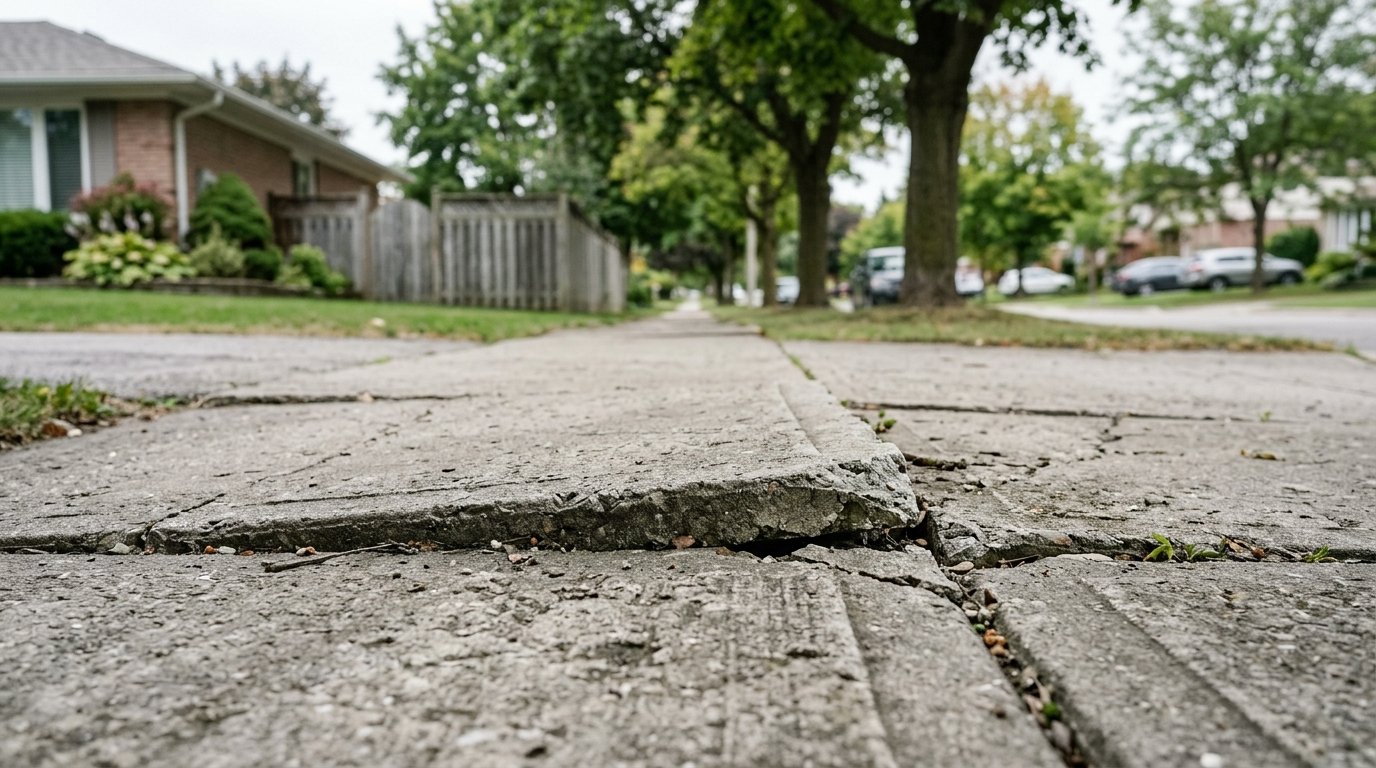
Sidewalk liability depends on where the hazard is located and who has the legal duty to maintain that section. In most California cities, property owners are responsible for sidewalk panels adjacent to their property — even though the sidewalk sits in the public right-of-way. When a pedestrian trips and is injured, courts examine ownership, notice, and maintenance history to determine who bears responsibility.
- California law generally places sidewalk maintenance responsibility on adjacent property owners, not cities.
- Courts look at four factors: location, ownership or control, actual or constructive notice, and failure to act.
- A vertical height change of ¼ inch or more is the ADA threshold that flags a surface as a trip hazard.
- Documentation — inspection logs, repair records, and prompt corrective action — is your strongest liability defense.
- Proactive trip hazard correction is significantly less expensive than litigation, and far less expensive than concrete replacement.
The Core Question Courts Ask First
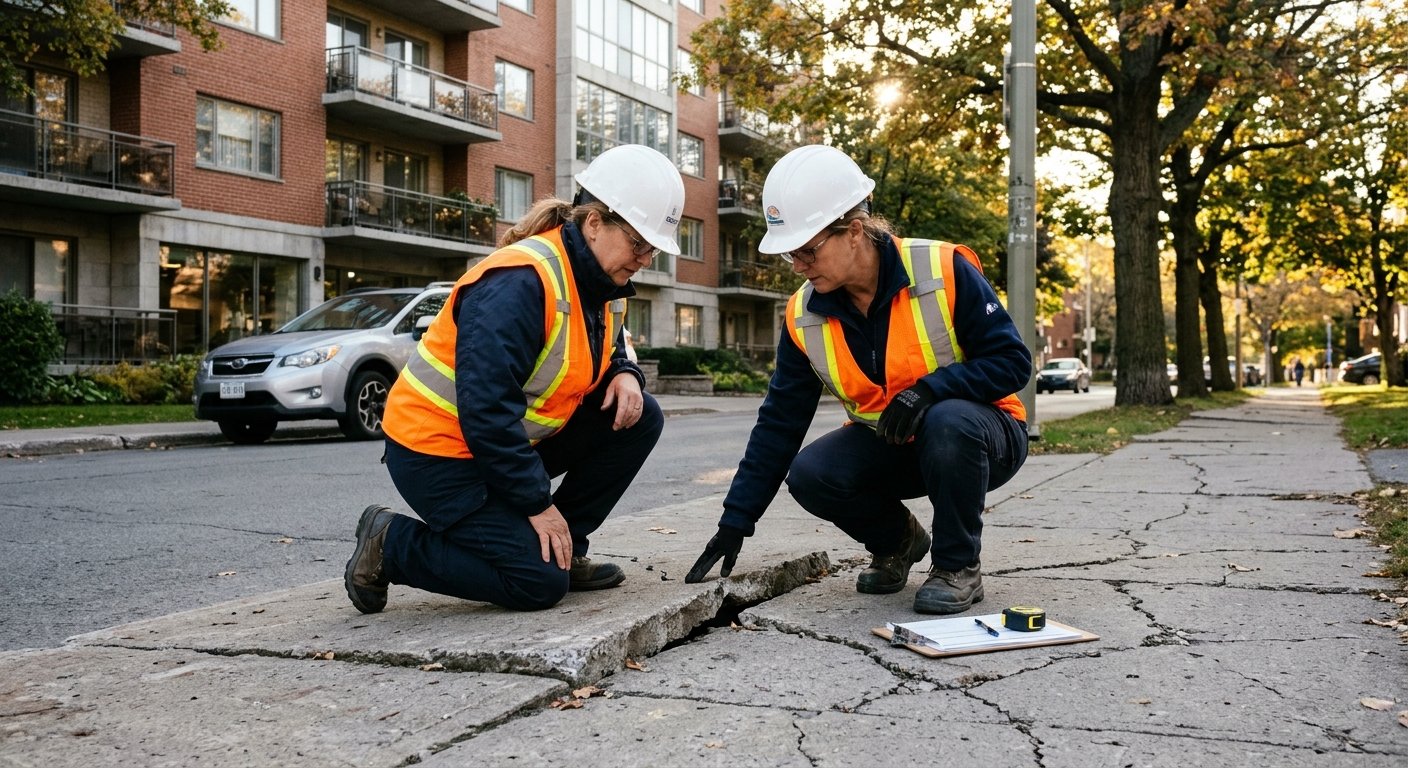
Before any judge or jury assigns fault, they establish one foundational fact: who had the legal duty to maintain the sidewalk where the injury occurred? In California, that answer is shaped by the California Streets and Highways Code Section 5610, which places the duty to maintain public sidewalks on the owners of the lots fronting those sidewalks. This applies to commercial properties, multifamily residential buildings, and certain other private land uses throughout the state.
Many property owners are surprised by this. The intuitive assumption is that because a sidewalk runs through city-owned right-of-way, the city bears the cost and risk of upkeep. That assumption is wrong in most California jurisdictions — and acting on it without understanding local ordinances can be an expensive mistake.
A sidewalk running in front of your building may sit on city-owned land, but that does not mean the city is responsible for fixing it. Under California law, the adjacent property owner typically carries both the maintenance duty and the liability exposure when that sidewalk is defective.
When the City Can Be Held Liable
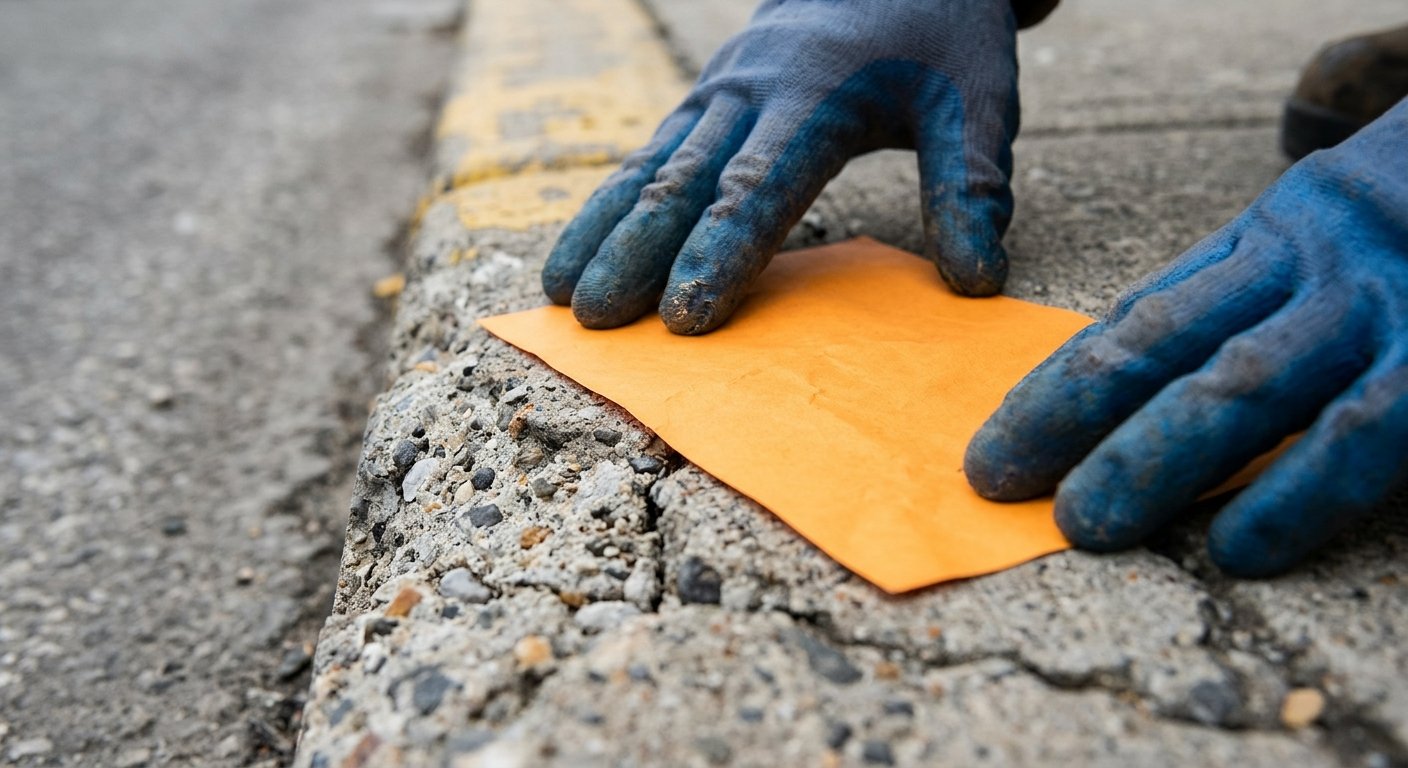
Municipal liability is not impossible — it is just narrower. Cities can be found responsible for sidewalk injuries when they own or control the specific area where the hazard exists (medians, parks, transit stops), when they created the hazardous condition through public works activity, or when they had actual written notice of the defect and failed to act within a reasonable time.
California’s Government Claims Act (Government Code §§ 810–996.6) governs how claims against public entities are filed and evaluated. Injured parties must file a government tort claim within six months of the injury before filing a lawsuit — a procedural requirement that filters many cases before they reach court. Even when a city does face liability, government immunity provisions often limit or eliminate recovery unless the claimant can prove the public entity had notice and a dangerous condition existed on public property.
For property managers and commercial owners, the practical takeaway is this: do not assume the city will absorb the claim if someone falls in front of your building. The more defensible position is ensuring your frontage is maintained to current safety standards.
The Four Factors Courts Examine
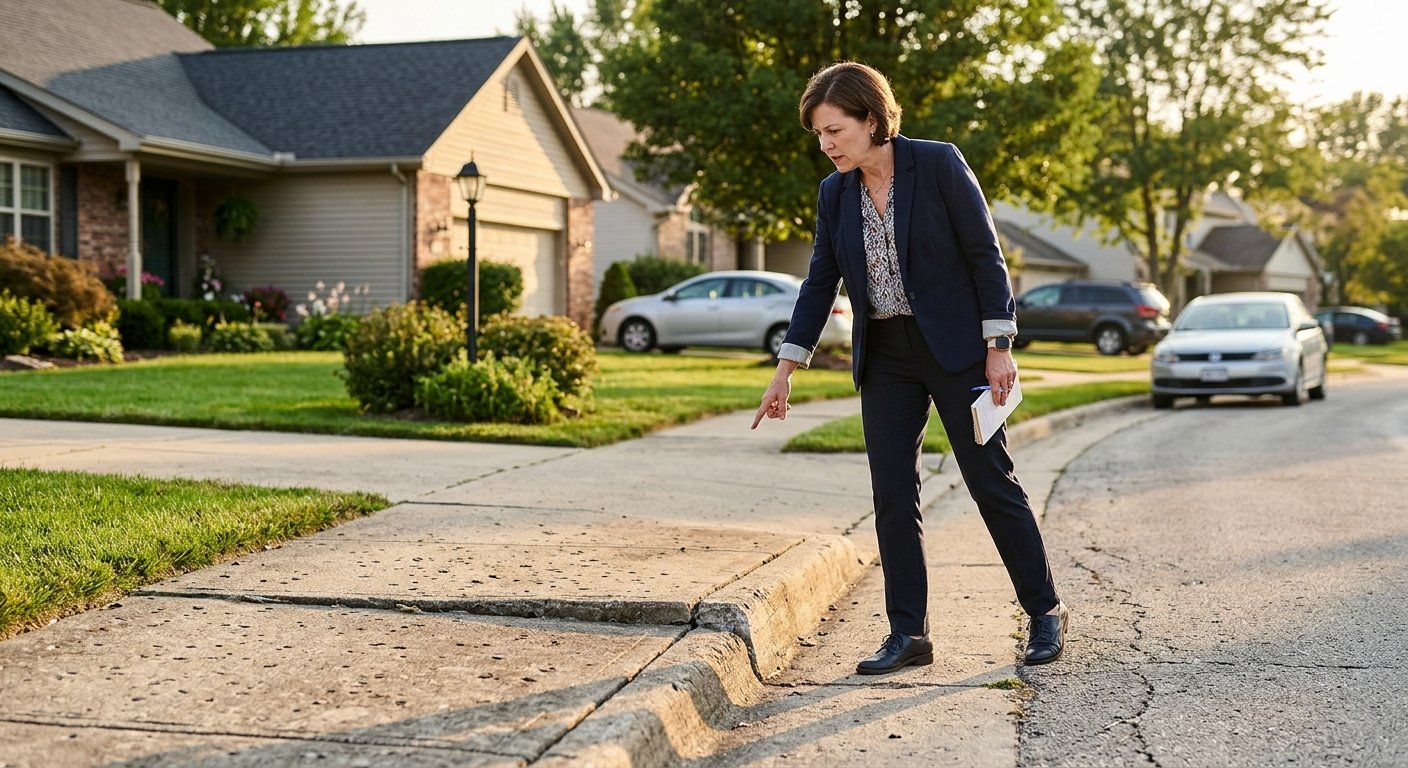
Whether the defendant is a private owner or a municipality, personal injury attorneys and courts evaluate trip hazard cases through the same general framework:
- Location and ownership: Which parcel does the defective section front? Who owns or controls that property?
- Notice: Did the responsible party know — or should they have known — about the hazard? A defect visible for months before an injury is treated differently than one that developed recently.
- Severity of the defect: Under the ADA’s pedestrian access route standards, a vertical surface change of ¼ inch or more constitutes a trip hazard. Courts and insurance adjusters use this threshold as a practical benchmark.
- Failure to act: Once a defect is known, what did the responsible party do? Prompt corrective action — documented in writing — demonstrates reasonable care. Inaction after notice is difficult to defend.
A defect that has existed for months is far harder to defend than one discovered and scheduled for repair before an injury occurs.
What Documentation Actually Reduces Your Exposure
Liability exposure is not eliminated by repairs alone — it is reduced by a documented culture of proactive sidewalk safety. Property managers and facilities directors should maintain records that show:
- Regular sidewalk inspections with dated logs and photographs
- Written records of any complaints or notices received about trip hazards
- Work orders and invoices documenting corrective action taken
- ADA compliance assessments, particularly for properties serving the public
- Contractor credentials and licensing for any repair work performed (such as CSLB Contractor License #1032474 for Precision Concrete Cutting)
When a claim is filed, this documentation is often the difference between a defensible case and a costly settlement. Insurance carriers look for evidence of reasonable care; plaintiffs’ attorneys look for gaps in that record.
Photograph every sidewalk inspection and store dated images in a property maintenance file. If a defect is flagged, document the date discovered, the corrective action planned, and the date completed. This paper trail demonstrates the standard of care that courts look for in negligence cases.
The ADA Dimension: Compliance and Liability Intersect
ADA compliance is not just a federal regulatory requirement — it functions as a liability standard in personal injury cases. When a sidewalk surface has a vertical differential exceeding ¼ inch between adjacent panels, or when cross-slopes exceed 2 percent, the surface may be inaccessible to wheelchair users and poses a documented fall risk to all pedestrians.
For commercial properties in Sacramento, Oakland, and Burlingame, failure to maintain ADA-compliant walkways can expose owners to both personal injury claims and ADA enforcement actions. The two risks reinforce each other: a surface flagged in an ADA complaint is simultaneously evidence of negligence in a slip-and-fall claim.
Learn more about what qualifies as an actionable defect in our detailed overview of ADA-compliant sidewalk standards and repair requirements.
Grinding vs. Cutting: Why the Repair Method Matters for Compliance
Not all sidewalk repairs achieve the same standard of compliance. Traditional grinding — the most common method used by general contractors — shaves down the raised edge of a panel but leaves a sloped surface that may still create accessibility issues. The result can be a surface that passes a quick visual inspection but fails ADA slope requirements upon measurement.
Precision Concrete Cutting’s patented cutting method approaches the problem differently. Rather than surface-level shaving, the process cuts and levels the displaced panel to achieve zero differential between adjacent sections and an ADA-compliant slope of 1:12. The surface texture that results meets OSHA standards for slip resistance — an important distinction when both fall prevention and regulatory compliance are the objectives.
The cost difference compared to full concrete replacement is substantial: the cutting method costs significantly less than panel replacement, without sacrificing the compliance outcome. For a property manager responsible for dozens of linear feet of commercial frontage, that cost efficiency makes proactive maintenance financially realistic rather than something deferred until an injury occurs.
For a side-by-side evaluation of repair approaches, see this comparison of common fixes for uneven sidewalks and how they stack up on compliance and durability.
| Factor | Traditional Grinding | Patented Cutting Method |
|---|---|---|
| Panel differential achieved | Reduced, not eliminated | Zero differential |
| ADA slope compliance | Not guaranteed | 1:12 compliant slope |
| Slip resistance | Variable | OSHA compliant |
| Cost vs. replacement | Moderate savings | 70–90% less than replacement |
| Debris handling | Varies by contractor | Recycled |
HOA Boards and Municipal Facilities: Special Considerations
HOA communities face a layered question: does the association or the individual homeowner bear responsibility for sidewalk frontage? The answer depends on the CC&Rs and the specific maintenance obligations defined in the governing documents. In many HOA structures, common area walkways fall under association responsibility, while individual frontage may fall to the homeowner. Boards that have not audited their governing documents against California’s sidewalk statutes may be carrying liability they have not accounted for.
Municipal public works departments face a different challenge: aging infrastructure across large sidewalk networks, limited budgets, and the ongoing obligation to respond to resident complaints. For municipal facilities, documented inspection programs and prioritized repair schedules are essential both to manage liability and to demonstrate good faith management of public assets. Our overview of commercial sidewalk repair considerations addresses the specific challenges facing larger property portfolios.
Frequently Asked Questions
Is the city always responsible for sidewalk injuries on public property?
Not in California. Under Streets and Highways Code Section 5610, the duty to maintain sidewalks is generally placed on the adjacent property owner, even though the sidewalk runs through city right-of-way. Cities may share or assume liability in specific circumstances — such as when they created the hazard or received prior written notice — but the default responsibility often rests with the private property owner.
What height difference makes a sidewalk a legal trip hazard?
The ADA identifies a vertical surface change of ¼ inch or more as a trip hazard on a pedestrian access route. This threshold is widely used by courts, insurance carriers, and municipal inspectors as the practical standard for determining whether a sidewalk defect is actionable.
How does documentation help in a sidewalk liability claim?
Documentation demonstrates that a property owner exercised reasonable care. Inspection logs, photographs, complaint records, and repair invoices all show that the owner monitored the property and acted on known defects. Courts and insurance adjusters weigh this evidence heavily when evaluating negligence claims.
Does repairing a trip hazard eliminate liability for a past injury?
No. A repair made after an injury does not retroactively resolve liability for that incident. However, prompt repair after discovery — documented before any injury — is strong evidence of reasonable care. Proactive maintenance is the most effective liability management strategy available.
Is concrete cutting genuinely ADA compliant, or just a cosmetic fix?
When performed correctly using a method that achieves zero panel differential and a 1:12 slope, concrete cutting meets the ADA’s pedestrian access route standards. Precision Concrete Cutting’s patented process is specifically engineered to achieve both zero differential and ADA-compliant slopes, along with OSHA-compliant slip resistance — not merely a surface-level reduction of the visible edge.
Protect Your Property with Compliant Sidewalk Repair
Precision Concrete Cutting serves property managers, HOA boards, municipal facilities, and commercial owners throughout Sacramento, Oakland, and Burlingame — with licensed, insured service and a patented cutting method that achieves zero differential and ADA compliance at a fraction of replacement cost.

About Precision Concrete Cutting
Precision Concrete Cutting provides ADA-compliant sidewalk repair and trip hazard correction services for property managers, municipal facilities, and commercial property owners throughout Northern California. Using a patented concrete cutting method, the company delivers cost-effective solutions that are 70-90% less expensive than replacement while achieving zero differential and ADA-compliant slopes. The approach emphasizes safety, regulatory compliance, environmental responsibility through debris recycling, and rapid completion that minimizes disruption. Visit pccnorcal.com →