
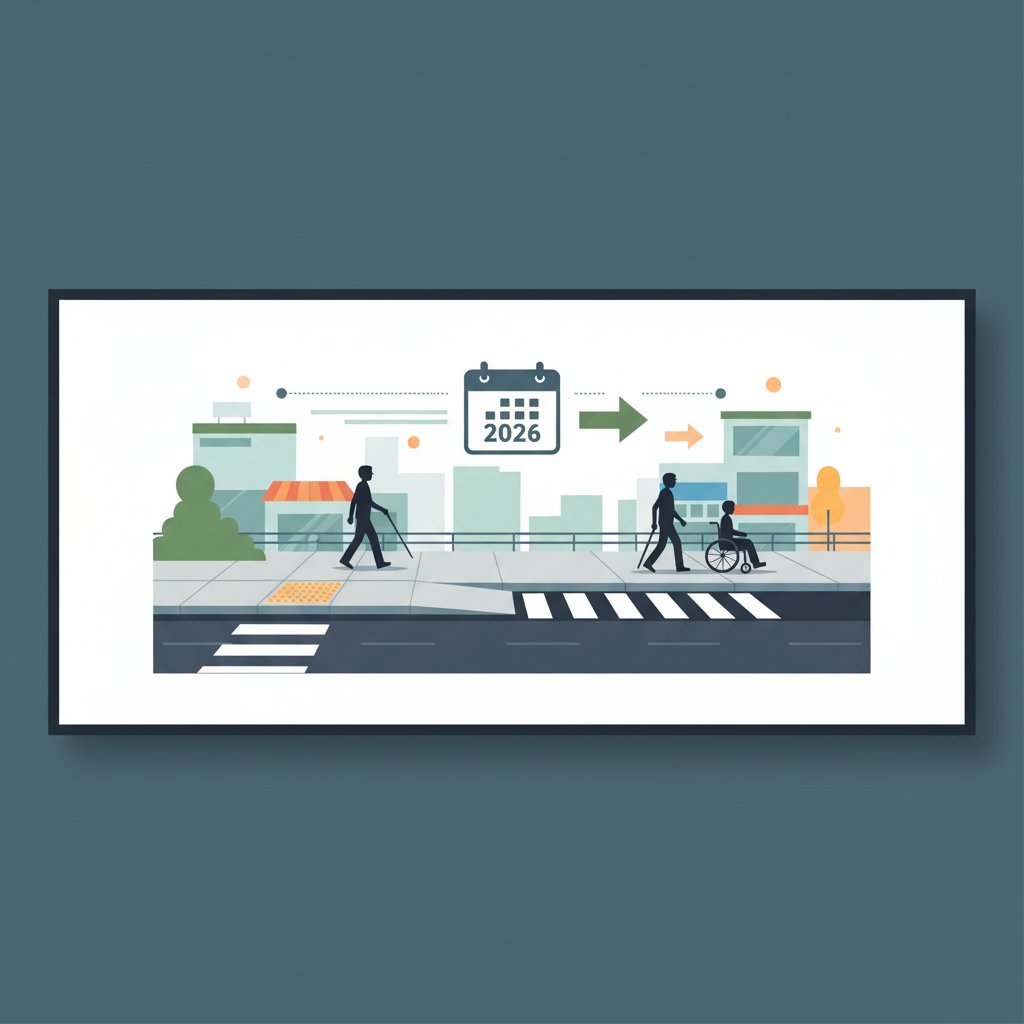
# Commercial ADA Sidewalk Compliance: 2026 Action Plan
A commercial property owner in Oakland recently faced a $65,000 lawsuit after a visitor tripped on a sidewalk raised just three-eighths of an inch above the adjacent section. The property had been inspected two years earlier, but small changes in concrete elevation had gone unaddressed. This scenario plays out across Northern California every month, yet most facility managers and property owners remain unaware that the Americans with Disabilities Act establishes a clear threshold: any vertical displacement of one-quarter inch or more constitutes a trip hazard requiring immediate correction.
As we move through 2026, regulatory enforcement has intensified while liability insurance premiums continue climbing for properties with documented accessibility deficiencies. Commercial property managers in Sacramento, Oakland, and Burlingame now face heightened scrutiny from both public entities and private plaintiffs. The question is no longer whether to address sidewalk compliance, but how to do so cost-effectively while minimizing operational disruption.
Understanding ADA Sidewalk Requirements in 2026
The Americans with Disabilities Act establishes specific technical standards for accessible routes on commercial properties. These requirements apply to virtually all properties open to the public, including retail centers, office buildings, municipal facilities, educational institutions, and healthcare complexes.
Current sidewalk ADA compliance standards mandate several critical specifications:
- Zero vertical displacement: Changes in level between adjacent concrete sections cannot exceed one-quarter inch, measured vertically
- Slope requirements: Cross slopes must not exceed 1:48 (2%), while running slopes in pedestrian access routes must comply with ramp standards of 1:12 when exceeding 5%
- Surface characteristics: Walking surfaces must be stable, firm, and slip-resistant under all weather conditions
- Clear width: Accessible routes must maintain a continuous minimum width of 36 inches
- Protrusions: Objects cannot protrude into the accessible route beyond specified limits
The U.S. Access Board provides detailed technical guidance, but compliance ultimately requires practical solutions that address real-world concrete deterioration without excessive cost or disruption.
Why Traditional Repair Methods Fall Short
Property managers pursuing commercial sidewalk repair traditionally faced two primary options, each with significant drawbacks that make compliance challenging.
Concrete Grinding Limitations
Grinding machines remove high sections by abrading the concrete surface. While this approach can reduce vertical displacement, it creates several compliance problems. The grinding process often produces irregular slopes that fail to meet the 1:12 requirement. Surface texture changes dramatically, creating inconsistent slip resistance that may violate ADA surface requirements. Perhaps most problematically, grinding removes only material from high sections, meaning the overall pathway elevation drops inconsistently, often creating new trip hazards at transitions to unground sections.
Full Replacement Complications
Complete concrete replacement theoretically solves all compliance issues, but the practical barriers make it prohibitive for most commercial properties. Costs typically range from $8 to $15 per square foot in Northern California markets. Projects require multi-day closures of pedestrian access, creating significant operational disruption. The removal process generates substantial debris requiring specialized disposal. For properties with extensive sidewalk networks, replacement costs can easily exceed $100,000, making budgetary approval extremely difficult.
The Cost-Effective Compliance Solution
A patented concrete cutting method now provides commercial properties with a third option that addresses the shortcomings of both grinding and replacement. This approach uses precision cutting equipment to remove exact amounts of material from elevated concrete sections, creating smooth transitions that achieve zero differential between adjacent slabs.
The process works by making multiple parallel cuts in the raised concrete section, then removing thin strips of material to lower the surface precisely to match adjacent sections. This technique allows contractors to control both the vertical height correction and the transitional slope with accuracy measured in fractions of an inch. The result consistently meets ADA compliant sidewalk repair standards while preserving the underlying concrete structure.
Quantifiable Advantages
Commercial property sidewalk repair using this cutting method delivers measurable benefits across multiple metrics property managers care about:
Cost reduction: Projects typically cost 70-90% less than full replacement, bringing a $50,000 replacement project down to $5,000-$15,000 for comparable compliance outcomes.
Speed: Most commercial properties complete repairs in one to three days rather than the week or more required for replacement, minimizing tenant disruption and lost business.
Compliance precision: The cutting method achieves true zero differential and controlled slopes that consistently meet the 1:12 ADA requirement, unlike grinding’s irregular results.
Surface preservation: The existing concrete surface remains intact except at cut locations, maintaining consistent slip resistance across the entire pathway.
Environmental responsibility: Removed concrete material can be recycled rather than requiring landfill disposal, supporting corporate sustainability objectives.
Building Your 2026 Compliance Action Plan
Facility managers and property owners should approach commercial ADA sidewalk compliance systematically rather than reactively. A structured plan reduces both liability exposure and long-term costs.
Phase 1: Comprehensive Assessment
Begin with a thorough walkway inspection documenting all vertical displacements, slope irregularities, and surface defects. Use a simple straight edge and measuring tool to identify changes in level exceeding one-quarter inch. Photograph each location and create a prioritized list based on pedestrian traffic volume and proximity to building entrances. High-traffic areas and primary access routes require immediate attention, while secondary pathways may be scheduled for later phases.
Phase 2: Regulatory Review
Verify that your property’s compliance obligations align with current interpretations. While federal ADA standards apply nationwide, California often implements stricter accessibility requirements. Municipal codes in Sacramento, Oakland, and Burlingame may include additional specifications. Consult with your legal counsel to understand exposure levels, particularly if your property has received previous complaints or accessibility-related inquiries.
Phase 3: Solution Selection
Evaluate repair options based on your property’s specific conditions. For properties with extensive trip hazards across large areas, the cutting method’s cost advantages become compelling. For properties with severely damaged concrete showing cracking, spalling, or structural deterioration, targeted replacement of damaged sections combined with cutting method repairs for adjacent displacement issues often provides the optimal balance.
Phase 4: Implementation Scheduling
Plan repair work to minimize operational impact. Many commercial properties schedule sidewalk repairs during low-traffic periods or seasonal closures. Coordinate with tenants, security, and maintenance staff to ensure alternative access routes remain available. Licensed and insured contractors serving Northern California communities can often provide flexible scheduling that accommodates business requirements.
Phase 5: Documentation and Maintenance
Maintain detailed records of all compliance work, including before and after measurements, contractor certifications, and inspection reports. This documentation proves invaluable in demonstrating good-faith compliance efforts should accessibility questions arise. Establish a regular inspection schedule—typically semi-annual or annual depending on climate exposure and traffic levels—to identify new issues before they create liability exposure.
Liability Considerations for Property Managers
Trip and fall incidents represent one of the most common sources of premises liability claims. National Floor Safety Institute research indicates that falls account for over 8 million emergency room visits annually, with uneven walking surfaces contributing significantly to these incidents.
From a risk management perspective, documented accessibility violations create compounded liability. Not only does the property owner face potential injury claims from individuals who fall, but the presence of a known ADA violation that went unaddressed demonstrates negligence that can substantially increase damage awards. Insurance carriers increasingly require properties to demonstrate proactive maintenance programs as a condition of coverage.
The one-quarter inch threshold established by ADA sidewalk requirements provides property managers with a clear, measurable standard. Any vertical displacement meeting or exceeding this measurement requires correction. There is no discretionary judgment involved—the standard is absolute, making compliance straightforward to determine and essential to maintain.
ROI Analysis: Compliance as Investment
Financial decision-makers evaluating sidewalk accessibility sidewalk repair should view compliance work as risk mitigation investment rather than pure expense. Consider the cost comparison:
A typical commercial property with 5,000 square feet of sidewalk containing multiple trip hazards might face $75,000 in replacement costs. Using precision cutting methods, the same property achieves full compliance for approximately $12,000. The $63,000 savings can fund other property improvements while eliminating liability exposure.
Compare this proactive investment against reactive costs. A single trip-and-fall lawsuit settlement averages $20,000-$50,000 for minor injuries, with serious injury claims reaching six or seven figures. Legal defense costs alone typically exceed $15,000 even when the property owner prevails. Insurance premium increases following claims can add thousands annually for years.
The return on investment calculation becomes clear: spending $12,000 to eliminate known hazards and achieve documented compliance provides superior financial outcomes compared to maintaining non-compliant conditions while hoping incidents don’t occur.
Municipal and Educational Facilities: Special Considerations
Public entities face heightened compliance obligations under Title II of the ADA. Municipal facilities, school districts, and government properties must not only maintain accessible routes but also demonstrate ongoing efforts to improve accessibility across all programs and services. This includes regular self-evaluation and transition planning documenting how accessibility barriers will be addressed.
For these entities, sidewalk ADA compliance standards represent minimum requirements. Budget-constrained municipal facilities and school districts particularly benefit from cost-effective repair methods that allow limited capital improvement funds to address more locations. A school district that might afford to replace sidewalks at two school sites can instead achieve compliance at six or eight sites using precision cutting methods, substantially accelerating overall accessibility improvements.
Frequently Asked Questions
What exactly qualifies as an ADA trip hazard on commercial sidewalks?
Any vertical displacement of one-quarter inch or more between adjacent concrete sections constitutes a trip hazard requiring correction under ADA standards. This measurement applies to all changes in level along pedestrian access routes on commercial properties. Even small displacements below this threshold should be monitored, as concrete settlement and root growth can cause progression over time.
How long does commercial ADA sidewalk repair typically take?
Using precision cutting methods, most commercial properties complete repairs within one to three business days depending on the extent of trip hazards being addressed. This timeframe includes assessment, cutting, material removal, and site cleanup. Traditional replacement projects typically require five to ten days for comparable scope, plus additional time for concrete curing before the area can be reopened to pedestrian traffic.
Can cutting methods address sidewalks with existing cracks or damage?
Precision cutting effectively corrects vertical displacement in structurally sound concrete. However, sections with significant cracking, spalling, or structural deterioration may require replacement. A comprehensive assessment identifies which sections can be repaired through cutting and which need replacement. Many properties achieve optimal results combining targeted replacement of severely damaged sections with cutting method corrections for adjacent displacement issues.
What maintenance is required after ADA compliance repairs?
Properly executed repairs using patented cutting technology require minimal ongoing maintenance beyond standard concrete care. Property managers should conduct regular inspections—typically twice annually—to identify any new settlement or displacement issues before they reach the one-quarter inch threshold. Prompt attention to new issues prevents minor problems from becoming compliance violations.
Are there financing options for commercial sidewalk compliance projects?
Many commercial properties incorporate sidewalk repairs into annual capital improvement budgets or facility maintenance allocations. The significantly lower cost of cutting methods compared to replacement often allows projects to proceed within existing budget authority without special appropriations. Some municipalities and school districts utilize bonds or capital lease arrangements for larger multi-site compliance programs.
Taking Action on Commercial ADA Compliance
Sidewalk accessibility represents a fundamental aspect of commercial property management that directly impacts safety, regulatory compliance, and financial exposure. As enforcement continues intensifying throughout 2026, property managers and facility directors who address compliance proactively position their organizations advantageously compared to those adopting reactive approaches.
The availability of cost-effective repair methods means budget constraints no longer justify deferred maintenance on trip hazards and accessibility deficiencies. Properties throughout Sacramento, Oakland, and Burlingame can now achieve full commercial ADA sidewalk compliance at a fraction of traditional costs while minimizing operational disruption.
Property managers ready to develop their 2026 compliance action plan should begin with a comprehensive walkway assessment identifying all locations requiring attention. Licensed and insured contractors with patented cutting technology can provide detailed evaluations and project proposals that clearly outline scope, timeline, and investment requirements.
The question facing commercial property decision-makers is straightforward: will you address accessibility proactively when costs are manageable and scheduling is flexible, or reactively after an incident when urgency compounds both expense and complexity? Organizations that choose proactive compliance protect not only their financial interests but also the safety of everyone who visits their properties.
Contact Precision Concrete Cutting today to schedule your property assessment and receive a detailed compliance action plan tailored to your specific facility requirements and operational constraints.