
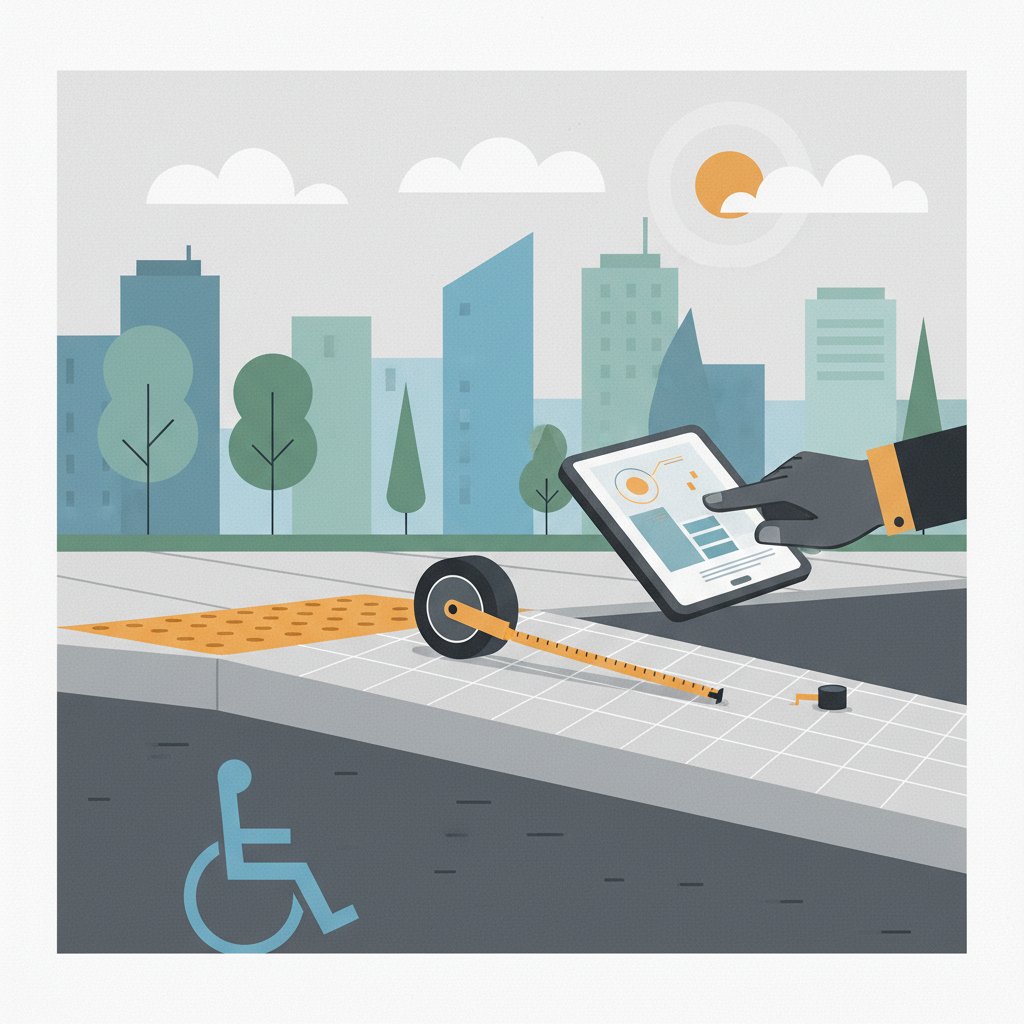
Property owners face mounting liability risks from non-compliant sidewalks in 2026, with trip-and-fall claims averaging $50,000 in settlements and legal fees. As ADA enforcement intensifies and municipalities increase citation rates for sidewalk violations, understanding what to inspect has become essential for risk management. An effective ADA sidewalk inspection isn’t just about regulatory compliance—it’s about preventing injuries, avoiding lawsuits, and maintaining accessible pathways for everyone.
Understanding ADA Sidewalk Compliance Standards in 2026
The Americans with Disabilities Act sets clear standards for pedestrian pathways, and enforcement has accelerated significantly in recent years. Sidewalk ADA compliance standards require property owners to maintain surfaces that accommodate wheelchair users, individuals with mobility aids, and people with visual impairments. The regulations apply to commercial properties, multifamily housing, schools, government facilities, and in many cases, residential properties adjacent to public sidewalks.
The critical measurement in any ADA compliance sidewalk inspection is the vertical displacement between adjacent concrete sections. According to federal guidelines, any vertical change exceeding ¼ inch constitutes a trip hazard requiring correction. This seemingly small measurement represents the threshold where a mobility device can catch or a pedestrian can trip, creating both accessibility barriers and liability exposure.
Essential ADA Sidewalk Requirements Every Property Owner Must Know
When conducting an ADA sidewalk inspection, several specific criteria determine compliance status. Understanding these requirements helps property owners identify problems before they result in injuries or citations.
Maximum Vertical Displacement
The ¼ inch vertical change regulation is non-negotiable. Measure any crack, settled section, or heaved area where one slab sits higher than an adjacent section. Even if the displacement appears minor, it must be addressed if it exceeds this threshold. Property managers should use precise measuring tools rather than visual estimates, as the difference between compliant and non-compliant can be millimeters.
Sidewalk Slope ADA Requirements
Running slope—the grade along the direction of travel—cannot exceed 1:20 (5%) without being classified as a ramp. When classified as a ramp, the pathway must meet additional requirements including handrails and level landings. Cross slope, which runs perpendicular to the travel direction, must not exceed 1:48 (2.08%) to prevent wheelchair users from veering off course or tipping.
These sidewalk slope ADA requirements become particularly important when repairing settled sections. Simply grinding down a raised edge without considering the resulting slope can create new violations while attempting to fix the vertical displacement issue.
Surface Texture and Slip Resistance
Beyond height differentials, ADA compliant sidewalk repair must maintain proper slip resistance. OSHA standards require a slip resistance coefficient appropriate for pedestrian traffic, which means surfaces cannot be overly smooth or polished. This consideration becomes crucial when choosing repair methods, as some techniques can create slippery surfaces that pose hazards in wet conditions.
Clear Width and Obstruction-Free Zones
Accessible routes must maintain a minimum clear width of 36 inches, with 48 inches preferred for two-way traffic. During your inspection, check for encroaching vegetation, signs, utility boxes, or other obstructions that reduce the effective pathway width. Protruding objects above the walking surface cannot extend more than 4 inches into the pathway when mounted between 27 and 80 inches above the ground.
Conducting a Comprehensive Commercial ADA Sidewalk Compliance Inspection
For facilities directors and property managers responsible for commercial ada sidewalk compliance, systematic inspection procedures identify problems efficiently and document compliance efforts for liability protection.
Inspection Frequency and Documentation
Best practices in 2026 recommend quarterly inspections for high-traffic commercial properties, with annual inspections as the minimum standard. Document each inspection with dated photographs, measurements, and written notes describing observed conditions. This documentation proves invaluable if a claim arises, demonstrating proactive maintenance efforts and reasonable care.
Prioritizing Identified Hazards
Not all violations carry equal risk. Prioritize repairs based on pedestrian traffic volume, proximity to building entrances, and severity of the defect. A ½ inch vertical displacement near a main entrance in a shopping center requires immediate attention, while a ⅜ inch differential in a low-traffic area might be scheduled for the next maintenance cycle—though both exceed ADA thresholds and need correction.
Measuring Slopes Accurately
Digital inclinometers and smart levels provide precise slope measurements required for compliance verification. When inspecting existing sidewalks, measure both running and cross slopes at regular intervals, particularly where grade changes occur or where previous repairs might have altered the original slope.
Handicap Accessible Sidewalk Repair Options
Once an ADA sidewalk inspection identifies violations, property owners must choose repair methods that restore compliance cost-effectively. The options vary significantly in cost, durability, and compliance outcomes.
Traditional Replacement
Complete section replacement involves removing and replacing entire concrete panels. While this approach creates a uniform surface, costs typically range from $8 to $15 per square foot. The process generates substantial debris requiring disposal, creates extended access disruptions, and requires 3-7 days of curing time before the sidewalk can reopen.
Conventional Grinding
Standard grinding reduces raised sections by removing material from the high side. This method costs less than replacement—typically $3 to $5 per linear foot—but creates sloped transitions that may not meet sidewalk slope ADA requirements. The 1:12 maximum slope for accessible routes is difficult to achieve with grinding when addressing substantial vertical displacements, and the resulting surface often lacks proper slip resistance.
Precision Cutting Method
Advanced handicap accessible sidewalk repair using patented cutting technology addresses the limitations of grinding and replacement. This method creates zero differential between sections while maintaining ADA compliant slopes of exactly 1:12. The process costs 70-90% less than replacement, typically $2.50 to $4.00 per linear foot, and achieves OSHA compliant slip resistance ratings.
The cutting technique works by precision-beveling the raised section to create a code-compliant transition. Unlike grinding, which creates variable slopes depending on the operator’s technique, the cutting method consistently achieves the specified 1:12 ratio. The equipment recycles all debris on-site, eliminating disposal costs and environmental impact. Properties remain accessible throughout the repair process, with individual sections completed in minutes rather than days.
Liability Implications of Non-Compliant Sidewalks
Property owners who neglect ADA sidewalk inspection face exposure beyond simple citations. Trip-and-fall litigation has increased 23% since 2023, with plaintiffs’ attorneys specifically targeting properties with documented accessibility violations. Courts consistently rule that property owners have a duty to maintain safe pedestrian pathways, and knowledge of defects—even if discovered during an inspection but not promptly corrected—establishes negligence in injury claims.
Insurance carriers have responded by increasing premiums for properties with documented sidewalk hazards and, in some cases, excluding trip-and-fall coverage entirely for properties that fail to address known violations. Some municipalities have implemented systematic inspection programs, issuing correction notices with compliance deadlines and daily fines for continued violations.
Special Considerations for Different Property Types
Multifamily Housing and HOAs
Homeowner associations and apartment complexes must inspect not only main walkways but also paths to amenities like pools, mailbox areas, and parking structures. Fair Housing Act requirements overlap with ADA standards, creating additional compliance obligations for residential properties.
Educational Facilities
Schools face heightened scrutiny due to their public nature and the vulnerability of their populations. School district administrators should prioritize pathways to and from bus drop-off areas, playgrounds, and building entrances. Section 504 of the Rehabilitation Act imposes additional requirements beyond basic ADA compliance for educational institutions receiving federal funding.
Municipal Sidewalks
Public works departments manage extensive sidewalk networks requiring systematic inspection protocols. Many municipalities have adopted computerized asset management systems tracking sidewalk conditions, repair history, and compliance status. These systems help prioritize limited budgets while demonstrating due diligence in maintaining public infrastructure.
Implementing an Ongoing Compliance Program
Effective sidewalk ADA compliance standards require more than one-time inspections. Establishing a comprehensive program protects against evolving hazards as concrete settles, tree roots grow, and environmental factors create new displacements.
Assign clear responsibility for inspection and maintenance within your organization. Facilities directors should establish written protocols specifying inspection frequency, measurement procedures, documentation requirements, and repair authorization thresholds. Train maintenance staff to recognize compliance issues and report them promptly.
Budget proactively for repairs rather than deferring maintenance until violations accumulate. Addressing individual trip hazards as they develop costs significantly less than emergency repairs prompted by citations or injuries. The precision cutting method’s cost-effectiveness makes regular maintenance financially feasible, allowing property owners to maintain continuous compliance rather than cycling between violation and emergency correction.
Choosing Qualified Contractors for ADA Compliant Sidewalk Repair
Not all concrete contractors understand ADA compliance nuances. When selecting a repair provider, verify their knowledge of current standards and their ability to achieve code-compliant slopes and surfaces. Request documentation of previous projects, including measurements confirming compliance with sidewalk slope ADA requirements.
Contractors using precision cutting technology should demonstrate their equipment’s calibration and provide warranties guaranteeing ADA compliance. Ask for references from similar property types and verify the contractor’s insurance coverage includes work quality guarantees.
Protect Your Property and Pedestrians
Regular ADA sidewalk inspection isn’t optional—it’s essential risk management for property owners in 2026. Understanding what to inspect, how to measure compliance, and which repair methods achieve lasting results positions you to maintain safe, accessible pathways while controlling costs and liability exposure.
Don’t wait for a citation or injury claim to address sidewalk violations. Contact a qualified contractor specializing in ADA compliant repairs to schedule a comprehensive inspection. Precision cutting technology offers a cost-effective solution that achieves superior compliance results, often at a fraction of replacement costs. Taking action now protects your property investment, serves your community, and demonstrates the proactive care that reduces both legal liability and insurance premiums.