
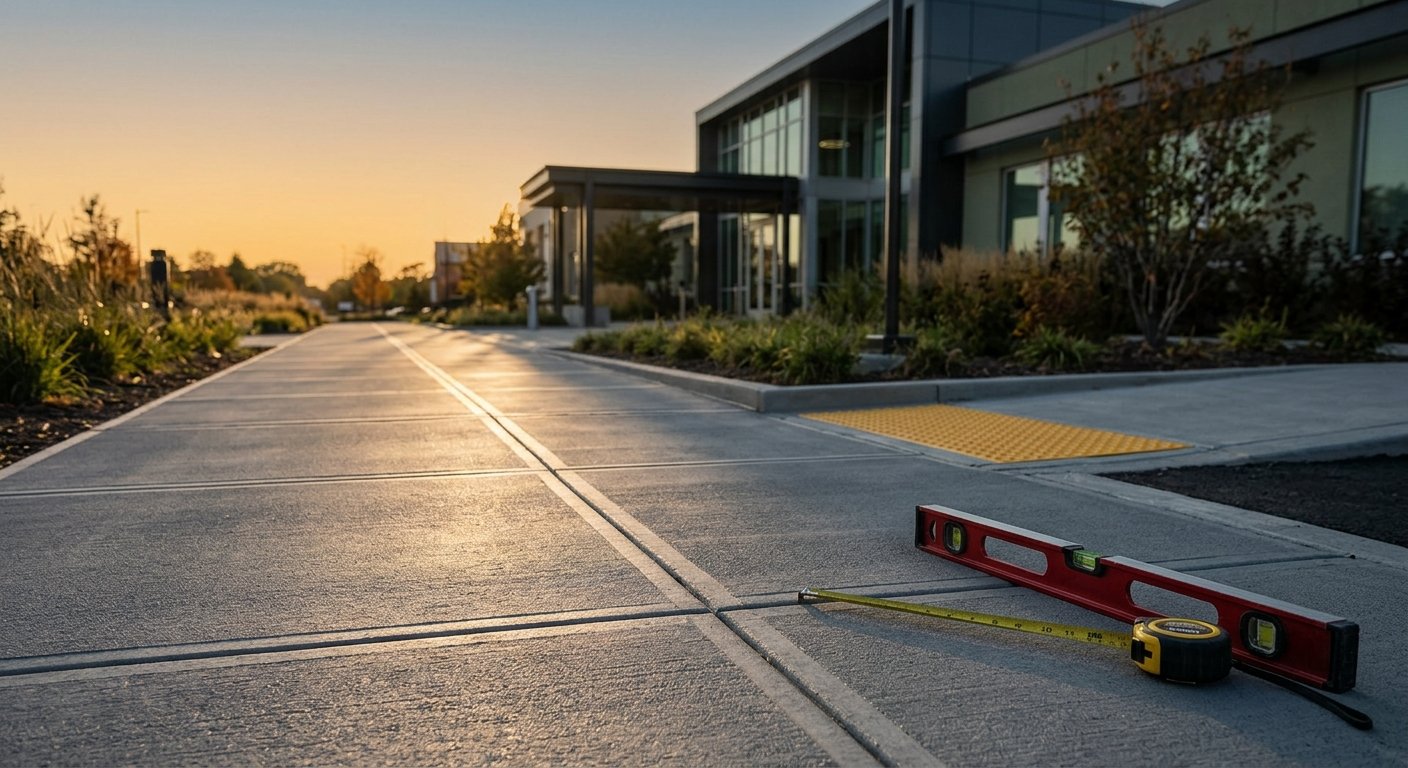
ADA sidewalk slope requirements set two critical limits: a maximum running slope of 1:20 (5%) along the direction of travel and a maximum cross slope of 1:50 (2%) perpendicular to travel. Any vertical change between adjacent concrete panels exceeding ¼ inch is considered a trip hazard and a compliance violation. These standards apply to all commercial properties, public rights-of-way, and facilities covered by the Americans with Disabilities Act.
- Running slopes must not exceed 1:20 (5%); cross slopes must not exceed 1:50 (2%) per ADA standards.
- A vertical height difference of more than ¼ inch between sidewalk panels constitutes a trip hazard and an ADA violation.
- Ramps with handrails are permitted up to a 1:12 slope when transitioning significant elevation changes.
- Patented concrete cutting can restore compliant slopes without full replacement, at a fraction of the cost.
- Property managers in Sacramento, Oakland, and Burlingame face real legal exposure from non-compliant walkways.
Why Slope Measurements Matter Under the ADA
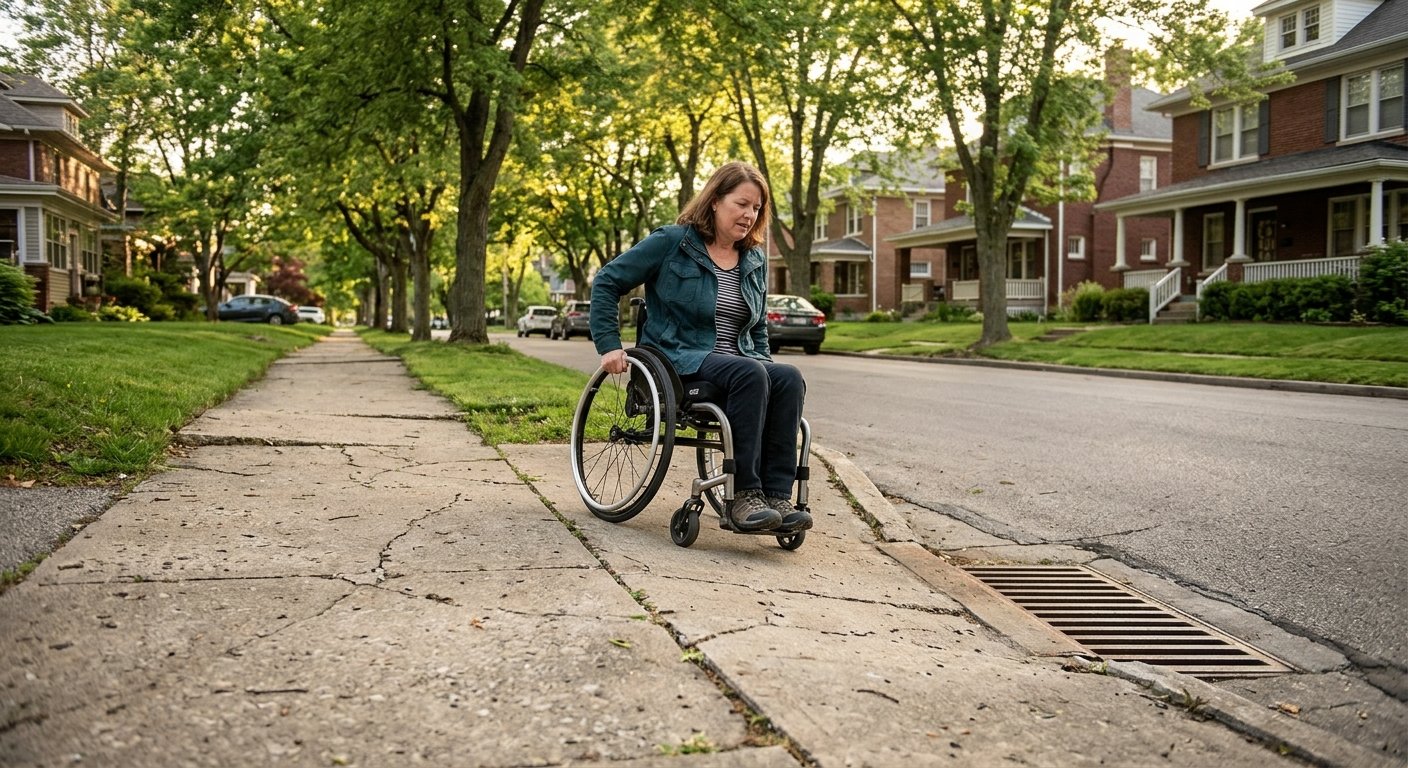
The Americans with Disabilities Act mandates that sidewalks and pedestrian routes remain accessible to individuals using wheelchairs, walkers, canes, and other mobility aids. Slope is not an abstract engineering metric — it directly determines whether a person with a mobility impairment can navigate a walkway safely or at all.
When a cross slope exceeds 1:50, a wheelchair user must exert significant lateral force to maintain a straight path, creating both fatigue and fall risk. When a running slope exceeds 1:20 without being properly designated as a ramp with handrails, users lose control of their pace going downhill and cannot generate enough force going uphill. Both conditions fail the fundamental accessibility requirement: an unobstructed, usable pedestrian path.
Legal exposure is equally concrete. Under Title II (public entities) and Title III (places of public accommodation) of the ADA, failure to maintain accessible routes can result in federal complaints, Department of Justice investigations, and civil litigation. For facilities directors and public works departments, non-compliant sidewalk slopes are not a deferred maintenance item — they are an active liability.
A ¼ inch vertical differential between concrete panels may seem minor, but it meets the ADA’s definition of a trip hazard and can form the basis of both an accessibility complaint and a premises liability claim. Proactive correction is always less costly than reactive litigation.
Understanding the Three Key Slope Standards
Running Slope
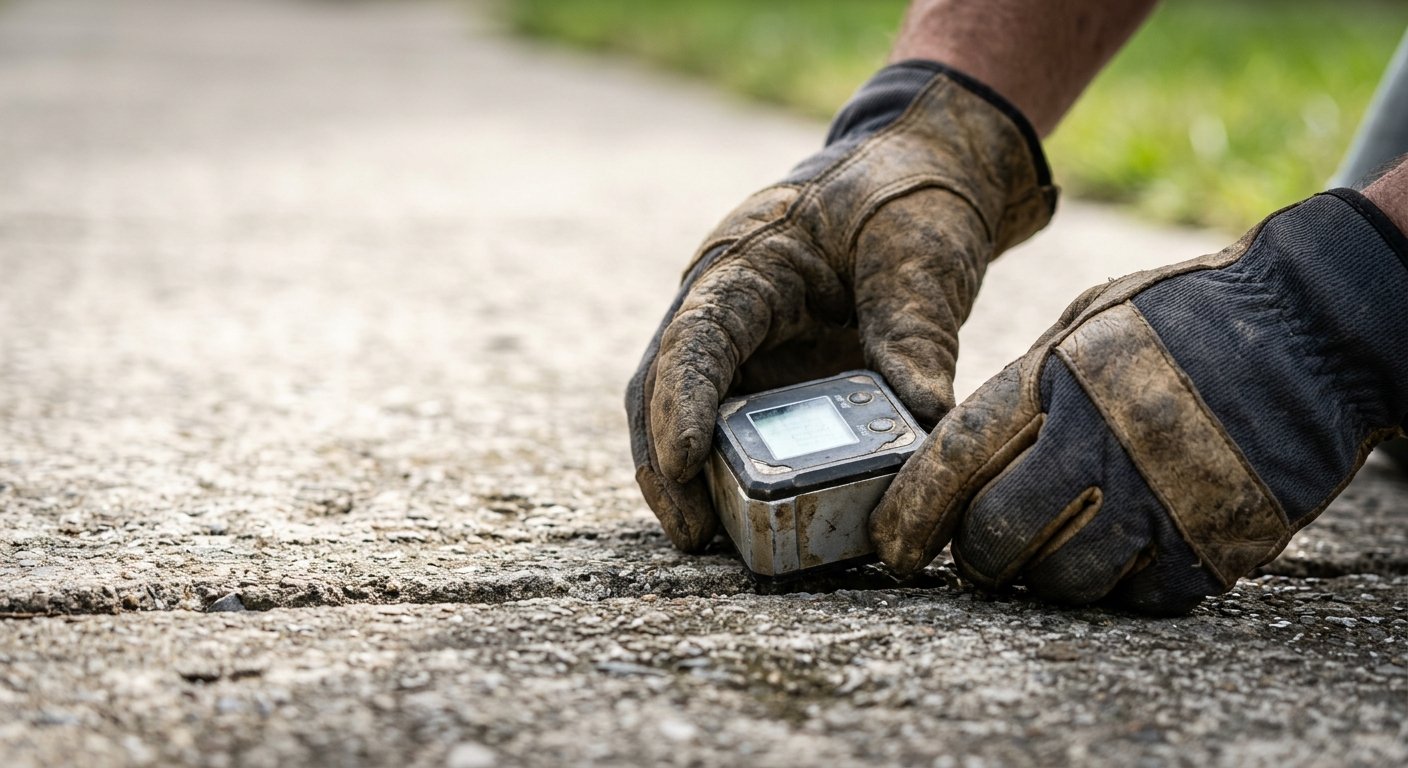
The running slope is measured parallel to the direction of travel. The U.S. Access Board’s ADA guidelines require that accessible routes maintain a running slope no steeper than 1:20, which equals a 5% grade. Slopes steeper than 1:20 must be engineered as formal ramps and include handrails, edge protection, and level landings — a significantly more complex and costly intervention.
Cross Slope
Cross slope runs perpendicular to the direction of travel. The maximum permitted is 1:50 (2%). Cross slopes often develop gradually due to soil settlement, tree root intrusion, or freeze-thaw cycles that shift individual concrete panels over time. Even small deviations from level can accumulate into a measurable compliance problem across a long walkway section.
Ramp Slope
When a change in elevation requires a ramp, the ADA permits a maximum slope of 1:12. This ratio allows a person in a wheelchair to ascend or descend with manageable effort. Ramps must also include level landings at the top and bottom and, when the rise exceeds 6 inches or the run exceeds 72 inches, handrails on both sides.
How to Identify Non-Compliant Sections During a Walkthrough
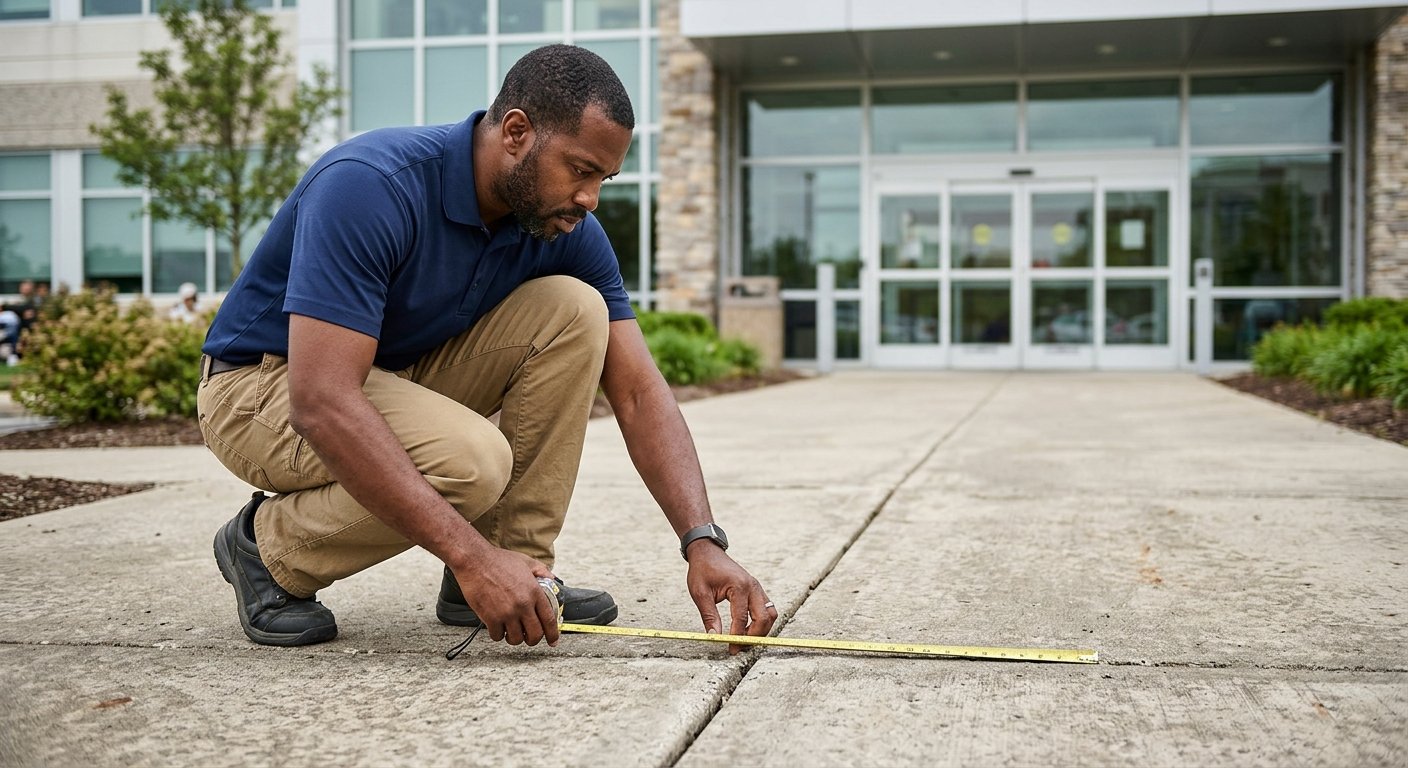
A systematic inspection does not require expensive equipment to begin. Facilities directors and property managers can conduct a preliminary assessment with a digital level, a tape measure, and a checklist. The goal is to identify sections where slope, panel differential, or surface texture has drifted outside compliance thresholds.
Map Your Pedestrian Routes
Identify all routes required to be accessible under your ADA transition plan or facility assessment. Prioritize primary entrances, parking lot connections, and paths to public transportation stops.
Measure Panel Differentials
At each joint between panels, place a straight edge across the gap and measure the vertical height difference. Any reading above ¼ inch requires correction. Document location, measurement, and photograph each defect.
Check Cross Slope with a Digital Level
Place a 4-foot level perpendicular to the direction of travel and read the slope percentage. Readings above 2% indicate a cross slope violation that could prevent wheelchair users from maintaining a straight path.
Assess Running Slope on Inclined Sections
On any section that follows a grade, confirm the running slope does not exceed 5%. Sections exceeding this threshold without ramp designation and handrails must be reclassified and corrected.
Evaluate Surface Texture
OSHA-compliant slip resistance requires surfaces that remain stable and slip-resistant under wet and dry conditions. Polished, spalled, or heavily worn concrete may need attention beyond slope correction alone.
Grinding vs. Cutting vs. Full Replacement
Once non-compliant sections are identified, facilities managers face a choice of correction method. Each approach carries different outcomes for compliance, cost, and disruption. Understanding the differences helps decision-makers allocate budgets effectively and avoid repeat failures. For a broader comparison of approaches, the guide on quick fixes for uneven sidewalks provides useful context across multiple methods.
| Criterion | Grinding | Patented Cutting | Full Replacement |
|---|---|---|---|
| ADA slope compliance | Partial — addresses vertical lips only | Full — achieves zero differential and correct slope | Full — when properly installed |
| Cross slope correction | No | Yes | Yes |
| Relative cost | Low but limited | 70-90% less than replacement | Highest cost option |
| Disruption to operations | Minimal | Minimal | Significant — cure time required |
| Environmental impact | Dust and debris | Debris recycled | High — full concrete disposal |
| Surface texture result | Variable | OSHA-compliant slip resistance | Depends on contractor |
Traditional concrete grinding removes material from the high side of a panel lip to reduce the vertical differential. It is effective for isolated, minor lips, but it cannot correct cross slope, correct running slope, or address panels that have rotated or settled unevenly. Grinding leaves a tapered bevel that reduces the trip hazard but rarely achieves the precise slope ratios the ADA requires.
Full concrete replacement is the most disruptive and expensive option. It requires saw-cutting the existing slab, breaking out and disposing of the material, forming and pouring new concrete, and waiting for cure — typically several days before the area can be re-opened. When slope issues are widespread, replacement costs can be prohibitive for municipal budgets and commercial property managers alike.
Getting the slope right the first time protects both people and property — compliance is not a cosmetic standard, it is a functional one.
Precision Concrete Cutting’s patented cutting method addresses the limitations of both alternatives. By making precise cuts beneath panel sections and adjusting the slab to the correct elevation and slope, the process achieves zero differential between panels and ADA-compliant slopes — including the 1:12 ramp standard where applicable. The result meets both ADA and OSHA slip-resistance requirements without the cost or timeline of replacement. Debris generated during the process is recycled, reducing the environmental footprint of the repair. For properties served across Sacramento, Oakland, and Burlingame, this approach offers a cost-effective path to full compliance. Learn more about the full scope of sidewalk trip hazard repair and how the cutting method is applied in practice.
When scheduling a sidewalk inspection, prioritize sections near accessible parking spaces, building entrances, and curb ramps — these are the most heavily trafficked accessible routes and the most frequently cited in ADA complaints and DOJ investigations.
Legal Standing and Proactive Maintenance
ADA compliance is not a one-time certification. Sidewalk surfaces change as soil settles, tree roots expand, and concrete panels shift seasonally. A walkway that was compliant at installation may fall out of compliance within a few years without ongoing monitoring and correction.
For public entities subject to Title II, an ADA transition plan must include a schedule for evaluating and correcting pedestrian infrastructure. For private commercial property owners under Title III, the obligation is to remove barriers when doing so is “readily achievable” — a standard that courts have consistently interpreted to include low-cost repairs like slope correction. Maintaining accurate inspection records and promptly correcting identified deficiencies demonstrates good-faith compliance efforts, which carries weight in any legal proceeding.
Proactive sidewalk maintenance also reduces premises liability exposure under California law, independent of federal ADA requirements. A documented inspection and repair program supports a property owner’s defense that reasonable care was exercised to maintain safe conditions. For a deeper look at ADA compliance obligations and how they apply to commercial sidewalk maintenance, the resource on ADA-compliant sidewalk repair covers the regulatory framework in detail.
Frequently Asked Questions
What is the maximum cross slope allowed on an ADA-compliant sidewalk?
The maximum cross slope on an accessible pedestrian route is 1:50, which equals 2%. Slopes exceeding this threshold make it difficult or impossible for wheelchair users to maintain a straight path and constitute an ADA violation requiring correction.
How much vertical difference between sidewalk panels is a trip hazard?
Any vertical height change greater than ¼ inch between adjacent concrete panels is classified as a trip hazard under ADA standards. This threshold applies regardless of how the differential was created — settlement, root intrusion, or heaving are all equally non-compliant.
Can concrete grinding fully restore ADA compliance?
Grinding can reduce a vertical lip between panels but typically cannot correct cross slope or running slope deviations. It addresses the symptom at the joint rather than the underlying slope condition, which means a panel that has rotated or settled out of level will not achieve full ADA compliance through grinding alone.
Is full concrete replacement necessary to fix non-compliant slopes?
Not in most cases. A patented concrete cutting method can precisely correct slope and eliminate panel differentials without removing and replacing the slab. This approach restores ADA-compliant slopes at significantly lower cost and with far less operational disruption than full replacement.
How often should commercial sidewalks be inspected for ADA compliance?
Annual inspections are a reasonable baseline, with additional assessments following significant weather events, ground movement, or visible surface changes. Public entities with ADA transition plan obligations should maintain documented inspection schedules as part of their ongoing compliance program.
Get a Professional Slope Assessment
Precision Concrete Cutting serves property managers, public works departments, and commercial owners throughout Sacramento, Oakland, and Burlingame — using patented cutting technology to deliver ADA-compliant results without the cost of full replacement.

About Precision Concrete Cutting
Precision Concrete Cutting provides ADA-compliant sidewalk repair and trip hazard correction services for property managers, municipal facilities, and commercial property owners throughout Northern California. Using a patented concrete cutting method, the company delivers cost-effective solutions that are 70-90% less expensive than replacement while achieving zero differential and ADA-compliant slopes. The approach emphasizes safety, regulatory compliance, environmental responsibility through debris recycling, and rapid completion that minimizes disruption. Visit pccnorcal.com →