
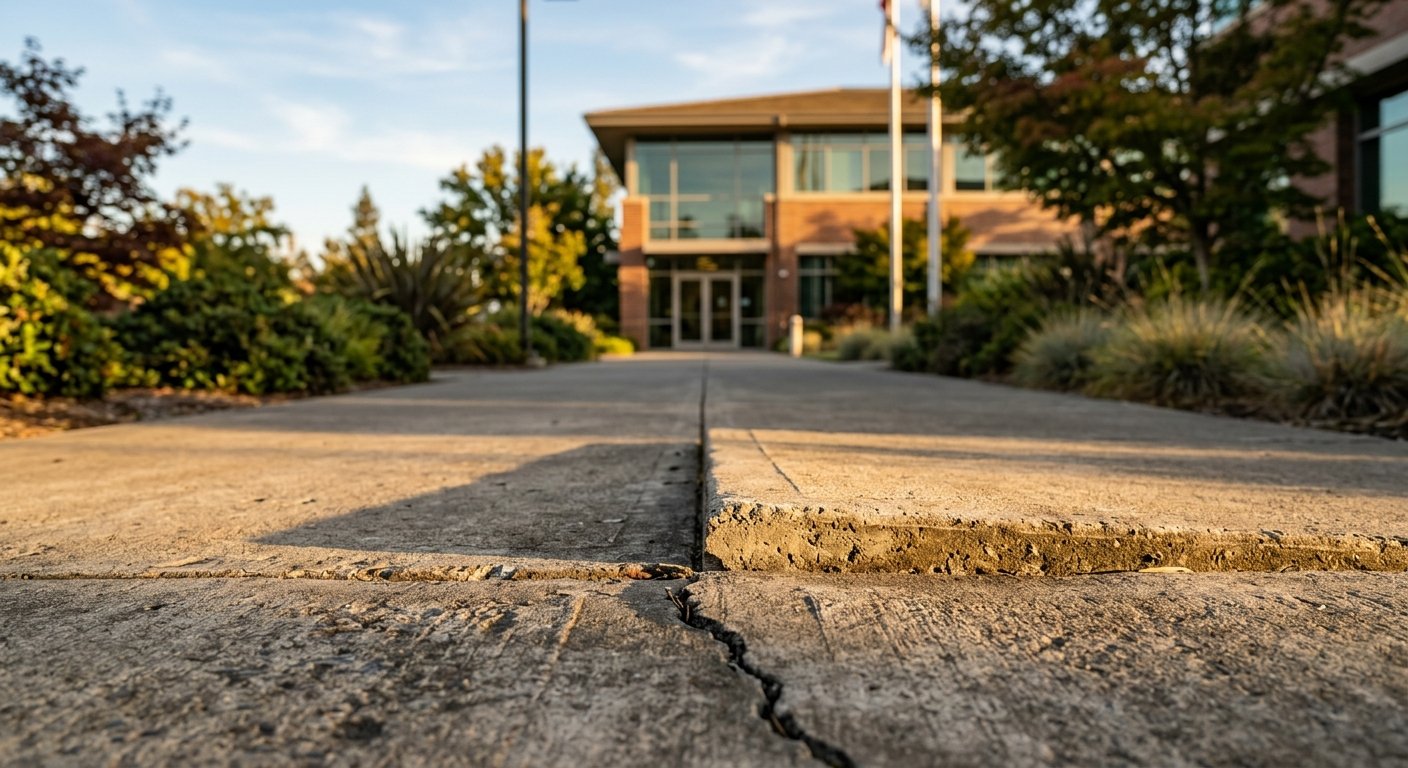
A single trip hazard on your sidewalk can result in a six-figure lawsuit. That’s not a worst-case scenario — it’s an increasingly common reality for property managers and facility directors across Northern California who delay or overlook sidewalk maintenance. In 2026, with ADA enforcement activity at an all-time high and plaintiff attorneys actively targeting commercial and municipal properties with documented hazards, understanding your sidewalk liability exposure is no longer optional. It’s a core responsibility of property ownership.
This guide breaks down how sidewalk liability works, what regulations actually require, and how proactive trip hazard removal can dramatically reduce your legal and financial risk.
What Is Sidewalk Liability?
Sidewalk liability refers to a property owner’s legal responsibility when someone is injured due to a hazardous walkway condition on or adjacent to their property. In California, property owners — including commercial landlords, HOAs, municipalities, school districts, and facility managers — have a legal duty of care to maintain safe walking surfaces accessible to the public.
When that duty is breached and someone is injured, the injured party can sue for medical costs, lost wages, pain and suffering, and in some cases punitive damages. California courts have consistently upheld this liability standard, and the burden often falls on the property owner to demonstrate they exercised reasonable care in inspecting and maintaining their walkways.
What constitutes a hazardous condition? Under the ADA Title II and Title III regulations, any vertical change in a walking surface greater than ¼ inch is considered a trip hazard. Even a small concrete lip — something easy to overlook during a routine walk-through — meets the threshold for a reportable and litigable defect.
The Real Cost of Inaction
Property managers sometimes delay sidewalk repairs because they’re focused on other budget priorities. The financial logic seems straightforward: why spend money fixing something that hasn’t caused a problem yet? But this reasoning fails when you account for the actual cost of a slip-and-fall claim.
Average settlements for pedestrian trip-and-fall cases in California can range from $30,000 to well over $200,000 depending on injury severity, documentation of prior knowledge of the hazard, and the plaintiff’s legal representation. In cases where a property owner had been notified of a hazard — by a tenant complaint, inspection report, or prior near-miss — courts view the failure to act as negligence, and damage awards increase accordingly.
Beyond direct legal costs, there’s the ripple effect: increased insurance premiums, reputational damage to commercial properties, disruption to operations during litigation, and the administrative burden on facility management staff. Proactive sidewalk trip hazard repair consistently proves less expensive than the consequences of ignoring it.
ADA Compliance Is Not Optional
The Americans with Disabilities Act sets clear standards for accessible walking surfaces. For property managers and municipal public works departments, compliance isn’t just a best practice — it’s a federal requirement with enforcement mechanisms that include complaints, investigations, and consent decrees.
Key ADA sidewalk standards relevant to liability include:
- Vertical changes: No vertical level change greater than ¼ inch is permitted without a beveled transition. Changes between ¼ inch and ½ inch must be beveled at a 1:2 slope.
- Cross-slope: Sidewalk cross-slopes must not exceed 1:48 (approximately 2%).
- Running slope: Accessible routes must maintain slopes no steeper than 1:20 unless designated as a ramp, in which case a 1:12 slope standard applies.
- Surface stability: Walking surfaces must be stable, firm, and slip-resistant under the U.S. Access Board’s ADA Accessibility Guidelines.
For commercial property owners in Sacramento, Oakland, and Burlingame, these aren’t abstract regulations. Municipal code enforcement and ADA-related complaints are active channels through which non-compliant properties face legal exposure. The question isn’t whether you’ll eventually need to address uneven concrete sidewalk repair — it’s whether you’ll do it proactively or reactively.
Why Traditional Repairs Often Fall Short
When property managers finally address sidewalk hazards, they often default to two options: concrete grinding or full slab replacement. Both have significant drawbacks.
Concrete grinding can reduce a trip hazard, but it rarely achieves true ADA compliance. Grinding tends to leave residual surface irregularities, and without precise slope control, the repaired area may still fail to meet the 1:12 ramp standard or introduce new cross-slope issues. It’s also a temporary fix — grinding removes material without addressing the underlying cause of displacement, and the hazard often returns within a few seasons.
Full slab replacement is expensive, disruptive, and time-consuming. Replacing concrete in a commercial parking lot entrance or a high-traffic municipal walkway can cost thousands of dollars per panel, require extended closure of the affected area, and generate significant concrete waste that ends up in landfills.
Neither option consistently delivers the precision needed for documented ADA compliance, and neither is particularly cost-effective for large portfolios of properties with multiple hazard locations.
A Better Approach: Precision Concrete Cutting
Precision Concrete Cutting uses a patented concrete cutting method that offers a fundamentally different approach to commercial sidewalk repair. Rather than grinding the surface or demolishing and replacing the slab, the cutting method precisely removes the raised section of concrete to achieve a zero differential between panels while maintaining ADA-compliant slopes.
The results are measurable and documentable:
- Zero differential: The cut edge achieves a flush transition between panels, eliminating the trip hazard entirely rather than minimizing it.
- ADA-compliant slopes: The cutting angle produces slopes that meet the 1:12 standard required for accessible routes.
- OSHA-compliant slip resistance: The cut surface maintains appropriate texture for safe pedestrian use in both wet and dry conditions.
- Cost efficiency: The patented method typically costs 70-90% less than full slab replacement, making it feasible to address multiple hazard locations within a standard maintenance budget.
- Environmental responsibility: Concrete debris from the cutting process is collected and recycled, reducing landfill waste compared to demolition-and-replace methods.
For property managers overseeing large commercial campuses or municipal facilities directors managing city sidewalks across Sacramento, Oakland, or Burlingame, this approach means being able to address more hazards in less time and at a fraction of the traditional cost — while achieving compliance that holds up to scrutiny.
Documentation: Your Best Defense
Even the most well-maintained property will occasionally develop sidewalk hazards due to tree root growth, soil settlement, seismic activity, and the natural aging of concrete. In California, particularly in urban areas with mature street trees, root-induced sidewalk displacement is one of the leading causes of trip hazards on commercial and municipal properties.
What separates a defensible position from an indefensible one in litigation is documentation. Property managers who can demonstrate a systematic approach to sidewalk inspection, hazard identification, and timely repair are in a far stronger legal position than those who cannot.
Best practices for documentation include:
- Conducting scheduled sidewalk inspections at least twice annually and after significant weather events
- Photographing and measuring any identified hazards, including vertical differentials exceeding ¼ inch
- Maintaining repair records that specify the date, location, and method of each repair
- Retaining certificates or documentation from your repair contractor confirming ADA-compliant outcomes
Learn more about building a compliant sidewalk maintenance program by reviewing our ADA compliance sidewalk resources.
Frequently Asked Questions
How much vertical difference makes a sidewalk legally hazardous?
Under ADA standards, any vertical change greater than ¼ inch in a walking surface is considered a trip hazard. Changes between ¼ inch and ½ inch require a beveled transition. Anything above ½ inch must be treated as a barrier to accessibility and repaired promptly to avoid liability exposure.
Who is responsible for sidewalk maintenance on commercial property?
In California, responsibility typically falls on the adjacent property owner, though specific rules vary by municipality. Commercial property owners, HOAs, and property managers are generally responsible for maintaining safe, ADA-compliant sidewalks along their property lines. Municipal properties follow similar obligations under public rights-of-way maintenance requirements.
Is concrete cutting as durable as slab replacement?
When performed using a precision method that achieves zero differential and correct slope, concrete cutting produces results that address the hazard at its source. The durability of the repair depends on the underlying cause of displacement — for instance, ongoing tree root intrusion may require root management in addition to surface repair. Precision cutting does not involve adding new material, so its longevity relates to the condition and stability of the existing slab.
Can precision cutting achieve ADA compliance certification?
Yes. Repairs performed using the patented cutting method can be documented to meet ADA slope and surface standards, providing property owners with defensible evidence of compliance. This documentation is a critical component of liability risk management for commercial and municipal properties.
How quickly can sidewalk hazards be repaired using this method?
The cutting process is significantly faster than concrete replacement. Most individual hazard locations can be addressed in a matter of hours rather than days, minimizing disruption to pedestrian traffic, tenants, and business operations. Properties with multiple hazard locations can often be completed in a single scheduled visit.
Take a Proactive Position on Sidewalk Safety
Sidewalk liability is a manageable risk — but only if you act before an incident occurs. The combination of increasing ADA enforcement, active litigation in California, and the relatively low cost of professional trip hazard removal makes proactive maintenance the clear choice for any property manager, facility director, or commercial property owner taking their responsibilities seriously.
Precision Concrete Cutting serves property owners and facility managers throughout Sacramento, Oakland, and Burlingame with licensed, insured services backed by a patented cutting technology that delivers ADA-compliant results at a fraction of replacement cost. Contact us today to schedule a site assessment and take the first step toward a safer, more compliant property.