
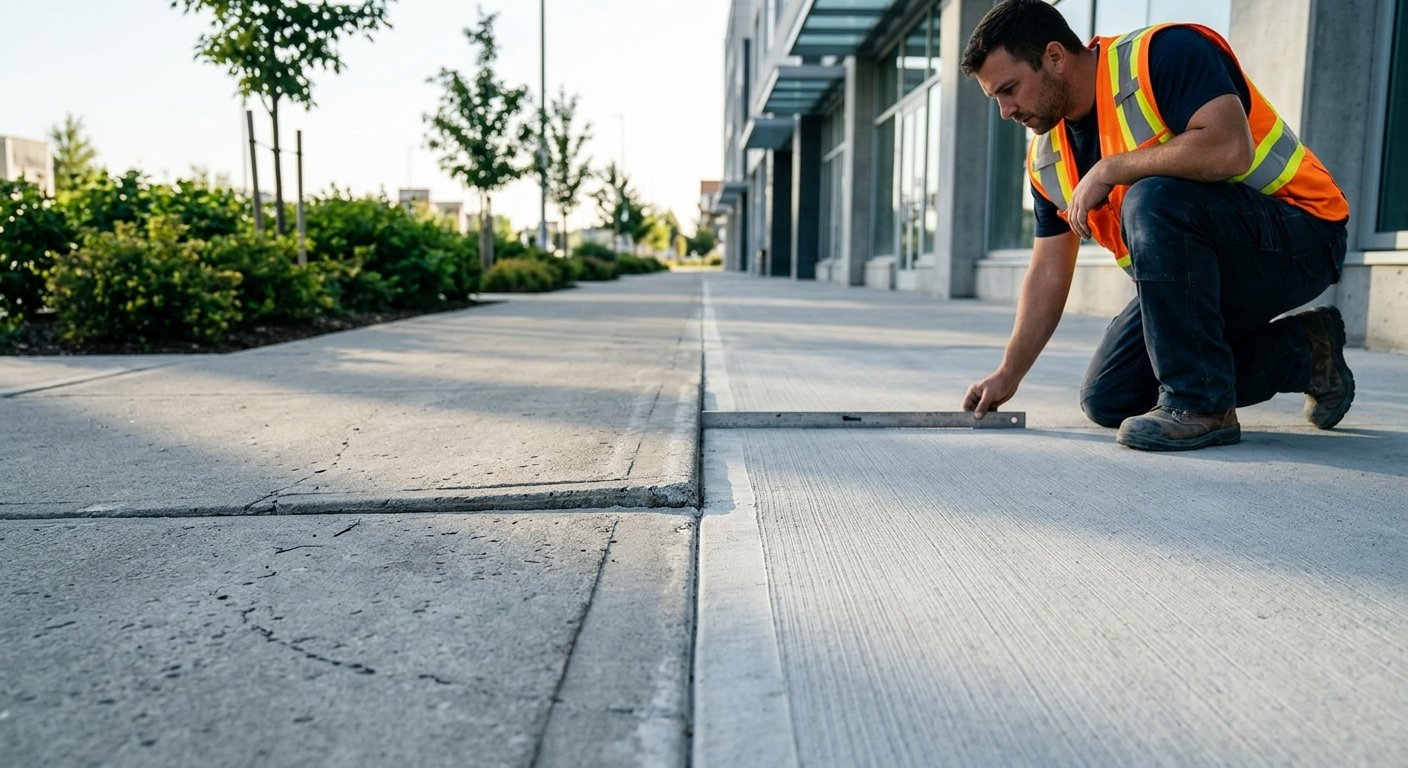
A single raised sidewalk slab can expose a property owner to tens of thousands of dollars in liability — yet the fix rarely requires tearing out and replacing the concrete. Still, many facility managers default to full replacement when they encounter an uneven sidewalk, often without realizing that cost-effective, ADA-compliant alternatives exist. In 2026, with construction material costs remaining elevated and municipal budgets stretched thin, understanding the real cost difference between concrete repair methods has never been more critical.
This analysis breaks down the costs, compliance implications, and long-term value of the two most common approaches: traditional concrete replacement and precision concrete cutting — a patented alternative to conventional grinding that delivers superior results at a fraction of the cost.
Why Sidewalk Repair Can’t Wait
Under the Americans with Disabilities Act, a vertical change of ¼ inch or more at a sidewalk joint is considered a trip hazard and a compliance violation. According to the ADA Standards for Accessible Design, accessible routes must be stable, firm, and slip-resistant — and any abrupt vertical change exceeding ½ inch is categorically prohibited.
For property managers in Sacramento, Oakland, and Burlingame, that means even minor surface displacement creates measurable legal exposure. Slip-and-fall claims involving uneven sidewalks consistently rank among the most common premises liability cases filed against commercial and municipal property owners. Proactive repair is not just good maintenance — it is a documented risk mitigation strategy.
But the question most decision-makers face is not whether to fix the problem. It’s which method delivers compliance at the best value.
The True Cost of Full Concrete Replacement
Full concrete replacement involves removing the existing slab, disposing of the debris, preparing the base, pouring new concrete, and allowing sufficient cure time before the area reopens. In 2026, commercial concrete replacement typically costs between $800 and $1,500 or more per panel, depending on slab thickness, access conditions, and site complexity. For a facility with multiple trip hazards across a large sidewalk network, those costs compound quickly.
Beyond the direct material and labor costs, replacement carries indirect costs that are often overlooked during the decision-making process:
- Extended closure time: Concrete cure time of 24–72 hours or more means walkways remain inaccessible, creating additional ADA access issues and disruption for building occupants and visitors.
- Debris disposal fees: Removed concrete must be hauled away and disposed of, adding landfill costs and environmental burden.
- Permit requirements: Many municipalities require permits for full slab replacement, adding administrative time and fees.
- Root and base issues: If tree roots or soil settlement caused the original displacement, replacement without addressing the underlying issue often results in recurrence.
Replacement is sometimes the right answer — particularly when a slab is severely deteriorated, structurally compromised, or when the overall concrete condition warrants it. But for the majority of trip hazard corrections, it is an expensive solution to a problem that does not require it.
What Is Precision Concrete Cutting?
Precision concrete cutting is a patented method that removes the raised edge of a displaced concrete slab to create a smooth, ADA-compliant transition. Unlike conventional grinding, which shaves the surface and can leave a rough, aesthetically inconsistent result, precision cutting uses specialized equipment to make clean, precise cuts that achieve zero differential between adjacent panels and produce ADA-compliant slopes of 1:12 — the standard required for accessible routes.
The process also maintains OSHA-compliant slip resistance on the repaired surface, a critical requirement that standard grinding can compromise by creating a texture that becomes dangerously smooth when wet.
Concrete debris generated during cutting is recycled, reducing environmental impact — a consideration that increasingly matters to municipalities and institutional facilities pursuing sustainability commitments.
The Cost Comparison: Cutting vs. Replacement
The financial case for precision concrete cutting as a concrete grinding alternative is straightforward. Compared to full replacement, precision cutting costs 70–90% less per repair location. For a property with 20 trip hazard locations, that difference can represent savings of $15,000 to $25,000 or more — funds that can be redirected toward other deferred maintenance priorities or capital projects.
Here’s how the two methods compare across key decision factors:
Direct Cost per Repair Location
- Full replacement: $800–$1,500+ per panel, plus disposal and permit fees
- Precision concrete cutting: Significantly lower per-location cost with no disposal fees
Downtime and Disruption
- Full replacement: 24–72+ hours of closure per area for curing
- Precision concrete cutting: Work areas can often be reopened the same day repairs are complete, minimizing disruption to building users and adjacent businesses
ADA Compliance Outcome
- Full replacement: Achieves compliance when properly installed, but new slabs can settle unevenly over time
- Precision concrete cutting: Achieves zero differential and a 1:12 ADA-compliant slope at the repair point, with OSHA-compliant slip resistance maintained
Environmental Impact
- Full replacement: Generates significant concrete waste for landfill disposal
- Precision concrete cutting: Debris is recycled, supporting environmental responsibility goals
Who Benefits Most from Precision Cutting?
Precision concrete cutting is particularly well-suited for commercial concrete repair scenarios where multiple trip hazards exist across a large property, where budget constraints require prioritizing cost-effectiveness, or where minimizing operational disruption is essential. The method delivers measurable value for:
- Property managers overseeing multi-building commercial or residential complexes in Sacramento, Oakland, or Burlingame with numerous sidewalk access points
- Municipal public works departments managing sidewalk maintenance across entire neighborhoods or districts on constrained annual budgets
- School district administrators responsible for accessible routes across campuses, where student foot traffic and ADA compliance are both paramount
- HOA boards seeking to maintain community walkways without imposing large special assessments on residents
- Facilities directors at healthcare, hospitality, or retail properties where safe pedestrian access is directly linked to operational integrity
For a broader overview of what qualifies as an ADA violation and how repairs are assessed, the U.S. Access Board’s ADA accessibility guidelines provide the regulatory foundation that governs sidewalk compliance requirements nationwide.
Understanding Uneven Sidewalk Repair Cost Factors
When evaluating uneven sidewalk repair cost for a specific property, several variables influence the final investment:
- Number of repair locations: More trip hazards typically allow for more efficient per-location pricing in a single mobilization
- Severity of displacement: A 1-inch vertical displacement requires more material removal than a ¼-inch offset, affecting time per location
- Accessibility: Locations with limited equipment access may take longer
- Surface area affected: Wider panels require more cutting passes
Engaging a licensed and insured contractor who can conduct an on-site assessment is the most reliable way to receive an accurate cost estimate. An assessment also identifies whether any locations genuinely require replacement rather than cutting — ensuring the repair strategy is correctly matched to conditions on the ground.
For more on the regulatory and safety dimensions of sidewalk maintenance, explore our detailed resources on ADA-compliant sidewalk repair, sidewalk trip hazard repair, and uneven concrete repair.
Frequently Asked Questions
What is the average uneven sidewalk repair cost compared to full replacement?
Precision concrete cutting typically costs 70–90% less than full slab replacement. While replacement can run $800–$1,500 or more per panel — plus disposal and permit costs — precision cutting delivers ADA-compliant results at a fraction of that investment, making it the preferred choice for most trip hazard corrections.
Is precision concrete cutting truly ADA compliant?
Yes. When performed correctly, precision concrete cutting achieves zero differential between panels and creates a 1:12 slope at the repaired transition — both meeting ADA Standards for Accessible Design. The repaired surface also maintains OSHA-compliant slip resistance, which standard grinding can sometimes compromise.
How long does it take to fix uneven concrete using the cutting method?
Most individual repair locations can be completed in under an hour, and unlike concrete replacement, there is no cure time required. Walkways can typically be reopened to foot traffic once the repair is complete, significantly reducing disruption compared to full replacement projects.
Can all trip hazards be corrected with concrete cutting rather than replacement?
Precision cutting is highly effective for the majority of trip hazards caused by slab displacement, settling, or root intrusion. However, concrete that is severely deteriorated, cracked through, or structurally compromised may require replacement. A professional site assessment will identify the appropriate repair method for each location.
Why does concrete leveling repair matter for liability management?
Under ADA standards and general premises liability law, property owners are responsible for maintaining accessible, hazard-free walkways. A documented trip hazard — defined as any vertical change of ¼ inch or more — creates legal exposure. According to the National Center for State Courts, premises liability claims are among the most frequently litigated civil cases in the U.S. Proactive repair creates a documented record of compliance effort, which is relevant in any liability assessment.
Making the Right Decision for Your Property
The data is clear: for most uneven concrete repair situations in commercial and municipal settings, full replacement is an expensive, disruptive choice when precision concrete cutting can deliver equal or superior ADA compliance outcomes at dramatically lower cost. The 70–90% cost savings are not theoretical — they reflect the difference between removing and replacing a massive concrete structure versus precisely correcting the specific surface dimension that created the hazard.
Property managers, facilities directors, and municipal decision-makers in Sacramento, Oakland, and Burlingame who are managing trip hazard corrections in 2026 should treat a site assessment as the essential first step. Understanding how many locations exist, what each requires, and what a compliant repair looks like is the foundation of a defensible, cost-effective sidewalk maintenance strategy.
Precision Concrete Cutting is licensed, insured, and equipped with patented cutting technology proven to achieve ADA-compliant results throughout Northern California. Contact us today to schedule a site assessment and receive a detailed cost comparison for your property.