
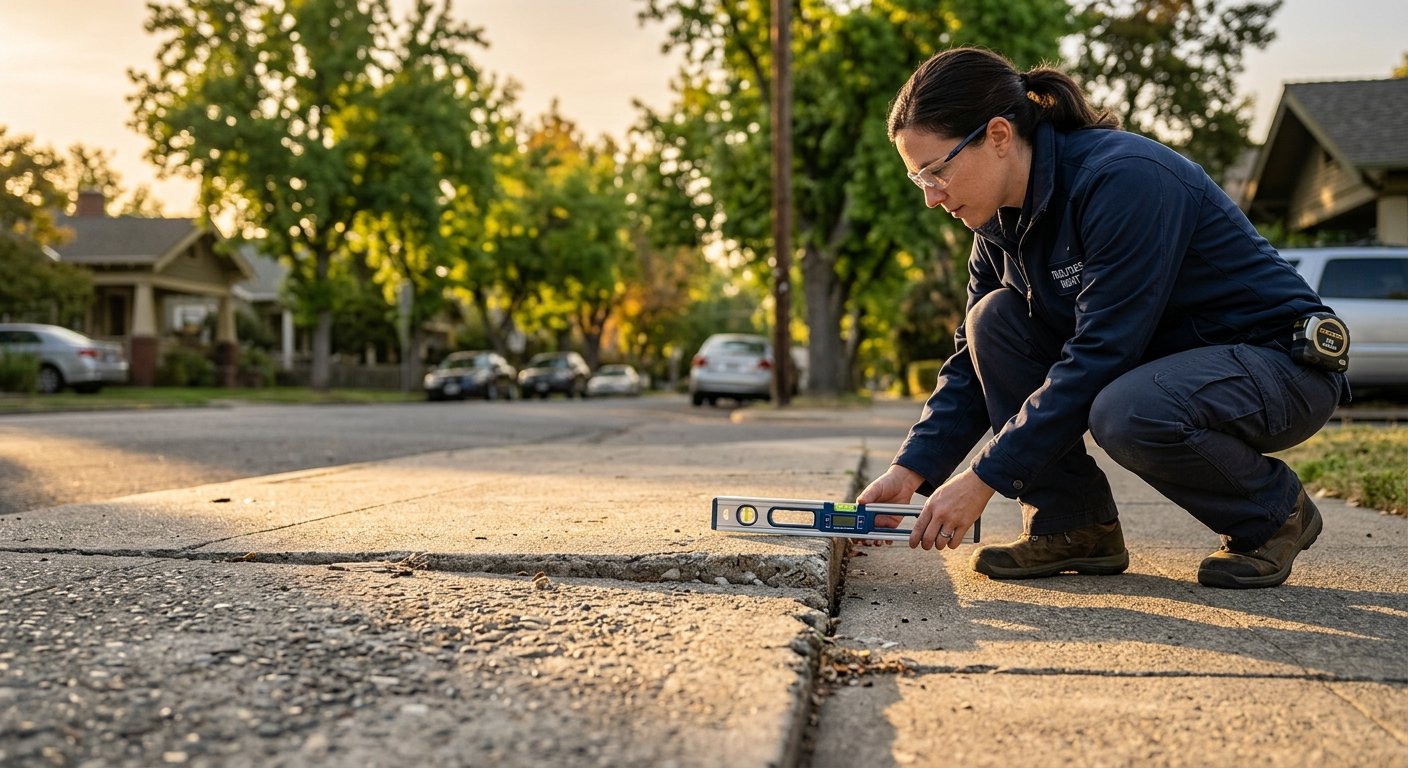
A quarter-inch. That’s all it takes — a vertical change of just ¼ inch in a sidewalk panel — to create an ADA-recognized trip hazard and expose your property to significant liability. For property managers and facilities directors across Sacramento, Oakland, and Burlingame, that’s not a hypothetical risk. It’s a daily reality on aging concrete walkways that shift, settle, and separate every season.
This guide covers what you need to know about concrete leveling in Northern California in 2026: how it works, what it costs, why the method matters, and how to make the right decision for your property.
Why Uneven Concrete Is a Bigger Problem Than It Looks
Concrete doesn’t fail overnight. It settles gradually — millimeters at a time — until one panel sits noticeably higher than the next. The problem is that by the time a lip is visible to the naked eye, it’s often already past the legal threshold for a compliant surface.
According to the U.S. Access Board’s ADA standards, a vertical change greater than ¼ inch constitutes a trip hazard requiring correction. Changes between ¼ inch and ½ inch must be beveled at a slope no steeper than 1:2. Anything beyond ½ inch requires a full transition ramp at a maximum 1:12 slope.
These aren’t suggestions — they’re enforceable standards. Municipalities, school districts, HOA boards, and commercial property owners in California can face formal complaints, lawsuits, or regulatory action when sidewalks fall out of compliance. The California Division of the State Architect actively enforces ADA compliance for public accommodations, and the exposure for non-compliant facilities is both legal and financial.
Beyond legal liability, there’s a straightforward human cost. Falls on uneven concrete surfaces result in serious injuries every year, particularly for elderly pedestrians and individuals with mobility impairments. Proactive repair is always less costly than reactive response.
What Is Concrete Leveling Repair — and How Does It Work?
Concrete leveling refers to the process of correcting height differentials between adjacent concrete panels without removing and replacing the slab. There are several methods used in the industry, and they differ significantly in cost, precision, and long-term results.
Traditional Grinding
Grinding shaves down the raised edge of a concrete panel using rotary cutting equipment. While it removes the lip, it often leaves a rough, beveled transition that may not meet ADA slope requirements. It also removes surface material, which can reduce the structural integrity of thinner slabs over time.
Mudjacking and Foam Injection
These methods inject material beneath a sunken slab to raise it back toward level. Mudjacking uses a cement-soil slurry; polyurethane foam injection is a newer variation. Both approaches attempt to address the root cause — a void or settling beneath the slab — but results vary depending on soil conditions, and the surface itself may still require further finishing to achieve compliant transitions.
The Patented Concrete Cutting Method
Precision Concrete Cutting uses a patented cutting process specifically engineered for trip hazard correction and ADA compliance. Rather than grinding the surface or injecting material from below, this method precisely cuts the raised concrete panel to achieve a zero differential at the joint and a smooth, ADA-compliant 1:12 slope transition.
The results are measurable and consistent:
- Zero differential at the panel joint
- ADA-compliant slopes of 1:12 or less
- OSHA-compliant slip resistance on finished surfaces
- No added materials that could degrade, crack, or separate over time
Because the method works directly on existing concrete rather than introducing new materials, it creates a durable, integral solution rather than a patch. All debris generated during the process is recycled, making it an environmentally responsible choice for facilities with sustainability commitments.
For a deeper look at the full scope of this approach, see the overview of uneven concrete repair services available throughout Northern California.
Uneven Concrete Repair Cost: What to Expect in 2026
Cost is consistently the first question property managers ask — and for good reason. Budgets are finite, and deferred maintenance tends to compound. Here’s how the numbers break down in practical terms.
Full concrete panel replacement in California currently runs between $300 and $600 per panel for residential-scale work, and significantly more for commercial or municipal projects when you factor in permitting, traffic control, demolition, disposal, and curing time. A sidewalk with 20 non-compliant panels could easily represent $10,000 to $15,000 or more in replacement costs.
The patented cutting method is 70 to 90 percent less expensive than full replacement. That cost differential makes it possible to address an entire property’s trip hazards — rather than cherry-picking the most visible ones — within a reasonable maintenance budget.
Beyond the direct cost comparison, consider the indirect costs of replacement: lane closures, business disruption, extended curing periods before the surface can be used, and the carbon footprint of disposing of old concrete. The cutting method eliminates most of these concerns. Most projects are completed quickly, with surfaces immediately usable, and no demolition waste sent to a landfill.
For property managers making the business case to ownership or boards, the cost-per-hazard metric is particularly compelling. Addressing 30 trip hazards through cutting typically costs less than replacing three or four panels through conventional methods.
ADA Compliance: The Regulatory Framework That Matters
Commercial property owners and municipal facilities directors in California operate under overlapping compliance frameworks. Federal ADA requirements establish the baseline, while California’s Title 24 and related statutes often impose stricter standards.
What matters most in practice is documentation. When a complaint is filed or an inspection conducted, the question isn’t just whether the hazard exists today — it’s whether the property owner had notice of the hazard and took reasonable steps to address it. A documented repair program using a compliant, professional method creates a defensible record of good-faith maintenance.
This is why the approach taken to repair matters as much as the speed of response. A grinding job that leaves a non-compliant bevel doesn’t resolve the liability. An injection repair that settles unevenly within months doesn’t either. Achieving zero differential and verified ADA-compliant slopes is the standard that fully resolves the issue.
Learn more about the specific compliance requirements and how professional repair addresses them on the ADA compliance sidewalk resource page.
Who Should Prioritize Concrete Surface Leveling
Not every property carries the same level of risk. The following categories of facilities typically have the highest exposure and the greatest urgency for proactive concrete leveling repair:
- Municipal public works departments — Sidewalks adjacent to public rights-of-way carry direct municipal liability. Sacramento, Oakland, and Burlingame all operate under ADA transition plan requirements.
- School districts — High foot traffic, diverse mobility needs among students and staff, and heightened duty-of-care standards make campus walkways a priority.
- HOA-managed communities — Common areas, parking lot walkways, and community pathways are the HOA’s direct responsibility.
- Commercial property managers — Tenant-facing walkways, loading areas, and parking lot pedestrian paths are high-traffic, high-visibility surfaces where trip hazards create acute liability.
- Healthcare facilities — Patient populations often include individuals with mobility impairments, making compliant walkways both a safety imperative and a regulatory requirement.
For any of these property types, waiting for a fall to happen before scheduling repairs represents a significant and unnecessary risk. The cost of one personal injury claim almost always exceeds the cost of a complete commercial concrete repair program for an entire property.
The Northern California Advantage: Local Knowledge Matters
Concrete in Northern California faces specific conditions that influence how and why slabs shift. Urban areas like Oakland and Sacramento have aging infrastructure with concrete sidewalks installed decades before modern ADA standards existed. Root intrusion from mature street trees is a persistent cause of panel lifting throughout these cities. Soil composition and drainage patterns in the Sacramento Valley also contribute to differential settling.
Working with a licensed, insured contractor who serves Sacramento, Oakland, and Burlingame specifically means working with a team that understands these local variables — and has the experience to assess and address them efficiently. Precision Concrete Cutting serves these communities with patented cutting technology calibrated to the real conditions Northern California properties present.
For more on what professional trip hazard correction involves in practice, the sidewalk trip hazard repair page provides detailed information on the assessment and repair process.
Frequently Asked Questions
What qualifies as a trip hazard under ADA standards?
Any vertical change greater than ¼ inch between adjacent concrete surfaces qualifies as an ADA trip hazard. Changes between ¼ and ½ inch must be beveled; anything over ½ inch requires a full ramp transition at a maximum 1:12 slope.
How much does concrete leveling cost compared to replacement?
The patented cutting method used by Precision Concrete Cutting is typically 70 to 90 percent less expensive than full concrete panel replacement. Exact costs depend on the number of hazards, severity of displacement, and site conditions.
How long does a commercial concrete repair project take?
Most projects are completed in a single day and require no curing time — surfaces are immediately usable after the work is complete. Project duration scales with the number of hazards being corrected.
Is concrete cutting as durable as replacement?
Yes. Because the method works with the existing concrete rather than adding patch materials, there’s no new material to crack, separate, or settle. The correction is made to the slab itself, producing a stable, integral result.
Does Precision Concrete Cutting serve my area?
Precision Concrete Cutting serves Sacramento, Oakland, and Burlingame, along with surrounding Northern California communities. Contact the team directly to discuss your property’s specific needs.
Take the Next Step Toward a Compliant, Safe Property
Uneven concrete is a manageable problem — when it’s addressed before a fall occurs. Precision Concrete Cutting offers Northern California property managers, municipalities, and commercial owners a faster, more cost-effective path to ADA compliance through patented cutting technology that delivers verifiable results: zero differential, compliant slopes, and slip-resistant surfaces.
If your property has sidewalks with visible panel displacement, or if it’s been more than a year since your last formal inspection, now is the time to act. Contact Precision Concrete Cutting to schedule a site assessment and get a clear picture of what compliant, affordable concrete leveling repair looks like for your property.