
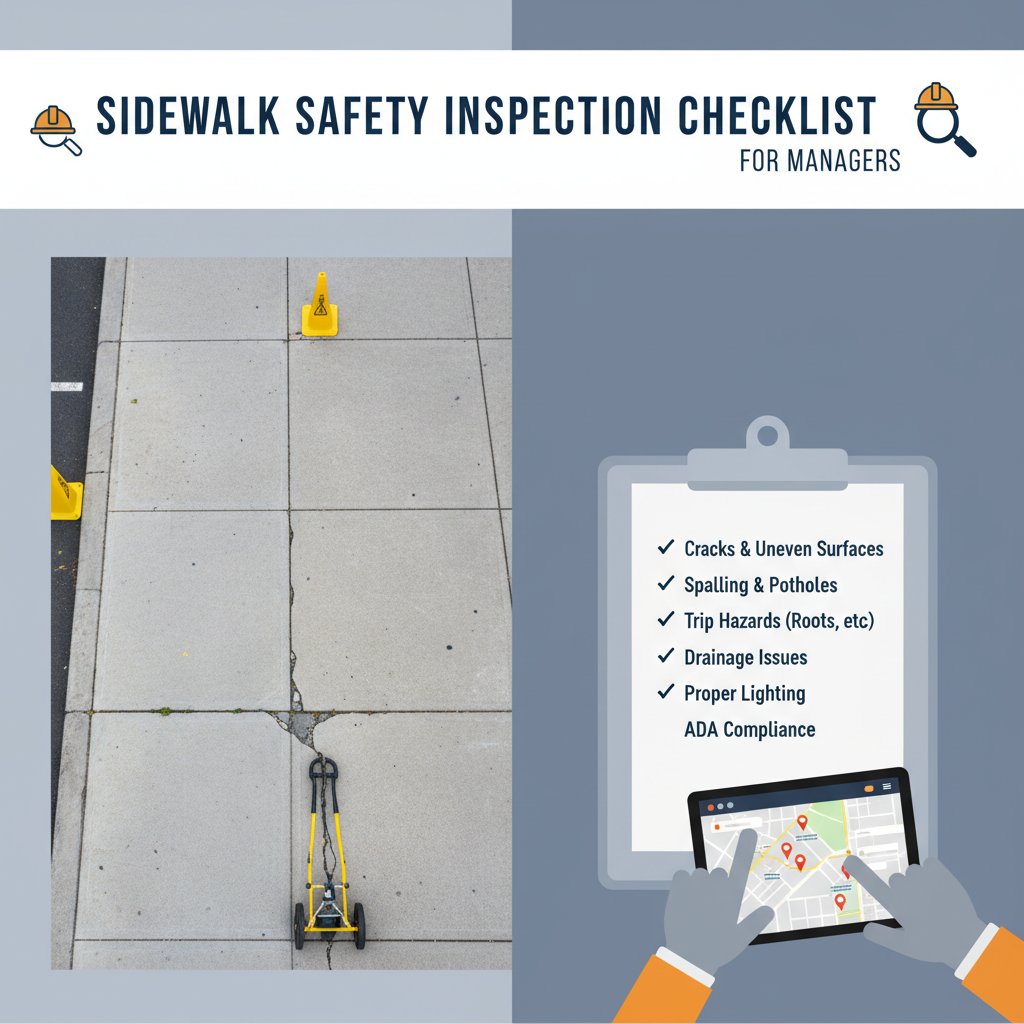
Property managers face significant liability when sidewalk defects cause pedestrian injuries. In 2026, premises liability lawsuits related to trip-and-fall accidents continue to cost property owners millions annually, with average settlements ranging from $50,000 to over $300,000 depending on injury severity. The good news? Most incidents are entirely preventable through systematic sidewalk inspections and proactive maintenance.
This comprehensive inspection checklist provides property managers, facilities directors, and municipal administrators with a practical framework for identifying hazards, prioritizing repairs, and maintaining ADA-compliant pedestrian walkways. Understanding what to look for—and when to take action—protects both pedestrians and your organization’s financial interests.
Understanding Legal Thresholds for Trip Hazards
Before conducting inspections, property managers must understand the regulatory standards that define actionable trip hazards. The Americans with Disabilities Act (ADA) establishes a vertical displacement threshold of ¼ inch as the maximum allowable height difference between adjacent concrete sections. Any vertical change exceeding this quarter-inch measurement creates a non-compliant condition requiring correction.
This seemingly small measurement carries substantial legal weight. Property owners who knowingly allow violations to persist face increased liability in personal injury claims. Courts frequently find defendants negligent when documented hazards remained unaddressed, transforming preventable accidents into expensive legal battles.
Beyond federal ADA requirements, many municipalities enforce additional local ordinances governing sidewalk maintenance. Property managers should consult with local building departments to understand jurisdiction-specific regulations, inspection frequencies, and repair timelines that may exceed federal minimums.
Pre-Inspection Preparation
Effective sidewalk safety inspections require proper planning and documentation tools. Before beginning your assessment, gather:
- Digital camera or smartphone for photographic documentation
- Measuring tape and feeler gauge for precise displacement measurements
- Clipboard with inspection forms or tablet with digital inspection software
- Marking paint or chalk to flag identified hazards
- Property maps showing all pedestrian walkways
- Previous inspection reports for comparison
Schedule inspections during daylight hours when visibility is optimal. Conduct assessments during dry conditions, as wet surfaces can obscure cracks, spalling, and other defects. Plan to inspect all pedestrian-accessible areas, including main sidewalks, crosswalks, curb ramps, building approaches, and parking lot walkways.
The Essential Sidewalk Safety Inspection Checklist
1. Vertical Displacement and Trip Hazards
Begin by systematically examining every sidewalk joint and crack for vertical displacement. Use a feeler gauge or measuring tape to quantify height differences. Document any separation exceeding ¼ inch as requiring immediate attention for sidewalk trip hazard repair.
Pay particular attention to areas where tree roots create uplift, settling has occurred, or soil erosion has undermined concrete sections. These conditions frequently produce the uneven surfaces that cause pedestrian falls. Mark each identified trip hazard location with paint and photograph from multiple angles, including close-ups showing measurement tools for scale.
2. Surface Condition Assessment
Examine concrete surfaces for deterioration that compromises safety or accessibility:
- Spalling: Surface flaking or chipping that creates rough, uneven texture
- Cracking: Fissures that may widen over time or allow water infiltration
- Scaling: Surface layer separation exposing aggregate
- Pitting: Small holes or depressions that collect water
- Disintegration: Advanced deterioration requiring replacement
Surface defects don’t just present trip hazards—they also affect slip resistance. OSHA requires walking surfaces to maintain adequate traction. Severely worn or polished concrete may fail to meet slip resistance standards, particularly when wet.
3. ADA-Compliant Slope Verification
Conducting an ADA sidewalk inspection requires verifying that slopes meet accessibility standards. Maximum running slope for accessible routes is 5% (1:20), while maximum cross slope is 2% (1:50). Curb ramps must maintain slopes no steeper than 1:12.
Use a digital level or inclinometer to measure slopes at curb ramps, transitions, and areas where grade changes occur. Non-compliant slopes create accessibility barriers for wheelchair users and individuals with mobility limitations. Document any areas exceeding ADA slope requirements as priority corrections to eliminate trip hazards and ensure accessibility.
4. Drainage and Ponding Issues
Examine walkways after rainfall to identify areas where water accumulates. Ponding indicates improper drainage slope, settlement, or surface depression. Standing water creates slip hazards, accelerates concrete deterioration through freeze-thaw cycles, and produces accessibility barriers.
Note locations where drainage directs water across pedestrian paths or where inadequate slope prevents proper runoff. These conditions require correction through releveling or reconstruction to restore proper drainage patterns.
5. Joint and Edge Condition
Inspect control joints, expansion joints, and sidewalk edges for separation, deterioration, or missing joint material. Damaged joints allow water infiltration that undermines the base, leading to settlement and vertical displacement.
Check edges where sidewalks meet grass, landscaping, or other surfaces. Erosion along edges often precedes more serious structural problems. Early identification allows cost-effective intervention before major repairs become necessary.
6. Vegetation Interference
Tree roots represent one of the most common causes of sidewalk uplift and trip hazard formation. During inspections, identify trees adjacent to walkways showing signs of root interference—cracking, lifting, or displacement of concrete sections.
Document vegetation encroachment that narrows effective walkway width below ADA-required minimums (typically 36 inches, though 48 inches is recommended). Overgrown landscaping creates accessibility barriers and may conceal trip hazards from pedestrian view.
7. Lighting and Visibility
Adequate lighting is essential for nighttime pedestrian safety. Note areas where insufficient illumination may prevent pedestrians from seeing trip hazards. While not always part of sidewalk maintenance responsibility, lighting deficiencies contribute to accidents and should be documented.
Prioritizing Repairs Based on Risk Assessment
Not all identified defects carry equal urgency. Property managers must prioritize sidewalk safety repair based on risk factors:
Immediate Priority (Address Within Days): Vertical displacements exceeding ½ inch, severe surface deterioration in high-traffic areas, non-compliant curb ramps at building entrances, or any condition presenting imminent danger.
High Priority (Address Within 30 Days): Vertical displacements of ¼ to ½ inch, moderate surface spalling, drainage problems causing ponding, accessibility slope violations.
Medium Priority (Address Within 90 Days): Minor surface cracking, edge deterioration without displacement, vegetation encroachment, joint deterioration.
Monitor (Address Within Annual Cycle): Cosmetic issues without safety impact, minor scaling, hairline cracks.
High-traffic areas serving elderly populations, schools, or medical facilities warrant elevated priority regardless of defect severity. The potential for serious injury increases in these contexts, as does legal liability exposure.
Cost-Effective Solutions for Identified Hazards
Once inspections identify problems requiring correction, property managers face decisions about repair methodology. Traditional approaches—complete section replacement or grinding—have dominated commercial sidewalk repair for decades, but innovative alternatives now offer superior results at dramatically reduced costs.
Total replacement involves removing and replacing entire concrete sections. While this addresses underlying structural problems, costs typically range from $8 to $15 per square foot, requires extended work zones, generates substantial debris, and may take weeks to complete for large properties.
Grinding uses rotating diamond wheels to reduce raised sections, creating a beveled transition. This approach costs $3 to $6 per linear foot but often leaves unsightly scars, may not achieve full ADA compliance, and removes protective surface layers, potentially accelerating deterioration.
The patented cutting method represents an advanced solution for commercial sidewalk repair that addresses trip hazards while maintaining structural integrity. This precision technique uses specialized equipment to make surgical cuts along joints and strategic internal cuts, then applies controlled pressure to lower raised sections back to flush alignment with adjacent concrete.
This approach delivers zero differential results that fully eliminate trip hazards and ensure ADA compliant sidewalk repair. The process costs 70-90% less than replacement while completing repairs in a fraction of the time. Treated sections maintain OSHA-compliant slip resistance without the surface scarring grinding creates.
Environmental responsibility represents another advantage—the cutting method recycles all debris, avoiding the landfill impact of replacement projects that may generate tons of concrete waste from large properties.
Documentation and Liability Management
Thorough documentation transforms inspections from routine maintenance into powerful liability protection. Photograph every identified hazard with date stamps enabled. Record precise measurements, locations using property maps or GPS coordinates, and detailed descriptions of each defect.
Maintain comprehensive inspection logs showing frequency, areas covered, conditions found, and corrective actions taken. This documentation demonstrates the reasonable care standard that courts apply in premises liability cases. Property owners who conduct regular inspections and address identified hazards promptly establish strong defenses against negligence claims.
When hazards cannot be corrected immediately, deploy temporary protective measures. High-visibility warning signs, barricades, or temporary ramping reduce interim accident risk while permanent repairs are scheduled. Document these interim measures photographically.
Establishing Ongoing Inspection Schedules
Single inspections provide snapshots, but sidewalk safety requires ongoing vigilance. Establish inspection frequencies appropriate to your property characteristics:
- High-traffic commercial properties: Quarterly comprehensive inspections with monthly spot checks
- Multi-family residential communities: Semi-annual comprehensive inspections
- Municipal sidewalk systems: Annual comprehensive inspections with complaint-response protocols
- Low-traffic areas: Annual inspections with event-triggered assessments after severe weather
Implement systems for documenting inspection completion, tracking repair status, and triggering follow-up assessments. Property management software with maintenance modules can automate scheduling and documentation workflows.
Protecting Pedestrians and Your Investment
Systematic sidewalk inspections using this comprehensive checklist transform liability exposure into manageable risk. Property managers who implement regular assessment schedules, prioritize repairs appropriately, and choose cost-effective repair solutions protect both pedestrians and organizational finances.
The quarter-inch ADA threshold isn’t merely a technical specification—it represents the difference between safe passage and serious injury. Understanding what to inspect, how to document findings, and which repair approaches deliver lasting, compliant results empowers property managers to maintain safe, accessible pedestrian environments while controlling costs.
If your inspection has identified trip hazards requiring correction, contact sidewalk safety specialists who utilize advanced cutting methods to fix uneven sidewalk conditions quickly and cost-effectively. Professional assessment can help you prioritize repairs, understand your options, and implement solutions that eliminate sidewalk liability while preserving your maintenance budget for other critical property needs.