
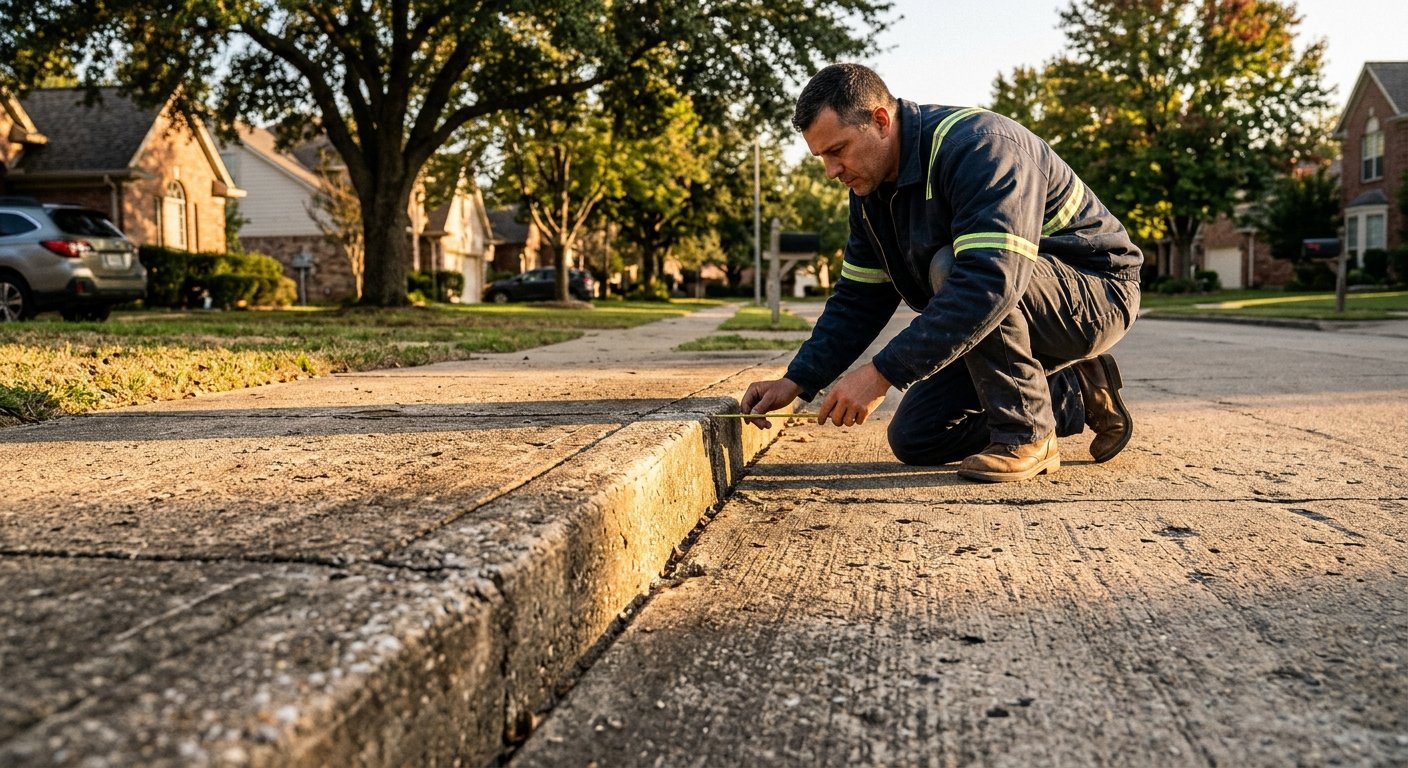
Concrete leveling and concrete grinding solve different problems. Leveling (mudjacking or polyurethane lifting) raises a sunken slab back toward its original position. Grinding — or more precisely, precision cutting — shaves a raised edge flush with the adjacent panel. Property managers and public works departments need to understand which defect they’re looking at before choosing a repair method, because selecting the wrong one wastes money and may still leave a code violation.
- Concrete leveling lifts a sunken slab; concrete cutting removes a raised lip — they are not interchangeable.
- The ADA defines a trip hazard as any vertical change greater than ¼ inch at a walkway joint or crack.
- Precision concrete cutting achieves zero differential between panels and ADA-compliant cross-slopes of 1:12 without full replacement.
- Cutting costs 70–90% less than slab replacement and recycles the removed material — no landfill waste.
- Choosing the wrong repair method can leave a property out of compliance and exposed to liability.
Understanding the Two Most Common Sidewalk Defects
Uneven concrete sidewalk repair starts with an accurate diagnosis. Sidewalk panels fail in two distinct ways, and each requires a different correction strategy.
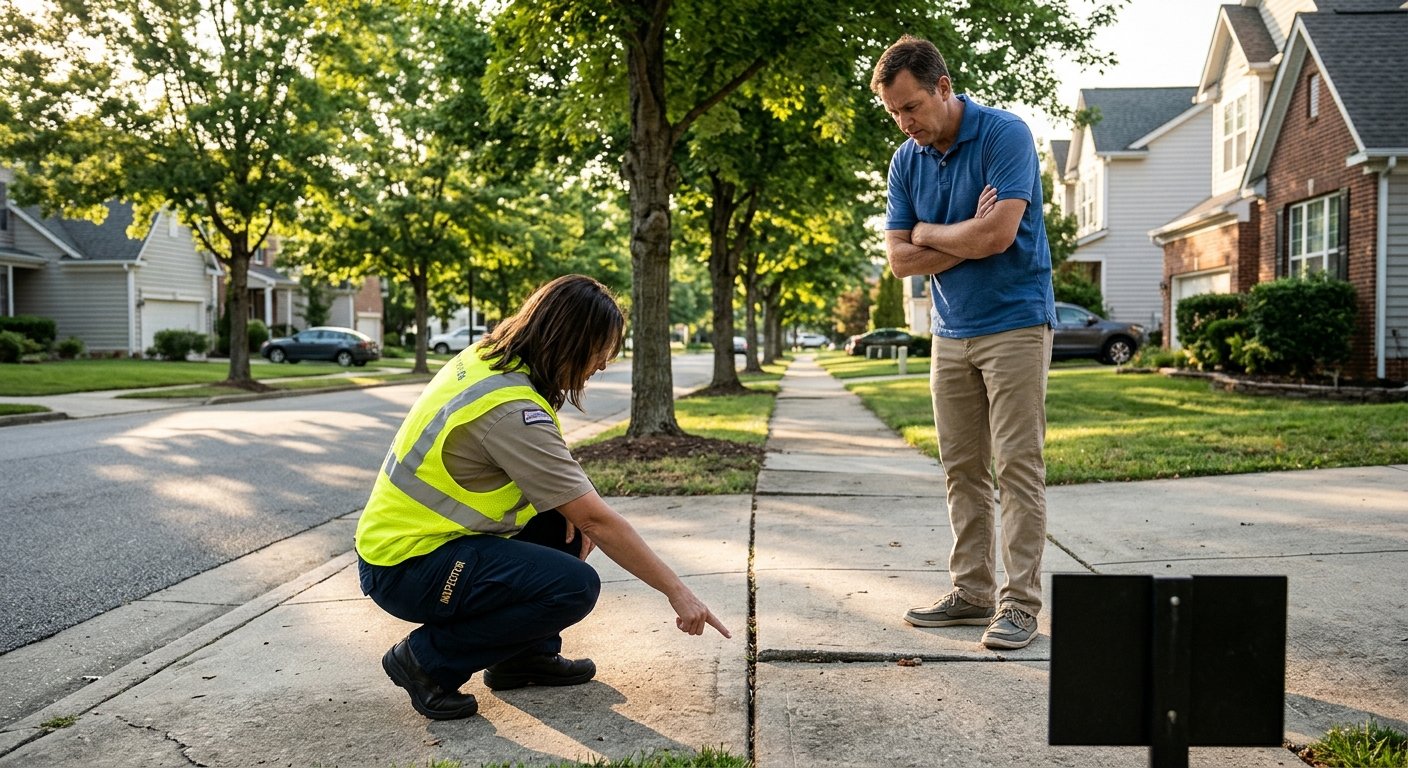
The first is slab settlement — one panel sinks below its neighbor because the soil or base beneath it has eroded, washed out, or compressed over time. The result is a low panel with a raised lip on the adjacent slab. The second is slab uplift, most often caused by tree root pressure or freeze-thaw cycles, where one panel is pushed upward, creating the same visible lip but from the opposite direction.
Both defects produce a vertical edge differential that pedestrians can catch a foot on — the classic trip hazard. But the underlying cause determines whether leveling, cutting, or a combination of both is the right fix.
The U.S. Access Board’s ADA guidelines require that changes in level greater than ¼ inch at walking surfaces be beveled, and changes greater than ½ inch must be ramped with a slope no greater than 1:12. A vertical edge of even ⅜ inch creates a code violation and a documented liability exposure.
What Concrete Leveling Actually Does
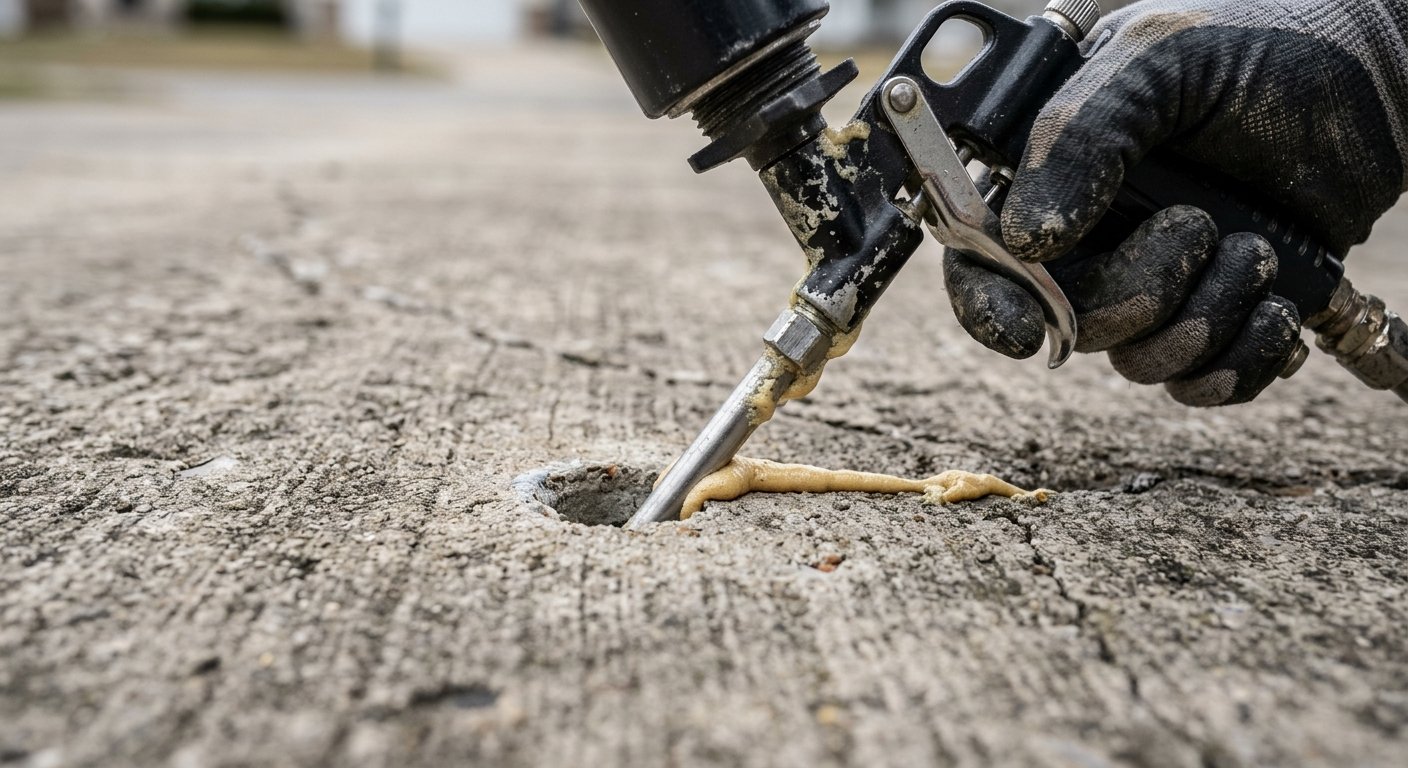
Concrete leveling — whether through mudjacking (pumping a cementitious slurry beneath the slab) or polyurethane foam injection — attempts to raise a sunken panel by re-establishing support underneath it. The theory is sound: if a lack of sub-base is causing the slab to sit low, restoring that support should bring it back to grade.
In practice, leveling has meaningful limitations for commercial and municipal applications:
- Slope control is imprecise. Hydraulic pressure distributes unevenly through the soil, making it difficult to achieve consistent cross-slopes that meet the ADA’s 1:12 requirement. The slab may come up, but not necessarily level.
- Tree root conflicts persist. If root pressure caused the uplift, leveling the adjacent low panel doesn’t address the root — and may create a new differential within months.
- Surface condition is unchanged. Leveling does nothing to reduce the lip height at the joint. A panel lifted two inches is still two inches above its neighbor if that neighbor wasn’t also adjusted.
- Void confirmation is required. Without ground-penetrating radar or physical inspection, it’s difficult to know whether voids actually exist or whether settlement will recur.
Leveling has its place — particularly when a slab has genuinely lost sub-base support and the surface itself is structurally sound. But it is not a universal fix for uneven concrete slab repair, and it rarely produces the documented, measurable ADA compliance that commercial property owners need.
What Concrete Grinding (and Precision Cutting) Does
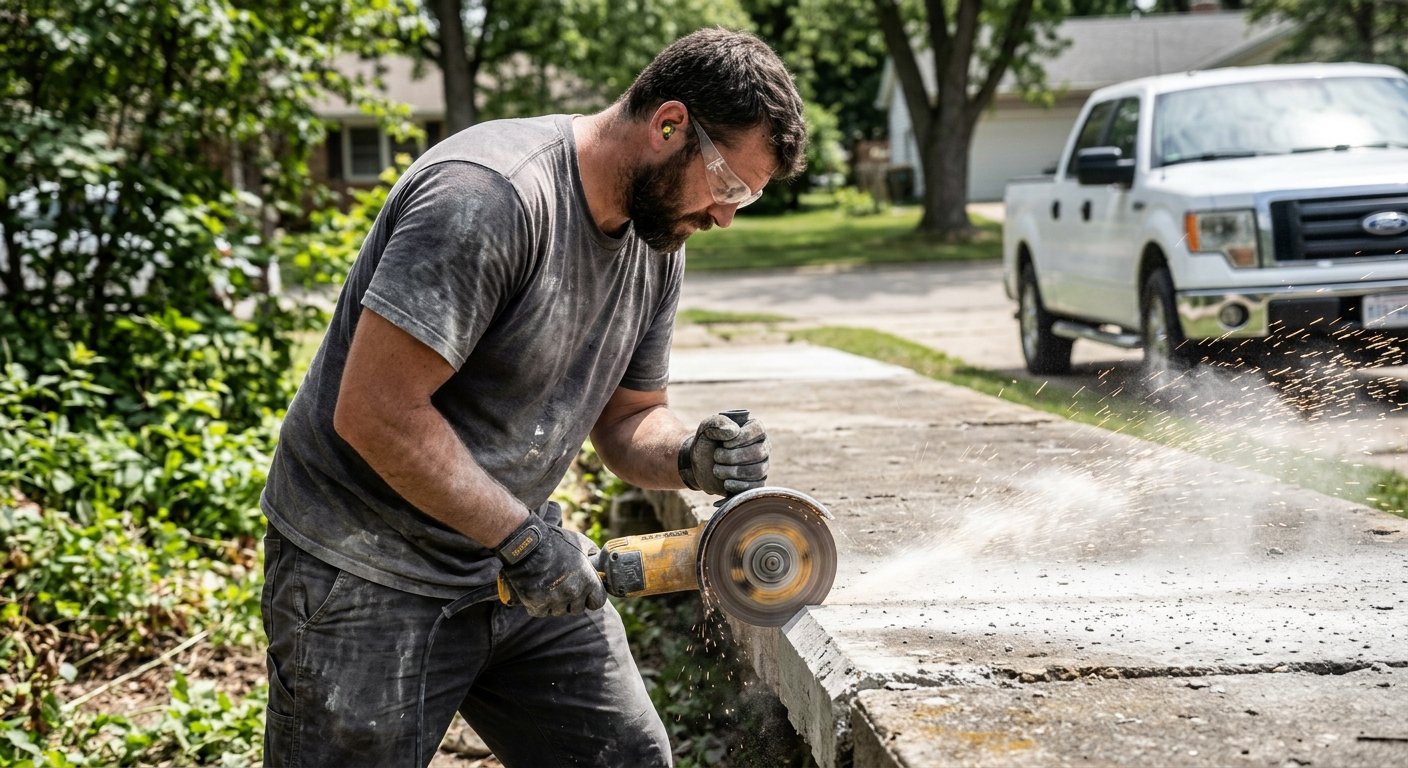
Traditional concrete grinding uses abrasive wheels to shave down a raised edge. It’s a faster, lower-tech approach than leveling, but it comes with significant drawbacks: grinding creates a tapered bevel rather than a flush transition, leaves a rough surface texture, and typically cannot remove enough material to correct larger differentials without compromising the structural integrity of the panel edge.
Precision concrete cutting is a fundamentally different process. Using a patented cutting method, the raised section of concrete is removed in a controlled, precise manner — producing a flat, flush surface between adjacent panels with zero differential. The result meets ADA slope requirements (1:12) and OSHA slip-resistance standards simultaneously. The removed material is recycled rather than sent to landfill, supporting environmentally responsible facility management.
Precision cutting removes the raised edge entirely, producing zero differential — the standard that grinding rarely achieves and leveling cannot address at all.
For property managers in Sacramento, Oakland, and Burlingame who need documented ADA compliance — not just a visual improvement — the distinction between grinding and precision cutting matters significantly. Learn more about the specific repair methods available for uneven concrete sidewalk repair and how the cutting approach compares to traditional alternatives.
| Factor | Concrete Leveling | Precision Concrete Cutting |
|---|---|---|
| Defect addressed | Sunken/settled slab | Raised lip or edge differential |
| ADA slope compliance | Difficult to confirm | Achieves documented 1:12 slope |
| Joint differential | May reduce; not eliminated | Zero differential achieved |
| Surface finish | Unchanged | OSHA-compliant slip resistance |
| Material disposal | Injection material added | Debris recycled |
| Cost vs. replacement | Less than replacement | 70–90% less than replacement |
| Recurrence risk | Higher if root/soil issue persists | Lower when root cause also addressed |
Matching the Repair to the Defect
The practical question for a facilities director or public works manager isn’t “which method is better” in the abstract — it’s which method addresses the specific defect in front of them.
When leveling may be appropriate
If a panel has clearly settled due to soil washout, no tree roots are involved, and sub-base voids are confirmed, leveling can be a reasonable intervention. It works best on interior walkways, patios, and areas with stable, well-drained soils. Even then, a follow-up evaluation of the joint differential after lifting is essential — if a lip remains, cutting may still be required to achieve ADA compliance.
When precision cutting is the right answer
For raised lips caused by tree root pressure or differential settling, precision cutting is the direct solution. It removes the hazard rather than attempting to realign the sub-base. It’s also the correct approach when the goal is documented compliance: the cutting process produces a measurable, verifiable result that property owners can point to during an inspection or, in a worst-case scenario, a liability review.
For a broader look at how these and other approaches compare for common sidewalk problems, the guide to quick fixes for uneven sidewalks walks through five repair strategies side by side.
Before scheduling any repair, photograph the differential with a ruler in frame. A documented pre-repair measurement protects you if a claim is filed, and it gives your repair contractor a baseline to work from. Post-repair documentation of the corrected slope is equally valuable.
Liability and Compliance — Why Method Selection Matters
The ADA Title II requirements that govern public sidewalks and government-owned facilities are not suggestions — municipalities, school districts, and public agencies face mandatory compliance obligations. For private commercial property owners, ADA Title III imposes parallel requirements on places of public accommodation.
A sidewalk repaired with the wrong method — one that still shows a ¼-inch or greater differential, or that introduces a cross-slope steeper than 1:12 — is not compliant, regardless of what was spent on the repair. Property owners who can demonstrate that they identified hazards, responded promptly, and achieved documented compliance are in a substantially stronger position than those who chose a cheaper-looking fix that didn’t solve the underlying problem.
Precision concrete cutting delivers that documented compliance. The cutting process is engineered to produce specific, measurable outcomes — zero differential between panels, correct slope angles — not approximations. For facilities teams responsible for ADA-compliant sidewalk maintenance, that measurability is the point. See how the full compliance framework applies to your property on the ADA sidewalk compliance service page.
Environmental and Operational Considerations
Beyond compliance, facilities directors increasingly face sustainability reporting requirements from their organizations. Traditional slab replacement generates significant concrete waste. Precision cutting minimizes the volume of material removed and recycles the debris — keeping it out of landfills and reducing the project’s environmental footprint.
Operationally, cutting is faster than replacement and requires no curing time for new poured concrete. Sidewalks can typically return to use the same day work is completed, which matters for schools, hospitals, retail centers, and municipal pathways that serve continuous foot traffic. The sidewalk trip hazard repair process is designed specifically to minimize downtime while delivering fully compliant results.
Frequently Asked Questions
Can concrete leveling achieve ADA compliance on its own?
Not reliably. Leveling can reduce a differential, but controlling the final slope to the ADA-required 1:12 ratio is difficult with hydraulic injection methods. After leveling, a joint inspection should confirm whether any remaining lip requires precision cutting to reach a zero-differential, compliant result.
What size lip is considered a trip hazard under ADA rules?
The U.S. Access Board’s ADA guidelines define any vertical change greater than ¼ inch as a hazardous level change requiring correction. Changes between ¼ inch and ½ inch must be beveled; anything over ½ inch requires a ramp with a slope no steeper than 1:12.
Is precision cutting appropriate for all types of concrete defects?
Precision cutting is specifically designed to address raised edges and differential settlement at panel joints. It is the appropriate solution when the defect produces a measurable vertical lip. Slabs with significant structural cracking, spalling, or sub-base failure may require a different evaluation before any surface repair is attempted.
How does precision cutting compare to full slab replacement in cost?
Precision concrete cutting costs 70–90% less than full slab replacement while achieving the same documented compliance outcome — zero differential and ADA-compliant slopes. Replacement also requires curing time and generates concrete waste; cutting does neither.
Which property types benefit most from precision concrete cutting?
Commercial properties, municipal sidewalks, school campuses, HOA common areas, and healthcare facilities all benefit significantly — any location where ADA compliance is mandatory, foot traffic is continuous, and budget efficiency is a priority. Precision Concrete Cutting serves property owners and public agencies throughout Sacramento, Oakland, and Burlingame.
Get a Professional Assessment of Your Sidewalk Hazards
Precision Concrete Cutting provides licensed, insured sidewalk trip hazard correction using patented cutting technology — serving Sacramento, Oakland, Burlingame, and surrounding Northern California communities. Contact us to schedule an evaluation and receive a documented repair plan that meets ADA and OSHA standards.

About Precision Concrete Cutting
Precision Concrete Cutting provides ADA-compliant sidewalk repair and trip hazard correction services for property managers, municipal facilities, and commercial property owners throughout Northern California. Using a patented concrete cutting method, the company delivers cost-effective solutions that are 70-90% less expensive than replacement while achieving zero differential and ADA-compliant slopes. The approach emphasizes safety, regulatory compliance, environmental responsibility through debris recycling, and rapid completion that minimizes disruption. Visit pccnorcal.com →