

A sidewalk inspection report documents every defect found on a property’s walkways, assigns a severity rating to each, and indicates whether the condition meets or violates ADA standards. For property managers, facilities directors, and HOA boards, understanding what those findings mean—and what action they require—is the difference between proactive risk management and unexpected liability.
- Any vertical change of 1⁄4 inch or more at a sidewalk joint is classified as a trip hazard under ADA standards and requires correction.
- Inspection reports use severity ratings—typically low, moderate, and high—to prioritize which defects demand immediate attention.
- Understanding the difference between grinding and cutting repairs helps you evaluate which remedy the report recommends and why it matters for long-term compliance.
- Proactive repair after an inspection is almost always significantly less expensive than slab replacement or litigation costs.
- Debris from concrete cutting can be recycled, making remediation both cost-effective and environmentally responsible.
Why Inspection Reports Exist and Who Generates Them
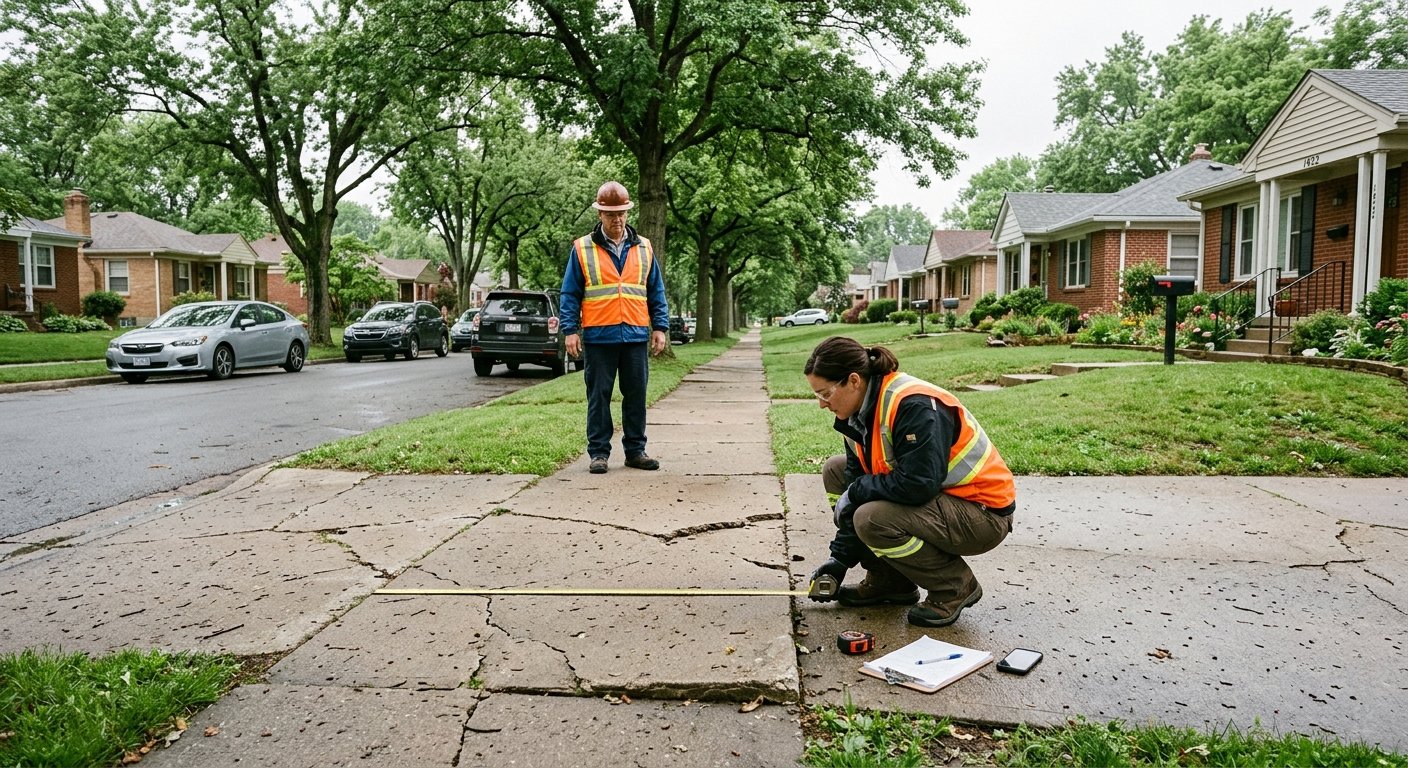
Sidewalk inspections are conducted by municipal public works departments, third-party accessibility consultants, or risk management firms hired by property owners. The goal is systematic documentation: every crack, raised panel, tilted slab, and surface deterioration is measured, photographed, and recorded so that maintenance teams and decision-makers have an objective baseline to act on.
In California, municipalities and property owners are expected to maintain walkways in a condition that meets the Americans with Disabilities Act’s accessibility requirements. The ADA’s Title II provisions apply to state and local government entities, while Title III covers commercial facilities—meaning most Northern California property managers operate under a clear legal obligation to correct identified hazards. Failing to act on a written inspection report can significantly complicate a property owner’s position in any subsequent personal injury claim.
Receiving a sidewalk inspection report and taking no action on documented high-severity defects creates a paper trail that may be used as evidence of known-but-unaddressed hazards in liability proceedings. Timely remediation is the safest course.
The Structure of a Standard Inspection Report

While formats vary by municipality and consultant, most sidewalk inspection reports share a consistent structure. Learning to navigate that structure quickly helps property managers triage their response.
Location Index and Site Map
The report typically opens with a location index—a numbered list or annotated map that assigns a unique ID to each defect. When you review a report, match the site map to the written findings before doing anything else. Knowing exactly where each issue is located prevents miscommunication with repair crews and ensures nothing is overlooked during remediation.
Defect Type Codes
Inspectors use standardized codes to classify defects. Common categories include vertical displacement (raised or sunken panels), surface deterioration (spalling or scaling), horizontal cracking, and slope non-compliance. Vertical displacement is the category most directly tied to trip hazard removal because it quantifies the physical step a pedestrian could catch a foot on.
Severity Ratings
Most reports assign a severity rating of low, moderate, or high to each defect. High-severity items typically require immediate corrective action. Moderate defects should be scheduled for repair within a defined period—often 30 to 90 days, depending on municipal ordinance. Low-severity findings are monitored and re-evaluated at the next inspection cycle.
Don’t skip the low-severity items. A 1⁄8-inch displacement documented today can open to a full trip hazard within a single freeze-thaw season or after root growth. Addressing minor defects early is considerably less disruptive than emergency repair after a fall.
The Critical Number: ¼ Inch
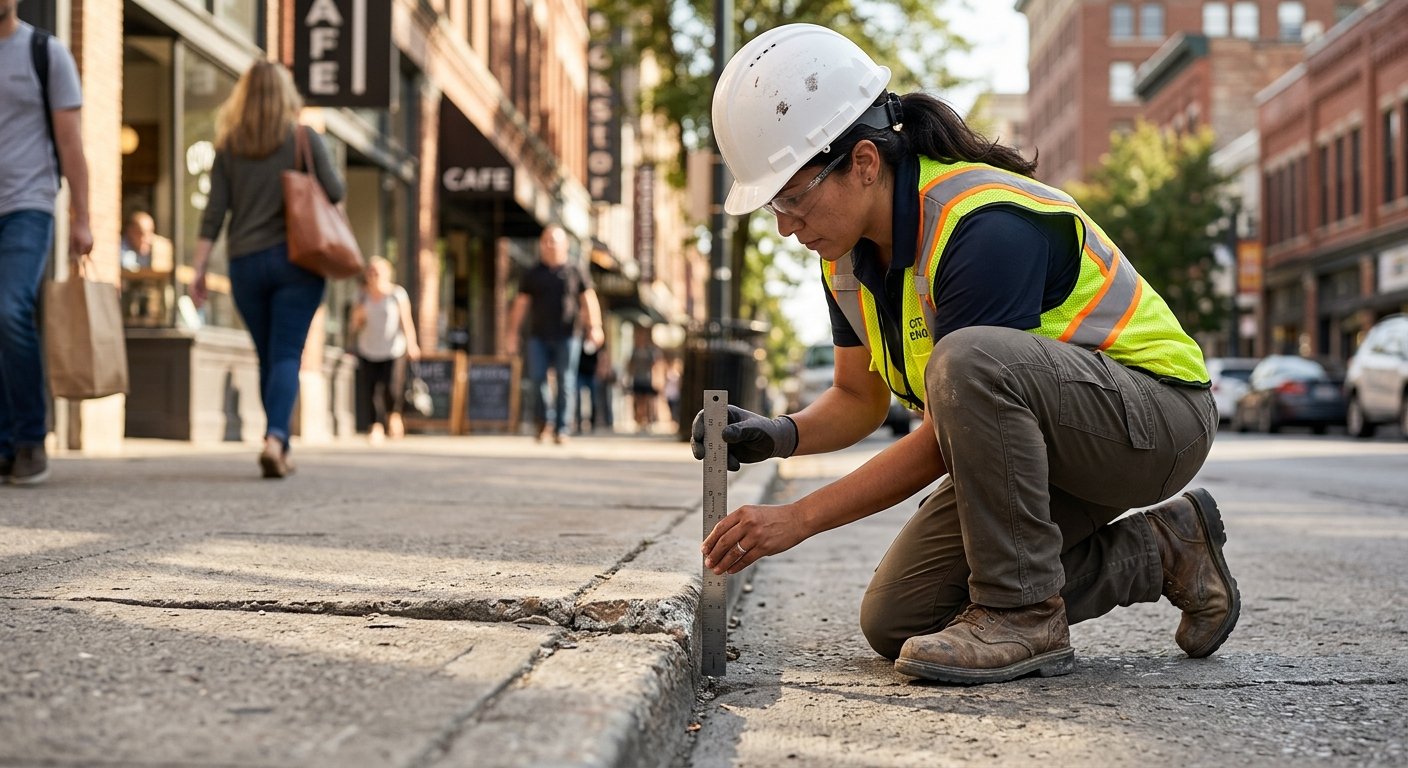
The single most important measurement in any sidewalk inspection report is the vertical differential at each joint or crack. According to the U.S. Access Board’s ADA Accessibility Guidelines, a vertical change of 1⁄4 inch or greater at a joint constitutes a trip hazard that must be corrected. Changes between 1⁄4 inch and 1⁄2 inch must be beveled at a slope no steeper than 1:2; changes exceeding 1⁄2 inch require full remediation.
When reviewing your report, look at every measurement listed under vertical displacement. Any figure at or above 1⁄4 inch is a confirmed ADA violation that requires a documented plan for correction. This is not a discretionary finding—it is a compliance threshold with regulatory authority behind it.
Any vertical change of ¼ inch or greater is not a gray area—it is a documented ADA violation that requires a remediation plan.
Evaluating the Recommended Remediation Method
A well-written inspection report does more than list problems—it recommends corrective methods. Understanding the difference between those methods helps you evaluate contractor proposals and ask the right questions.
| Criterion | Traditional Grinding | Precision Concrete Cutting |
|---|---|---|
| Vertical result | Tapered bevel, residual slope | Zero differential at joint |
| ADA slope compliance | Variable; depends on operator | ADA-compliant 1:12 slope achieved |
| Slip resistance | Can reduce surface texture | OSHA-compliant slip resistance maintained |
| Concrete removed | Surface layer only | Precise slab section, minimal waste |
| Debris handling | Dust and slurry | Solid debris available for recycling |
| Cost versus replacement | Moderate savings | 70–90% less than full replacement* |
*Cost comparison per client briefing; individual project costs vary by scope and site conditions.
When a report recommends “trip hazard removal” or “grinding,” it is worth confirming that the proposed method will achieve a true zero differential and an ADA-compliant slope—not simply reduce the height of the raised edge. A bevel that still leaves a detectable vertical step does not bring the location into full compliance and will reappear on the next inspection. For sidewalk trip hazard repair that achieves zero differential, the cutting method uses a patented process that removes a precise section of concrete, creating the 1:12 slope required for ADA compliance rather than simply shaving the raised edge.
Prioritizing Your Remediation Plan
After reviewing the severity ratings and defect types, your next step is building a remediation sequence. A practical prioritization framework looks like this:
Address all high-severity findings immediately
Documented high-severity trip hazards—particularly those at building entrances, parking lot transitions, and high-pedestrian-traffic areas—carry the greatest liability exposure and should be scheduled before anything else.
Cluster moderate-severity repairs geographically
Grouping nearby moderate-severity defects into a single mobilization reduces cost and minimizes disruption to tenants or the public. Share the site map with your contractor so they can price contiguous work efficiently.
Schedule low-severity monitoring and re-inspection
Low-severity findings should be re-measured at a defined interval—typically one year—so progression toward a hazardous threshold is caught early. Document the re-inspection date in your maintenance log.
Obtain compliance documentation after repair
Ask your repair contractor for a post-repair report or measurement record confirming that each corrected location now meets ADA slope and surface standards. This documentation is essential for demonstrating due diligence.
What “ADA Compliant” Actually Means in the Report
Inspection reports sometimes use the phrase “ADA compliant” loosely. For sidewalk surfaces, genuine ADA compliance means the running slope does not exceed 5% (1:20) along the direction of travel, the cross slope does not exceed 2% (1:50), and any change in level is within the thresholds described above. A location marked “repaired” on a prior report is not necessarily compliant if the repair method left a residual slope steeper than 1:12 at the transition point.
For ADA compliant sidewalk repair in Sacramento, Oakland, and Burlingame, confirming that the remediation method achieves the actual slope specification—not just a visual improvement—is the standard Precision Concrete Cutting, a licensed and insured contractor serving Northern California, applies on every project.
Slope compliance is measured with a digital level, not estimated visually. Request measurement documentation from any contractor claiming ADA compliance after repair. If they cannot provide it, the claim is unverified.
The Environmental and Operational Benefits of Cutting Over Replacement
When a report identifies extensive damage, property managers sometimes assume full slab replacement is the only path forward. In many cases, precision cutting addresses the root compliance problem—the vertical differential—without the cost, timeline, or waste of replacement. Concrete debris generated by the cutting process is solid and recyclable, reducing landfill impact compared to demolition waste from full replacement. Faster completion also means sidewalks reopen sooner, reducing the duration of any pedestrian detour required during work. For commercial sidewalk repair across Northern California, this operational efficiency matters as much as cost.
Frequently Asked Questions
What is the ADA-defined threshold that makes a sidewalk joint a trip hazard?
The U.S. Access Board specifies that any vertical change of ¼ inch or greater at a joint or crack must be corrected. Changes between ¼ and ½ inch must be beveled at no steeper than 1:2; anything over ½ inch requires full remediation to a compliant transition slope.
How long does a typical sidewalk cutting repair take compared to slab replacement?
Concrete cutting to eliminate a trip hazard is typically completed in a fraction of the time required for full slab removal and replacement. Because no curing period is needed, the area can often be reopened to pedestrian traffic the same day the work is finished, minimizing operational disruption.
Can a cutting repair bring a location into full ADA compliance?
Yes, when performed using a method calibrated to achieve a 1:12 slope and zero vertical differential. Precision Concrete Cutting’s patented process is designed specifically to meet ADA slope requirements and OSHA slip-resistance standards, not simply reduce the visual appearance of a raised edge.
What documentation should I request after repairs are completed?
Request a post-repair measurement record showing the corrected differential at each repaired location, confirmation of slope compliance, and any photographs taken after completion. This documentation supports your maintenance records and demonstrates due diligence if a compliance question arises later.
Are property managers in Northern California legally required to act on inspection findings?
Both ADA Title II and Title III impose maintenance obligations on public entities and commercial property owners respectively. California also has its own Unruh Civil Rights Act provisions. While specific timelines depend on the municipality and defect severity, documented hazards that go unaddressed after an inspection create significant legal exposure. Consulting legal counsel on your specific obligations is advisable.
Schedule a Sidewalk Assessment for Your Property
Precision Concrete Cutting provides licensed, insured sidewalk inspection follow-up and ADA-compliant trip hazard correction throughout Sacramento, Oakland, and Burlingame—contact us to discuss your inspection findings and get a remediation plan.

About Precision Concrete Cutting
Precision Concrete Cutting provides ADA-compliant sidewalk repair and trip hazard correction services for property managers, municipal facilities, and commercial property owners throughout Northern California. Using a patented concrete cutting method, the company delivers cost-effective solutions that are 70-90% less expensive than replacement while achieving zero differential and ADA-compliant slopes. The approach emphasizes safety, regulatory compliance, environmental responsibility through debris recycling, and rapid completion that minimizes disruption. Visit pccnorcal.com →