
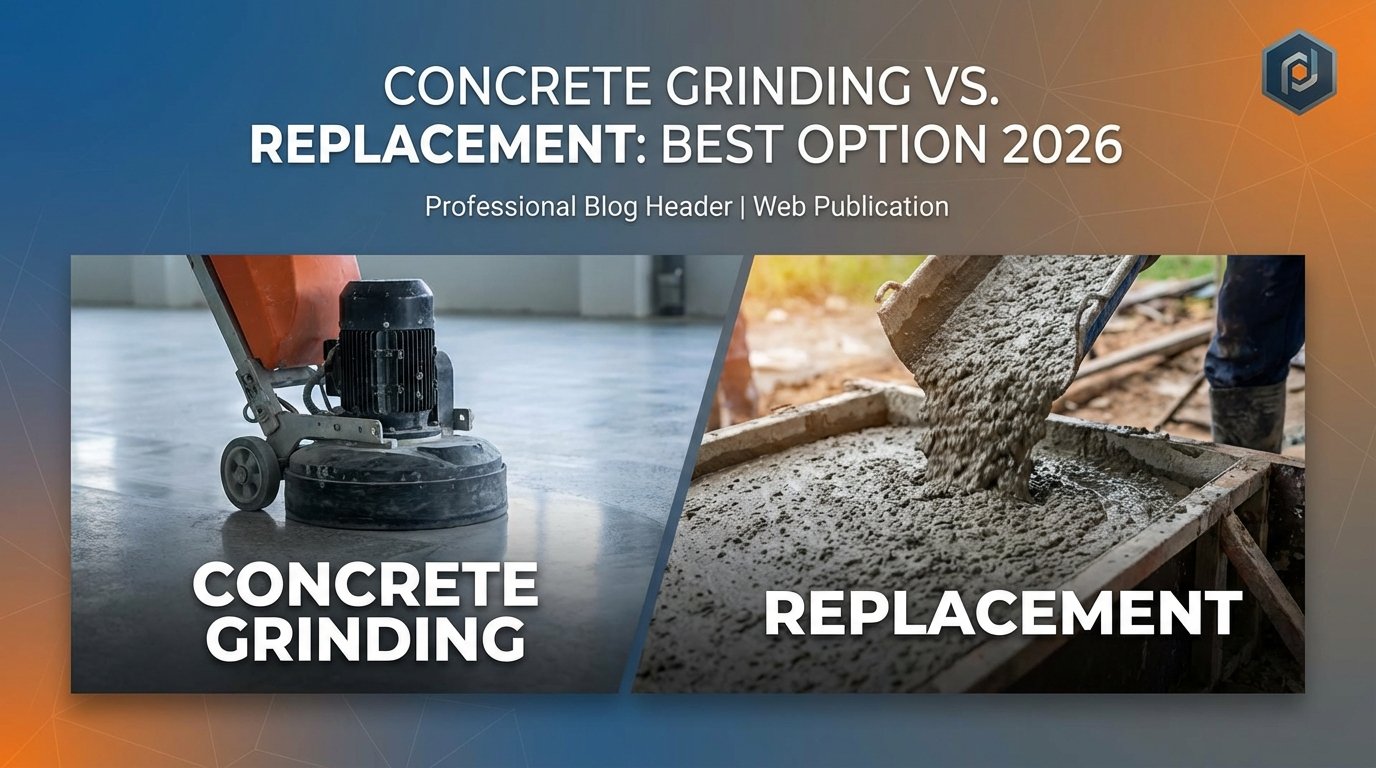
Property managers face a recurring dilemma when dealing with uneven concrete walkways: should they grind down problem areas, replace damaged sections entirely, or explore newer alternatives? With liability concerns mounting and budgets tightening across commercial properties in 2026, this decision carries significant financial and legal implications. The wrong choice can cost tens of thousands in unnecessary expenses or expose organizations to trip-and-fall lawsuits that average $50,000 to $100,000 in settlements.
Understanding the true costs, effectiveness, and limitations of each repair method has become essential for facilities directors and property managers tasked with maintaining safe, ADA-compliant walkways while protecting their organization’s bottom line.
The Trip Hazard Problem: Why Action Is Required
Under the Americans with Disabilities Act (ADA), any vertical displacement exceeding ¼ inch constitutes a trip hazard requiring remediation. This strict standard applies to commercial properties, municipal sidewalks, educational facilities, and any public accommodation. Beyond regulatory compliance, property owners face substantial liability exposure when visitors trip on uneven concrete.
Concrete settlement occurs naturally over time due to soil erosion, tree root growth, and ground shifting. While the problem is inevitable, the response strategy determines both immediate costs and long-term outcomes. Most property managers have traditionally chosen between two options: grinding or replacement. However, the landscape of sidewalk repair has evolved considerably, with newer alternatives offering superior results.
Traditional Concrete Grinding: The Common Approach
Concrete grinding uses industrial diamond-tipped equipment to smooth vertical edges and create gentler transitions between uneven slabs. This method appeals to budget-conscious property managers because it addresses visible trip hazards at a relatively low initial cost.
How Grinding Works
Grinding machines remove material from raised concrete edges, typically creating beveled transitions. The process is relatively quick, with crews handling multiple locations in a single day. Dust control systems capture most debris, though concrete particulate remains a consideration during operation.
Limitations of the Grinding Method
While grinding eliminates immediate trip hazards, it creates several significant problems that property managers discover only after the work is complete:
- Slopes often exceed ADA requirements: Standard grinding typically creates slopes steeper than the ADA-required 1:12 ratio, technically leaving properties out of compliance despite addressing the vertical displacement
- Surface texture issues: Ground areas develop a different appearance and texture than surrounding concrete, creating aesthetic inconsistencies and potential slip hazards
- Temporary solution: Grinding doesn’t address underlying settlement issues, meaning the problem continues worsening beneath the surface
- Material removal weakens concrete: Removing concrete thickness can compromise structural integrity, especially in high-traffic areas
- OSHA slip resistance concerns: Ground surfaces may not meet OSHA slip coefficient requirements, introducing new liability risks
For property managers seeking to eliminate trip hazards while maintaining full compliance, traditional grinding often proves inadequate despite its lower upfront cost. Many facilities end up addressing the same locations repeatedly as settlement continues.
Complete Concrete Replacement: The Expensive Standard
Full replacement involves removing damaged sections and pouring new concrete. This approach has long been considered the gold standard for uneven concrete sidewalk repair, offering a fresh start that addresses both surface symptoms and underlying problems.
The Replacement Process
Replacement requires saw-cutting around problem areas, breaking out existing concrete, addressing subbase issues, and pouring new sections. Proper replacement includes evaluating drainage, compacting soil, and ensuring adequate reinforcement. Curing time typically prevents use for 3-7 days depending on concrete specifications and weather conditions.
True Costs of Replacement
Sidewalk repair cost for replacement extends far beyond the concrete itself. Property managers must account for:
- Labor and materials: $8-$15 per square foot for standard sidewalk replacement in 2026, with costs higher in urban Northern California markets
- Downtime and access disruption: Multi-day closures affect tenant access, customer traffic, and daily operations
- Disposal fees: Hauling broken concrete to landfills adds $75-$150 per ton in many jurisdictions
- Matching concerns: New concrete rarely matches existing surfaces in color or texture, creating patchwork appearances
- Hidden damage expansion: Removal often reveals additional problems, escalating project scope and costs
While replacement delivers a complete solution, the expense makes it prohibitive for addressing multiple locations across large commercial properties or municipal sidewalk systems. Many property managers delay needed repairs due to budget constraints, inadvertently increasing liability exposure.
The Precision Cutting Alternative: Superior Results at Fraction of Replacement Cost
Advanced cutting technology has emerged as a concrete grinding alternative that addresses the limitations of both traditional methods. This patented approach removes material with surgical precision, creating ADA-compliant slopes while maintaining structural integrity and surface characteristics.
How Precision Cutting Differs
Unlike grinding’s aggressive material removal or replacement’s complete demolition, precision cutting uses specialized equipment to remove concrete with exact specifications. The process creates slopes that consistently meet the 1:12 ADA requirement while preserving the original surface texture and slip resistance properties.
This method represents genuine innovation in commercial sidewalk repair, combining the speed of grinding with results that rival or exceed replacement quality. The precision-engineered approach delivers zero differential between adjacent slabs, eliminating trip hazards completely rather than simply reducing them.
Measurable Advantages for Property Managers
Property managers evaluating options to fix uneven sidewalk issues find compelling benefits in the cutting approach:
- 70-90% cost savings versus replacement: Typical projects cost $2-$4 per square foot, delivering replacement-quality results at grinding-level pricing
- Same-day completion and use: No curing time means walkways reopen immediately, eliminating revenue loss and access disruption
- Guaranteed ADA compliance: Precisely engineered 1:12 slopes meet accessibility standards without compromise
- OSHA-compliant slip resistance: Original surface texture remains intact, maintaining proper coefficient of friction
- Environmental responsibility: All debris is recycled rather than landfilled, supporting sustainability initiatives
- Preserves concrete integrity: Minimal material removal maintains structural strength in high-traffic applications
- Aesthetic consistency: No color or texture mismatches, maintaining property appearance
Long-Term Value Proposition
The precision cutting method doesn’t just address surface symptoms—it provides a permanent solution to trip hazard removal. By creating proper transitions and addressing the mechanical relationship between settled and stable slabs, this approach eliminates the recurring maintenance cycle that plagues ground locations.
For facility managers overseeing multiple properties or extensive sidewalk systems, this translates to predictable budgeting and reduced liability exposure. The method’s speed allows addressing numerous locations within tight maintenance windows, minimizing operational disruption.
Cost Comparison: Real Numbers for 2026 Budgets
Consider a typical commercial property with 500 square feet of uneven concrete sidewalk requiring remediation:
Traditional Grinding: $750-$1,500 total cost, but with compliance concerns and probable re-work within 2-3 years as settlement continues
Complete Replacement: $4,000-$7,500 total cost, plus downtime expenses, disposal fees, and 5-7 day closure
Precision Cutting Alternative: $1,000-$2,000 total cost with guaranteed ADA compliance, immediate use, and permanent results
The concrete leveling Northern California property managers need becomes affordable at scale with cutting technology. A municipal sidewalk system addressing 20 locations annually saves $60,000-$100,000 compared to replacement, while achieving superior compliance outcomes compared to grinding.
Making the Right Choice for Your Property
Property managers should evaluate sidewalk repair options based on several critical factors:
Compliance Requirements
ADA compliance isn’t optional for commercial properties. Methods that create slopes steeper than 1:12 or compromise slip resistance introduce liability regardless of cost savings. Solutions must meet both accessibility standards and OSHA safety requirements.
Total Cost of Ownership
Initial price represents only part of the equation. Factor in downtime costs, recurring maintenance needs, disposal fees, and the probability of addressing the same location multiple times. The cheapest immediate option often proves most expensive over a 5-10 year planning horizon.
Operational Impact
Multi-day closures affect different properties in varying ways. Retail locations lose customer access, office buildings inconvenience tenants, and schools must route students around construction zones. Solutions that eliminate downtime provide value beyond direct cost savings.
Liability Exposure
Inadequate repairs create false security while leaving properties vulnerable to trip-and-fall claims. Solutions must completely eliminate hazards rather than simply reducing them. Half-measures that save money initially can cost exponentially more in legal settlements and increased insurance premiums.
Regional Considerations for Northern California Properties
Properties throughout Northern California face specific challenges that influence repair method selection. Clay soils common in many areas cause ongoing settlement, making permanent solutions especially valuable. Higher labor costs in urban markets increase the relative value of faster repair methods.
Environmental regulations in California municipalities increasingly scrutinize concrete disposal and construction waste. Methods that recycle debris align with state and local sustainability mandates while avoiding disposal fees that range significantly across jurisdictions.
Take Action on Uneven Concrete Before Liability Finds You
Every day that trip hazards remain unaddressed represents growing liability exposure for property managers. The evolution of repair technology means decision-makers no longer face the traditional trade-off between cost and quality. Precision cutting alternatives deliver superior results at fractions of replacement cost while maintaining full ADA and OSHA compliance.
Property managers, facility directors, and municipal administrators responsible for sidewalk safety should evaluate their current walkways against ADA standards and assess repair needs before incidents occur. Proactive maintenance using advanced methods protects visitors, preserves budgets, and eliminates the recurring costs associated with outdated approaches.
Contact specialized concrete repair professionals to assess your property’s specific needs and receive detailed cost comparisons between grinding, replacement, and advanced cutting alternatives. The right solution protects people, budgets, and your organization’s liability exposure for years to come.